Introduction
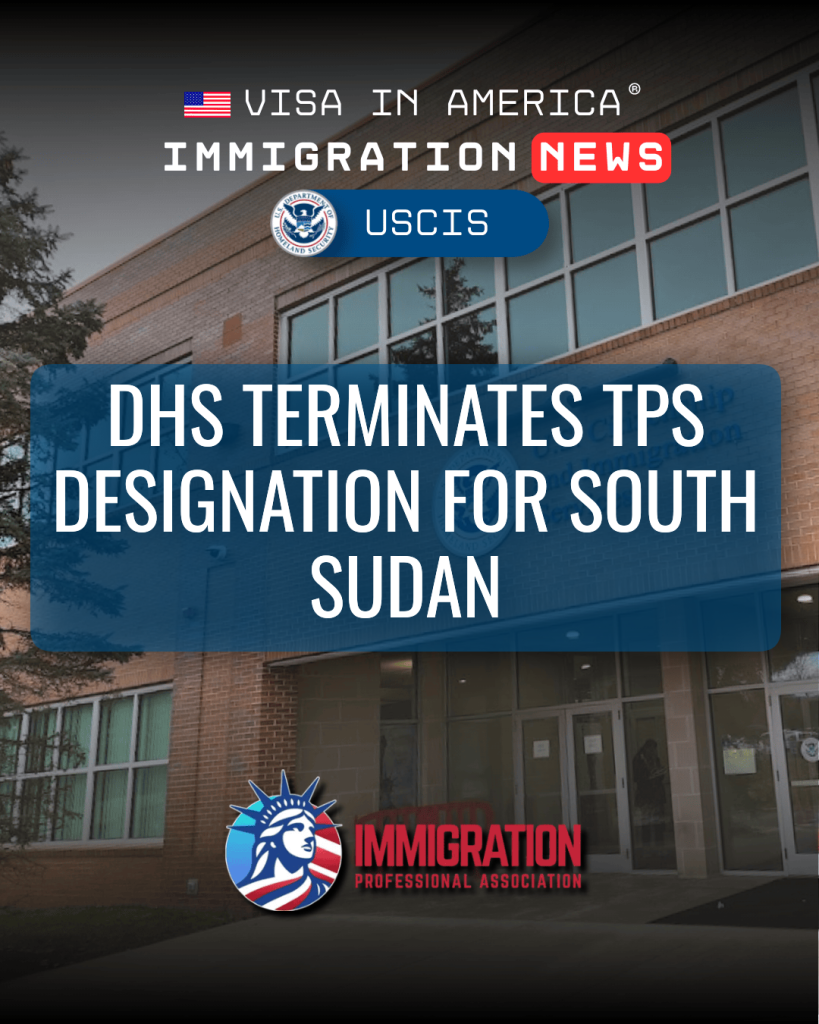
The Department of Homeland Security has terminated Temporary Protected Status for South Sudan, with the termination taking effect on August 7, 2026. USCIS confirmed the action in a notice issued the same day, superseding an earlier agency alert from August 6, 2026. The South Sudan TPS termination carries immediate, concrete consequences: employment authorization documents previously issued to South Sudanese TPS beneficiaries are no longer valid as of the termination date, leaving affected individuals without the legal work authorization and deportation protection that TPS previously provided.
Background
Temporary Protected Status is a humanitarian designation that allows nationals of certain countries experiencing ongoing armed conflict, environmental disaster, or other extraordinary conditions to live and work lawfully in the United States on a temporary basis. TPS does not lead to a permanent immigration benefit on its own, but it does provide critical protections — including protection from removal and eligibility for employment authorization — for as long as a country’s designation remains active.
South Sudan had held a TPS designation reflecting the country’s prolonged instability and humanitarian crisis. The formal process to end that designation began when former Secretary of Homeland Security Kristi Noem determined, following a review of current country conditions and interagency consultation, that South Sudan no longer met the statutory criteria for TPS. That determination was published in the Federal Register on November 6, 2025, at 90 Fed. Reg. 50484. The August 7, 2026 termination date represents the point at which that earlier determination became fully effective.
What Is Changing
The South Sudan TPS designation is now terminated. USCIS confirmed the effective date as August 7, 2026, and the agency’s TPS South Sudan webpage has been archived, signaling that no further registration or re-registration periods will be opened under this designation.
Most significantly for day-to-day practical purposes, all Forms I-766 (Employment Authorization Documents) bearing category codes A12 or C19 that were issued to South Sudanese TPS beneficiaries are no longer valid. These were the two EAD category codes used to document TPS-based work authorization, and their invalidation means employers can no longer accept them as proof of employment eligibility under Form I-9 requirements.
The USCIS notice also references the Supreme Court’s June 25, 2026 decision in Mullin v. Doe, 609 U.S. ____ (2026), which the agency describes as a favorable ruling in a similar case involving TPS terminations. The Court’s decision appears to have cleared a significant legal obstacle that had previously kept certain TPS terminations from taking effect, though the specific holdings and reasoning of Mullin v. Doe beyond what is stated in the USCIS notice are not detailed in the source material.
Who Is Affected
South Sudanese nationals currently in the United States under TPS protection are directly and immediately affected. As of August 7, 2026, they no longer hold TPS status, and the employment authorization that accompanied it is no longer valid. Individuals in this category should understand that they are no longer protected from removal solely on the basis of TPS, and their right to work lawfully in the United States under that basis has ended.
Employers who have South Sudanese TPS beneficiaries on their workforce are also directly affected. Federal law requires employers to maintain accurate and current I-9 records. An EAD with category A12 or C19 that was previously accepted as a List A document for South Sudan TPS is no longer acceptable proof of work authorization. Employers who continue to employ workers based solely on invalidated TPS documents risk I-9 compliance violations.
Immigration attorneys and accredited representatives working with South Sudanese nationals will need to evaluate whether any alternative immigration pathways — such as pending asylum applications, other pending petitions, or different humanitarian protections — remain available to their clients. Individuals who had layered TPS with other pending immigration benefits may have a different situation than those whose only legal status rested on TPS alone.
Practical Implications
For South Sudanese nationals who held TPS, the termination does not automatically resolve their underlying immigration situation — it removes a protective layer that may have been the primary basis for their lawful presence. Anyone in this category should treat the situation as time-sensitive and consult qualified immigration counsel promptly to assess what options, if any, remain open. Depending on individual circumstances, those options could include pending or new asylum applications, family-based petitions, or other deferred action requests, but each of those pathways has its own eligibility criteria, timelines, and procedural requirements that cannot be addressed generically.
For employers, the immediate I-9 compliance obligation is clear: EADs coded A12 or C19 for South Sudan TPS are no longer List A documents. Employers should conduct an internal audit of their I-9 records to identify any affected employees and follow proper reverification procedures. Accepting a document that an employer knows or should know is no longer valid creates meaningful legal exposure, and that risk is now present as of the termination date.
The reference to Mullin v. Doe in the USCIS notice also signals a broader landscape shift. If the Supreme Court’s decision has fortified the legal basis for TPS terminations, other pending or anticipated terminations may face fewer legal obstacles than similar actions encountered in prior years. Individuals holding TPS from other designated countries should monitor developments closely, as the litigation environment that previously slowed some terminations has changed materially.
What to Watch For Next
Individuals affected by the South Sudan TPS termination should monitor whether any transitional relief, deferred action, or extended voluntary departure options are announced separately by DHS or USCIS, though no such relief has been indicated in the current notice. Employers should watch for any I-9 guidance from USCIS or the Department of Justice’s Immigrant and Employee Rights Section clarifying reverification timelines or procedures specifically tied to the South Sudan termination. Given the Mullin v. Doe ruling, stakeholders should also monitor whether the decision affects pending litigation over TPS terminations for other nationalities.
How Immigration Professional Association Can Help
At Immigration Professional Association, we work directly with individuals navigating TPS terminations, including those who are evaluating next steps after losing a protected status that served as their primary basis for remaining in the United States. The termination of South Sudan TPS is exactly the kind of development that requires immediate, individualized attention — not because every situation is the same, but because each person’s available options depend on their specific history, family connections, pending applications, and immigration record.
For employers, our team regularly assists HR departments and compliance teams with I-9 audits, reverification procedures, and the practical steps required when a previously valid work authorization document loses its legal effect. Getting this right matters: I-9 compliance is an area where mistakes carry real penalties, and the South Sudan TPS termination creates a concrete and immediate obligation to act.
If you or someone you know held South Sudan TPS — or if your organization employs individuals whose work authorization was tied to that status — Immigration Professional Association is ready to help you understand what changed, what your options are, and how to move forward with a clear picture of where things stand. Reach out to our team to discuss your specific situation.