Background
Reports of Homeland Security Investigations (HSI) agents delivering “Warning Notice” forms to Americans who criticized U.S. Immigration and Customs Enforcement (ICE) first drew widespread attention in late June 2026. Two cases surfaced within days of each other, both involving agents from the same New York field office.
Case of Paigelynne Gonyea
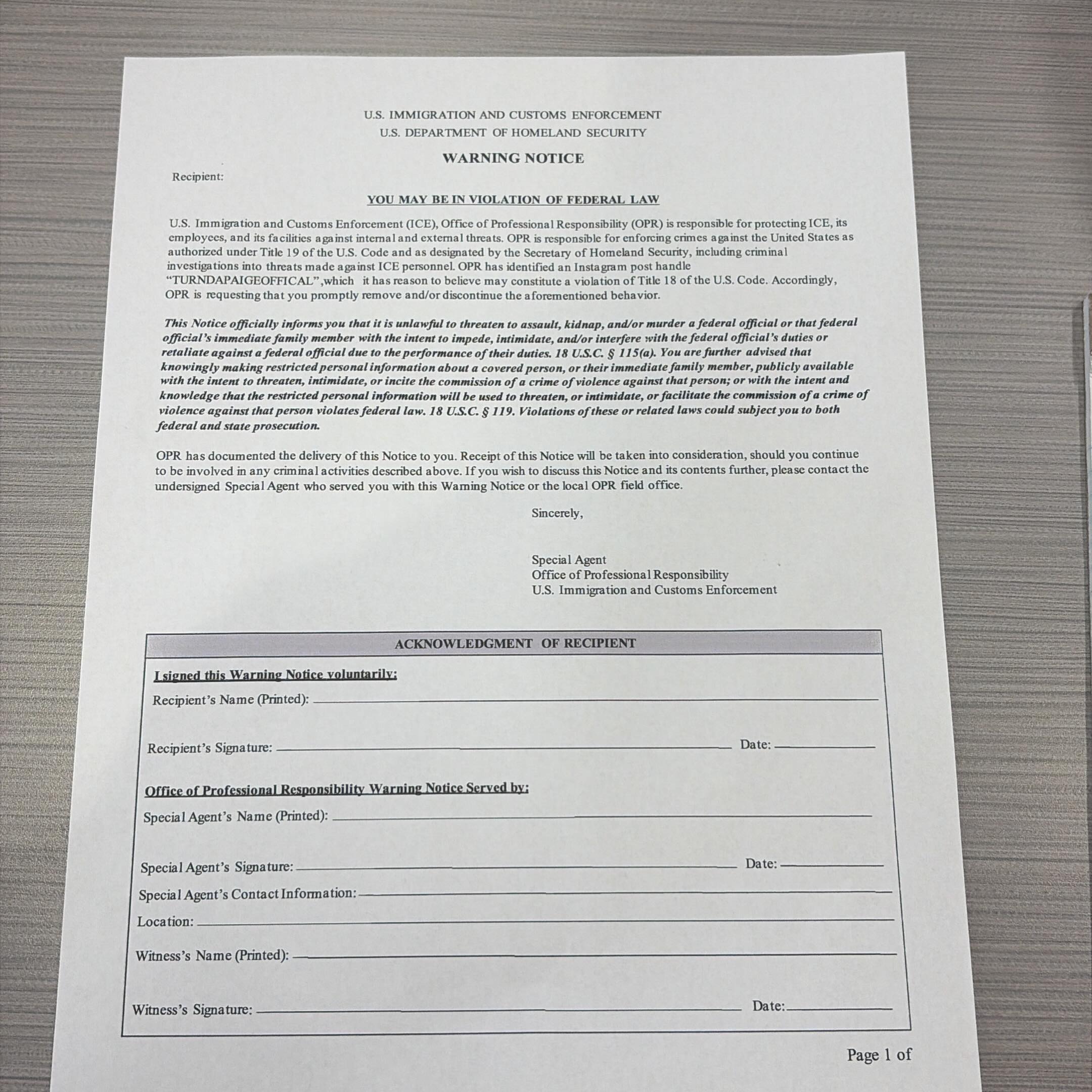
The first involved Paigelynne Gonyea, a poll worker in Syracuse, New York. On June 23, 2026, two HSI agents approached her at a polling place during the state’s primary election. They presented her with a form alleging that a post on her Instagram account, under the handle “@turndapaigeofficial,” may have violated federal law by threatening an ICE officer. Gonyea later posted the notice publicly, along with a caption noting that “ICE wanted my autograph. I declined.”
Case of David Streever
Later that afternoon, the two agents went to David Streever’s home in Rochester. Streever is a 45-year-old tech worker and former journalist. His wife is an Episcopal priest. She was informed that the visit was about “an email he may or may not have sent threatening” then-Acting ICE Director Todd Lyons. David Streever sent an email to Lyons’ government address on January 26, 2026, after the fatal shootings in Minneapolis. The message was harshly worded and compared Lyons to a Nazi official, but it did not threaten violence.
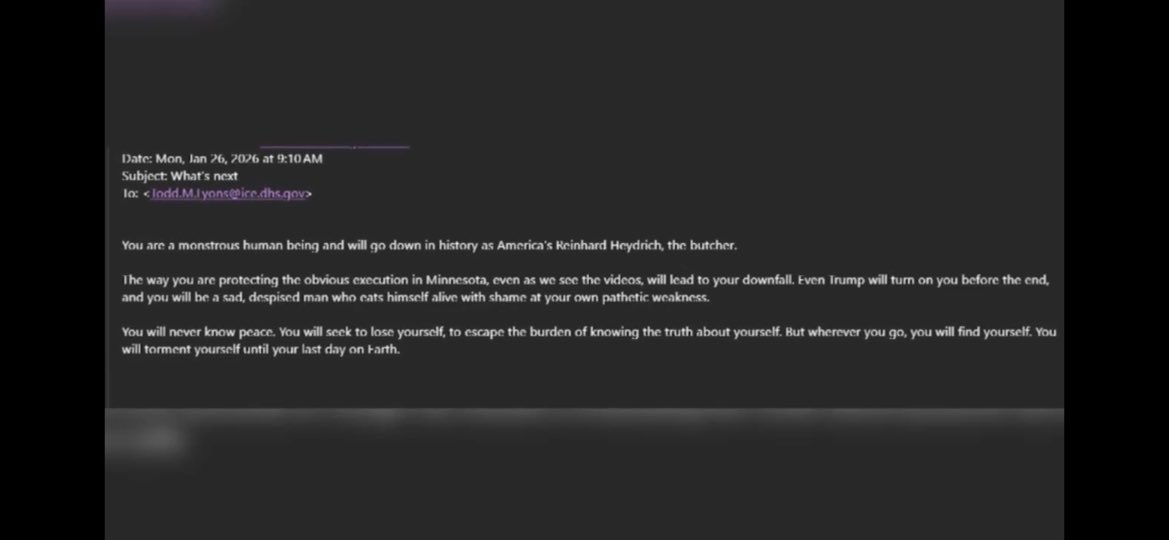
Date: Mon, Jan 26, 7026 at 9:10 AM
Subject: What’s next
to: lodd.M.Iyons@ice.dhs.govYou are a monstrous human being and will go down in history as America’s Reinhard Heydrich, the butcher.
The way you are protecting the obvious execution in Minnesota, even as we see the videos, will lead to your downfall. Even Trump will turn on you before the end, and you will be a sad, despised man who eats himself alive with shame at your own pathetic weakness. You will never know peace. You will seek to lose yourself, to escape the burden of knowing the truth about yourself. But wherever you go, you will find yourself. You will torment yourself until your last day on Farth.
What escalated the story beyond a single incident was what happened five days later. Streever was traveling internationally with his young daughter. A third HSI agent tracked him to an airport hotel near JFK International Airport hours after he landed back in the United States, despite not having disclosed his hotel choice to anyone, including his wife.
Civil liberties attorneys, including Adam Steinbaugh of the Foundation for Individual Rights and Expression (FIRE) and Nathan Freed Wessler of the ACLU, argued that neither the Gonyea post nor the Streever email met the legal definition of a threat and raised First Amendment concerns about the notices. DHS has stated that ICE “investigates all credible threats towards its employees and officers, including threats to the ICE Director” and does not comment on ongoing investigations. Advocates also pointed to a similar 2025 visit to a Philadelphia man who had emailed a DHS attorney criticizing a deportation decision, suggesting the practice may not be limited to these two cases.
What is a “Warning Notice”?
What is ICE OPR
U.S. Immigration and Customs Enforcement’s Office of Professional Responsibility (OPR) is one of the agency’s four supporting directorates, alongside the operational components Enforcement and Removal Operations (ERO) and Homeland Security Investigations (HSI), and the Office of the Principal Legal Advisor (OPLA). By ICE’s own description, OPR “upholds the agency’s professional standards through a multi-disciplinary approach of security, inspections and investigations,” organized into three program offices: Security, Inspections, and Investigations.
OPR’s stated core functions include assessing pre-employment suitability and background investigations for the ICE workforce, managing physical security and access to classified national security information, and investigating allegations of misconduct by ICE employees and contractors. Its Inspections program reviews ICE detention facilities and directorates for compliance with agency detention standards and federal law. ICE’s own materials describe OPR’s Investigations program as also covering “internal and external threats against ICE personnel and facilities” — a phrase that gives OPR some claimed basis for involvement in cases touching members of the public. Even so, the office’s structure, budget, and described day-to-day casework center on internal integrity and employee misconduct rather than the investigation of civilians.
The agency’s primary investigative arm for matters involving the public — transnational crime, financial fraud, smuggling, and related offenses — is HSI, not OPR. Notably, after the Warning Notice in the Streever case was delivered, the follow-up contact came from HSI special agents rather than OPR personnel, based on the voicemails and business card Streever received.
Is a “Warning Notice” Legal?
No published federal statute, regulation, or ICE directive establishing a “Warning Notice” procedure for members of the public has been identified. The form is not a standardized document listed in the Code of Federal Regulations or the Federal Register, and neither DHS nor ICE has cited codified authority for the practice in public statements.
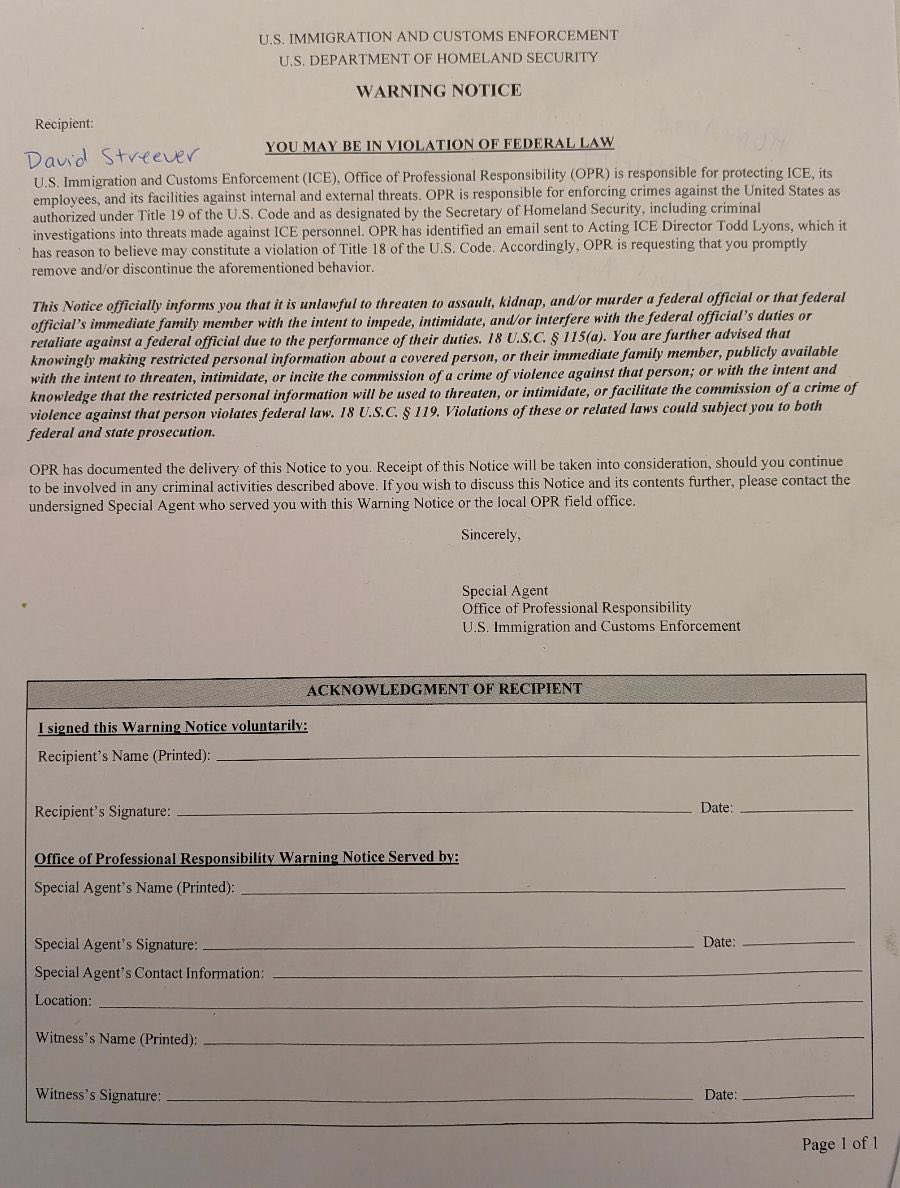
The notices themselves reference two real federal statutes as the underlying offenses: 18 U.S.C. § 115(a), which criminalizes threatening to assault, kidnap, or murder a federal official with intent to impede or retaliate against that official’s duties, and 18 U.S.C. § 119, which criminalizes publishing a covered person’s restricted personal information with intent to threaten or facilitate violence against them. Both statutes are legitimate and enforceable.
The notices are less clear, however, on OPR’s own authority to act. The forms state that OPR’s enforcement role is “authorized under Title 19 of the U.S. Code” — a title of federal law governing customs duties and trade, not criminal threats or harassment. The same document goes on to say that OPR “has reason to believe” the conduct at issue “may constitute a violation of Title 18 of the U.S. Code,” which is the correct title covering federal crimes generally. The mismatch between the title cited as the source of OPR’s authority (19) and the title cited for the alleged violation (18) appears on the face of the notices reviewed for this article.
Opinion of other lawyers
That mismatch is consistent with ICE’s own public description of OPR’s mission, which centers on internal misconduct and integrity oversight rather than the investigation of criminal threats made by the public — a function more commonly associated with HSI or the FBI. Civil liberties attorneys who reviewed the notices, including Adam Steinbaugh of the Foundation for Individual Rights and Expression (FIRE) and Nathan Freed Wessler of the American Civil Liberties Union (ACLU), have stated they are not aware of any codified rule authorizing OPR to issue this type of notice to a private citizen. DHS’s public response has addressed only the substance of the underlying allegations, saying that “ICE investigates all credible threats towards its employees and officers,” without identifying the specific authority behind the notice-and-signature process itself.
Current Litigations
The question is now before a federal court. On July 6, 2026, Streever filed suit against Homeland Security Secretary Markwayne Mullin and ICE officials in the U.S. District Court for the District of Columbia, captioned Streever v. Mullin, arguing that his email was protected political speech under the First Amendment and asking the court to bar further formal or informal action against him over it. His attorneys, from FIRE, filed a motion for a preliminary injunction on July 7, 2026, seeking to halt further government action while the case proceeds. As of this writing, the government has not filed a response, and the court has not ruled on the motion.
Because no public statute, regulation, or agency directive identifying OPR’s authority to issue Warning Notices to civilians has surfaced, and because the practice is now the subject of active litigation, the legal basis for these notices remains an open and disputed question rather than a settled one.
How Immigration Professional Association Can Help
What to Do If You Receive a Warning Notice
Anyone who receives an OPR “Warning Notice” — whether delivered in person, left with a family member, or mailed — should treat it as a serious legal matter and take the following steps.
Do not sign the notice.
The form itself frames signature as optional: its “Acknowledgment of Recipient” section requires the signer to attest that “I signed this Warning Notice voluntarily.” A signature is not legally required to receive the document, and signing — or adding any handwritten statement — can be treated as a statement attributable to the recipient in a later proceeding. Recipients should decline to sign anything presented by agents without first speaking with an attorney.
Do not answer questions about the underlying conduct.
The Fifth Amendment protects every person from being compelled to give testimony that could incriminate them, and that protection applies whether or not the person has been arrested. In non-custodial encounters — an agent at the front door, a phone call, a hotel front desk — Miranda v. Arizona, 384 U.S. 436 (1966) does not require agents to advise a person of these rights, but the underlying privilege still exists and can be exercised at will. Courts have also held that in a non-custodial setting, the privilege generally must be invoked clearly and affirmatively — silence alone may not preserve it. Salinas v. Texas, 570 U.S. 178 (2013). A simple, direct statement is sufficient: “I am not going to answer questions or sign anything without my attorney present.”
Do not guess, minimize, or offer an alternate explanation.
Making an inaccurate or incomplete statement to a federal agent, even one intended to be helpful, can itself be a separate federal crime under 18 U.S.C. § 1001, regardless of the outcome of the underlying inquiry the agents are pursuing. Declining to answer avoids this exposure entirely.
Document the encounter.
Note the date, time, and location; ask for the agents’ names, badge numbers, and business cards; and photograph any documents left behind, including both sides of any form. This record is often critical if the matter is later challenged or referred to counsel.
Contact an attorney immediately.
Federal agents are not required to wait for counsel to arrive before leaving the property, but nothing requires the recipient to engage further with the investigation — by phone, email, or in person — before speaking with a lawyer. Given that no public regulation currently defines the OPR Warning Notice process, and that the practice is presently being litigated in Streever v. Mullin in the U.S. District Court for the District of Columbia, recipients are in a fluid legal landscape where individualized legal advice matters more than generalized guidance.
Immigration Professional Association assists individuals who have received a Warning Notice or been contacted by HSI or OPR regarding protected speech, online posts, or communications with government officials. This includes reviewing the notice and any related correspondence, advising clients on their rights before further contact with agents, communicating with the issuing office on a client’s behalf, and, where appropriate, pursuing legal remedies — including First Amendment claims — in coordination with litigation counsel.
If you have received a Warning Notice or believe you may be the subject of a similar inquiry, do not sign anything or respond to agents before speaking with counsel. Contact Immigration Professional Association promptly so we can review your situation and advise you on the appropriate next steps.