Introduction
The U.S. Citizenship and Immigration Services (USCIS) has released its Fiscal Year 2026 Second Quarter performance data for the Deferred Action for Childhood Arrivals program, covering all DACA approvals from the program’s launch on August 15, 2012, through March 31, 2026. The cumulative DACA approvals data confirms that the program has generated more than 4.39 million approved requests across both initial and renewal filings — a figure that reflects nearly 14 years of continuous operation and underscores just how large and consequential the DACA population remains in the United States today. Mexico accounts for the overwhelming share of that total, but the data also reveals a genuinely diverse beneficiary population spanning more than two dozen countries across Latin America, Asia, Europe, the Caribbean, and Africa.
Background
DACA was established by executive action in August 2012 to provide temporary protection from removal and work authorization to individuals who arrived in the United States as children without lawful status, commonly referred to as Dreamers. Participants apply using Form I-821D and, if approved, receive renewable two-year grants of deferred action — not a visa, not a path to lawful permanent residence, but a formal exercise of prosecutorial discretion that shields recipients from deportation and allows them to obtain employment authorization.
The program has operated under sustained legal uncertainty since 2017, with multiple federal court decisions alternately restricting and partially reinstating it. As of the current reporting period, USCIS continues to accept and adjudicate renewal requests for current recipients, while the status of new initial applications remains subject to ongoing litigation. The quarterly performance data released by USCIS reflects cumulative accepted and approved request counts broken down by country of birth — a dataset that helps policymakers, advocates, and practitioners understand the scale and composition of the DACA-eligible population.
What Is Changing
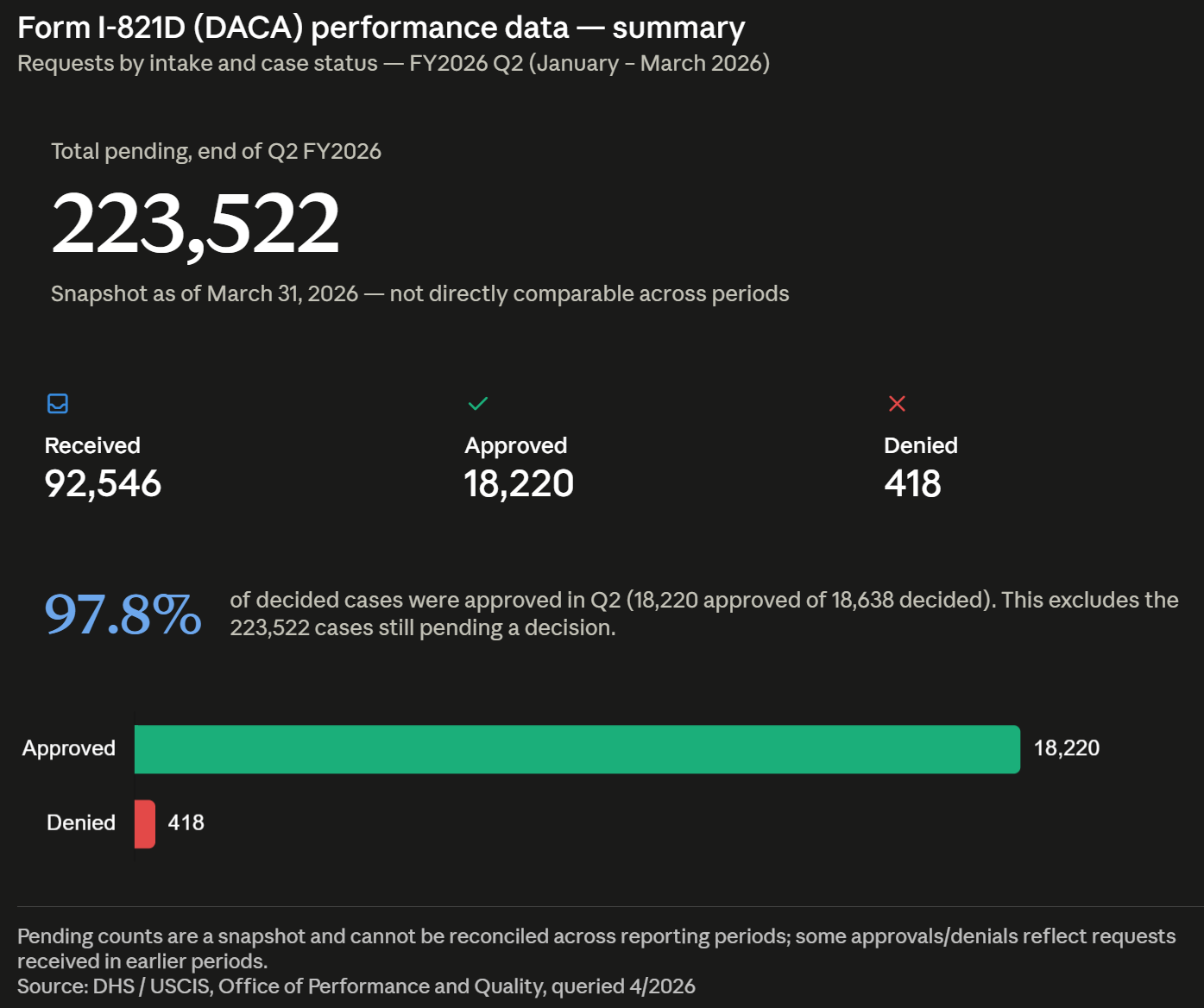
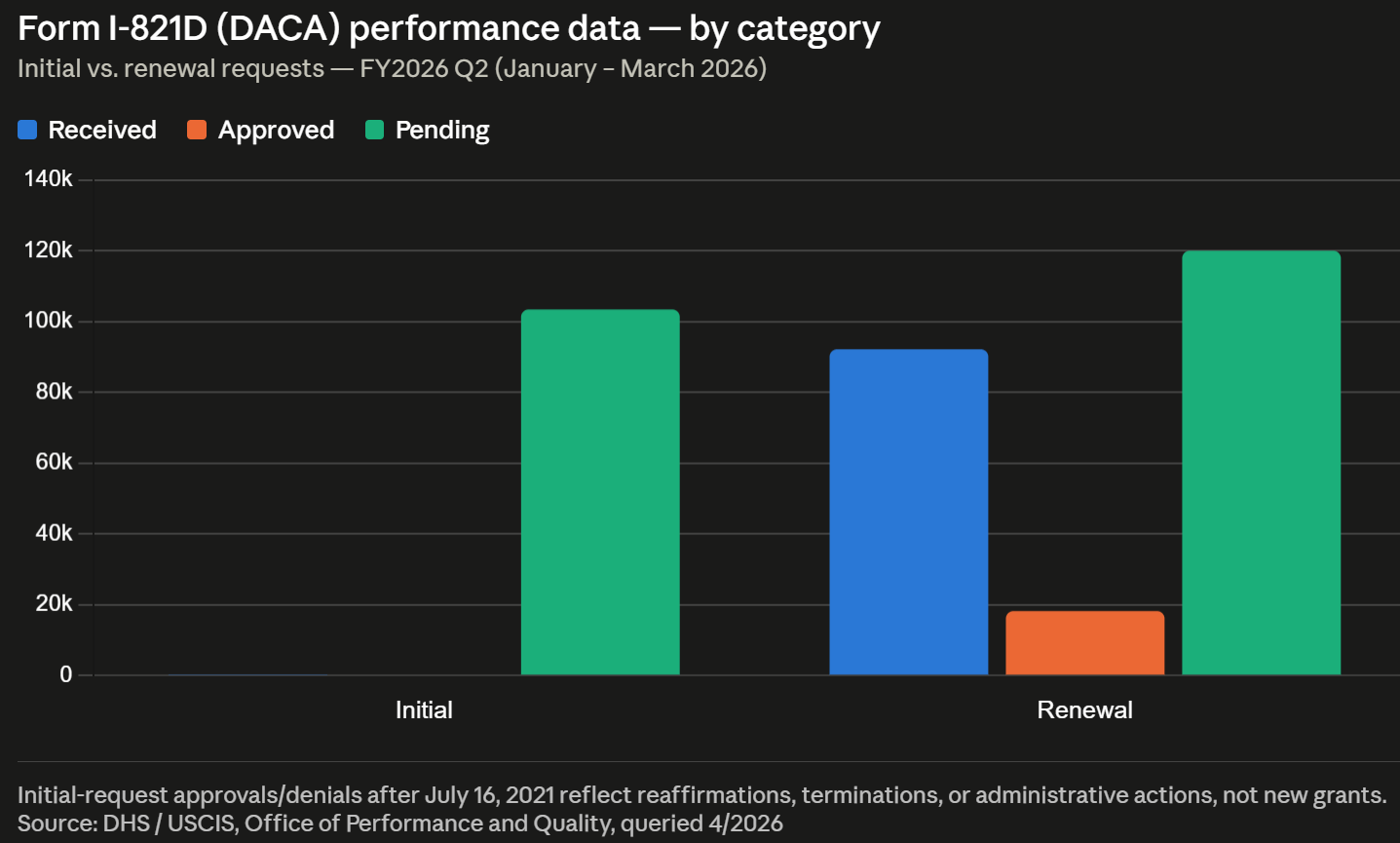
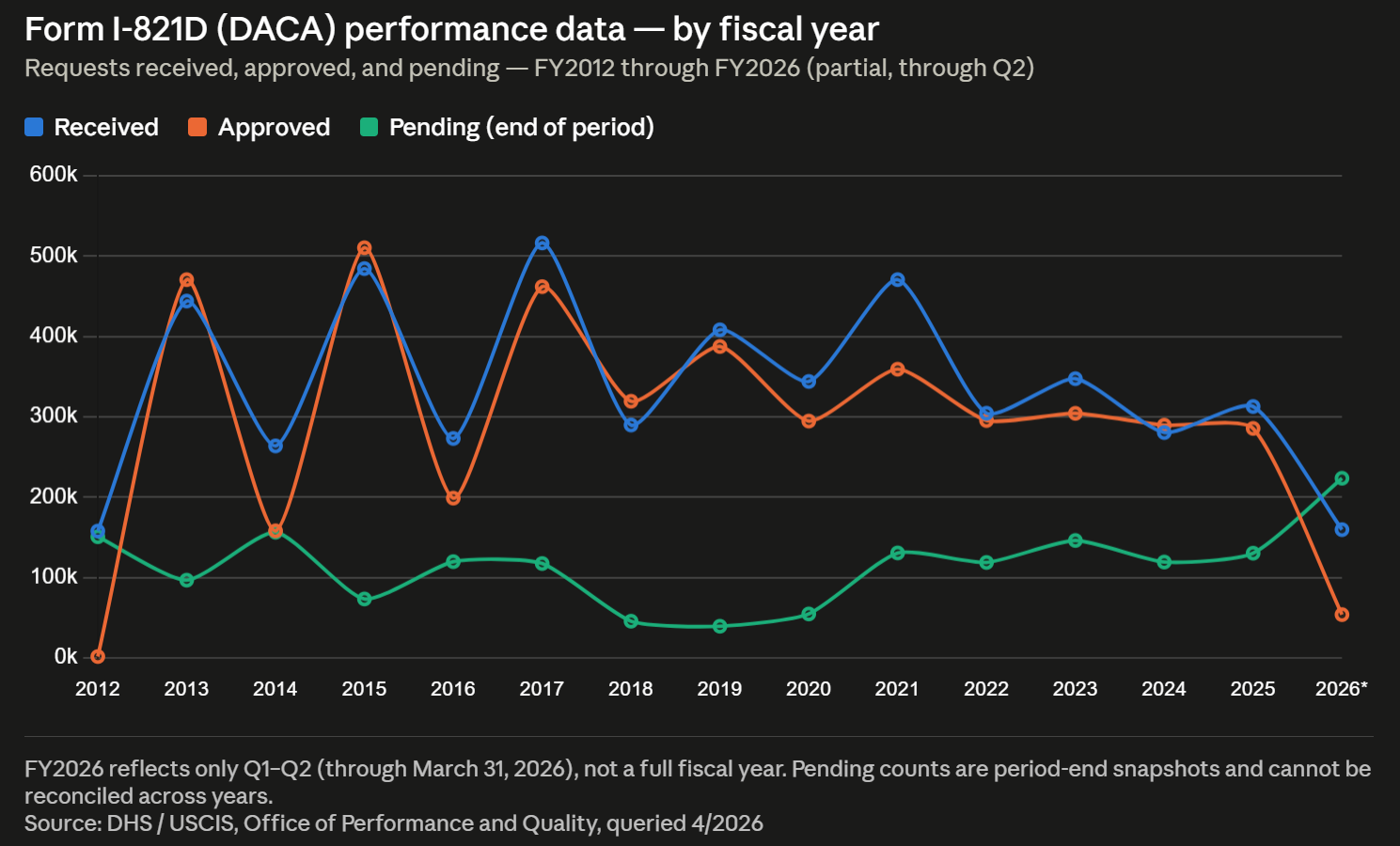
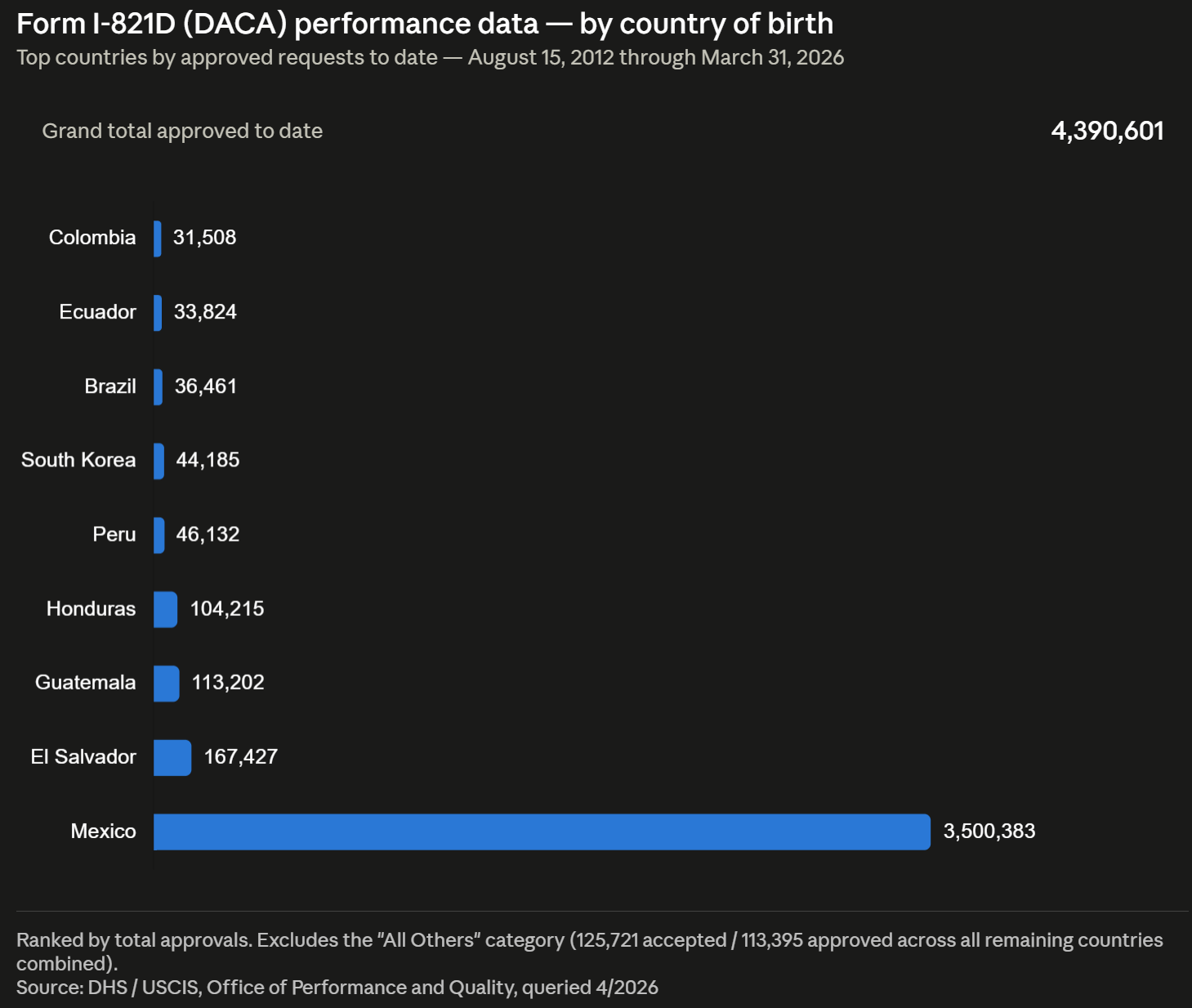
This report is a data release rather than a policy change, but its numbers are substantively significant. From program inception through March 31, 2026, USCIS accepted a total of 4,731,316 DACA requests — covering both initial filings and renewals — and approved 4,390,601 of those requests. Of the approved total, 835,093 were initial approvals and 3,555,508 were renewal approvals, reflecting the reality that most program activity in recent years has consisted of existing recipients renewing their status rather than new individuals entering the program.
Mexico is far and away the largest country of birth among approved applicants, accounting for approximately 3.5 million of the 4.39 million total approvals. El Salvador ranks second with roughly 167,000 approvals, followed by Guatemala at approximately 113,000 and Honduras at just over 104,000. Beyond Central America, the data shows meaningful DACA populations born in Peru, South Korea, Brazil, Ecuador, Colombia, and the Philippines — countries that frequently surprise those who associate DACA exclusively with Latin American immigration. India, Nigeria, Poland, and Pakistan also appear in the top 25 countries, illustrating that undocumented childhood arrivals have historically come from virtually every region of the world.
Who Is Affected
The most directly affected individuals are current DACA recipients — more than four million people who have at some point held an approved grant of deferred action and who depend on the program’s continuity for their ability to work and remain in the United States without fear of removal. Because the data is cumulative rather than a point-in-time active enrollment count, the 4.39 million approved figure includes individuals whose DACA has since lapsed, individuals who have left the country, and individuals who may have obtained other immigration status. The active recipient population is smaller, though precise current enrollment figures are not included in this specific dataset.
Employers are also directly affected by DACA’s status. Recipients authorized to work under DACA hold Employment Authorization Documents tied to their two-year grant periods, meaning employers who have hired DACA recipients must monitor renewal timelines to maintain I-9 compliance. Human resources and payroll teams at companies with DACA-holding employees have a genuine operational stake in the program’s stability and in the renewal process running smoothly.
Legal practitioners handling DACA matters — including renewal filings, associated requests for advance parole, and parallel applications for other immigration benefits — are also directly engaged with data of this kind, both for planning caseload and for advising clients on how many recipients remain active in the system. Families of current recipients, including U.S. citizen spouses, children, and parents, have an indirect stake in renewal approvals and any future legislative or judicial developments.
Practical Implications
For current DACA recipients, the most actionable takeaway from this data release is confirmatory rather than directive: USCIS continues to process renewal applications and approve them at scale. Recipients should treat that as encouragement to file renewals well in advance of their expiration dates, ideally 150 to 180 days before the current grant expires, to avoid any gap in work authorization coverage. A lapse in DACA — even a brief one — can mean loss of employment authorization, triggering I-9 reverification requirements and potential job loss.
The data also highlights an open question that this report does not resolve: the status of initial DACA applications remains subject to federal court litigation, and USCIS’s own guidance continues to reflect those constraints. Individuals who have never held DACA and believe they may meet the criteria should consult with qualified immigration counsel before drawing conclusions from this cumulative approval data — the existence of millions of past approvals does not mean new initial applications are being accepted at this time.
For employers, the renewal timeline issue carries concrete I-9 compliance implications. Under USCIS rules, employers may accept a combination of an expiring EAD and certain renewal documentation as evidence of continued work authorization for a limited window. HR teams unfamiliar with the specific procedures for DACA EAD auto-extension or re-reverification timelines face real compliance exposure, and this is an area where proactive legal guidance pays significant dividends.
What to Watch For Next
DACA’s legal landscape remains fluid. Stakeholders should monitor ongoing federal litigation, which continues to work through the appellate courts, as future rulings could affect USCIS’s authority to accept initial applications, modify the program’s structure, or alter renewal eligibility conditions. USCIS is expected to continue releasing quarterly performance data as part of its regular reporting cycle, with the next update anticipated to cover through June 30, 2026. Legislative activity in Congress — including any renewed proposals to create a statutory pathway for Dreamer populations — is also worth monitoring, though no specific legislation has been referenced in this data release.
How Immigration Professional Association Can Help
Immigration Professional Association works with DACA recipients at every stage of their immigration journey — from initial filings when they were first available, to renewal strategy, to identifying whether recipients may now be eligible for other immigration benefits through marriage, family sponsorship, or employer-based pathways that can run alongside DACA status.
For employers navigating the I-9 compliance side of DACA renewals, our team understands the intersection of employment authorization documentation and workforce planning in a way that generic HR guidance rarely captures. If your company employs DACA recipients and you are uncertain how to handle upcoming EAD expirations, re-reverification obligations, or the broader compliance picture, that is exactly the kind of practical question we help answer.
For individuals — whether long-term DACA recipients watching the legal landscape with concern, family members of recipients wondering what options may be available, or first-time applicants unsure whether the program applies to their situation — Immigration Professional Association can help you understand where you actually stand. Reach out to our team to discuss how the current state of DACA affects your specific circumstances and what steps make sense to take right now.