USCIS Waiver Backlog 2026: Introduction
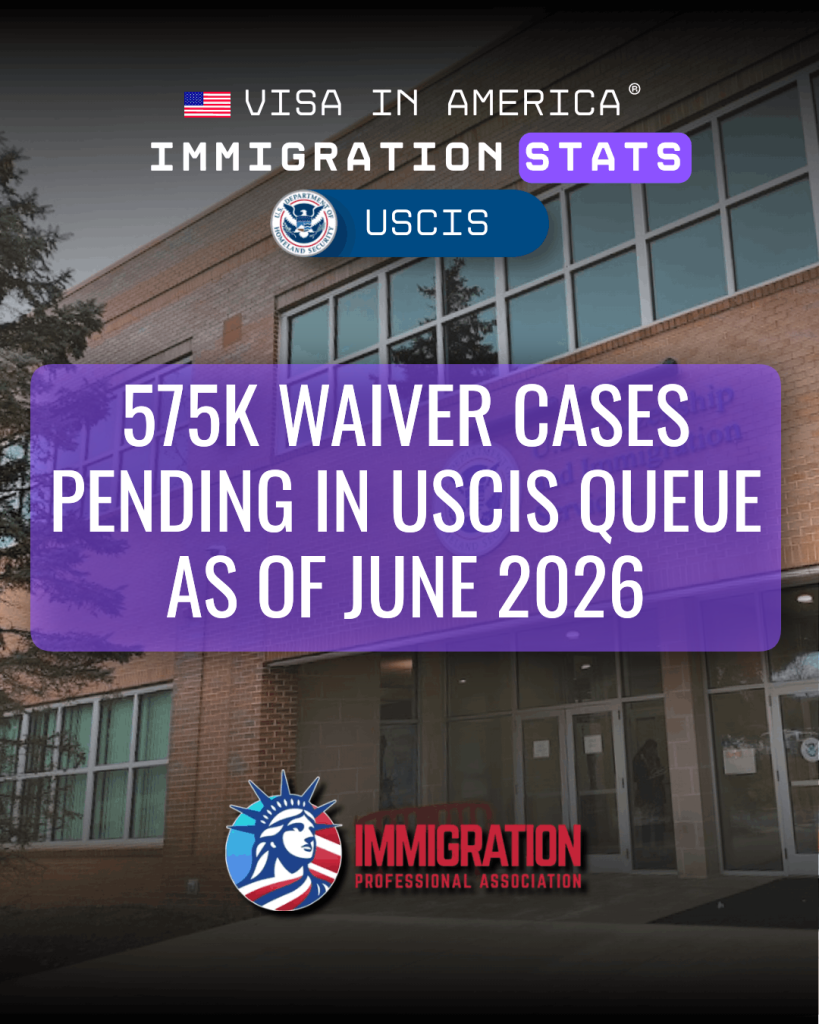
The USCIS waiver backlog 2026 is coming into sharper focus. Data released for the third quarter of fiscal year 2026 reveals that more than 575,000 waiver cases were pending agency review as of June 30, 2026. That figure captures the scale of the backlog now facing applicants across nearly every major waiver category. The agency received approximately 45,600 new waiver applications during the April through June 2026 quarter alone. It approved roughly 7,900 and denied around 4,200. For anyone dealing with the USCIS waiver backlog in 2026, these numbers carry direct, practical consequences. They affect planning, timing, and legal strategy.
Background on USCIS Waiver Processing
USCIS administers several distinct waiver forms under the Immigration and Nationality Act. Each form addresses a specific legal bar or procedural requirement. Some waivers allow foreign nationals to overcome grounds of inadmissibility — such as prior immigration violations, certain health-related grounds, or misrepresentation. Others address procedural prerequisites like passport requirements or foreign residence obligations. Applicants typically file these applications in conjunction with, or separate from, a visa petition or adjustment of status case. A waiver denial can halt an entire immigration case, regardless of how strong the underlying petition may be. The USCIS waiver backlog 2026 reflects this pattern, as waiver processing has historically been slower than other USCIS case types. Each application requires individualized review of potentially complex factual and legal circumstances.
What Is Changing in the USCIS Waiver Backlog 2026
The newly released data from USCIS’s Chief Data and Analytics Office quantifies the current state of the waiver pipeline. It covers the quarter ending June 30, 2026. The overall pending count stood at 575,908 cases at the close of that period. That figure spans seven distinct form types making up the USCIS waiver backlog 2026, with most cases packed into a few categories. The I-192 allows inadmissible foreign nationals to seek advance permission to enter the United States as nonimmigrants. It accounts for the largest share of the backlog by a significant margin — 475,726 pending cases, or roughly 83 percent of all pending waiver applications. The I-601 is the primary form used by applicants seeking waivers of grounds of inadmissibility in immigrant contexts. It shows 70,362 pending cases. The I-212 is filed by individuals seeking permission to reapply for admission following a deportation or removal order. It carries 26,003 pending cases.
Smaller but still meaningful backlogs appear for the I-612, the waiver of the two-year foreign residence requirement commonly linked to J-1 exchange visitors. It shows 3,116 pending cases against 2,785 received and 1,582 approved during the quarter. The I-191 covers relief under former INA section 212(c), and the I-193 covers passport or visa waivers. Each carries a modest pending total, 165 and 284 respectively. The I-602 is filed by refugees seeking waivers of inadmissibility grounds. It shows only 252 pending cases and a high approval rate — 366 approvals against 398 receipts during the quarter.
USCIS notes in the report’s methodology that administrative closures, inter-office transfers, system updates, and post-adjudicative outcomes occur. These prevent staff from reconstructing pending counts arithmetically from prior periods. These figures represent the agency’s most current snapshot at the time of the database query in July 2026.
Who Is Affected by the Backlog
The populations most directly affected by these pending volumes are applicants who have already filed one of these waiver forms and are awaiting a decision. Those considering filing in the near term are also affected. The I-192 backlog is particularly relevant to Canadian and other nationals who require advance permission to enter as nonimmigrants due to prior inadmissibility grounds. It also matters to individuals with T or U nonimmigrant status applications that include a concurrent waiver request.
The I-601 backlog directly affects prospective immigrants, including immediate relatives of U.S. citizens and preference-category applicants. Their visa or green card cases are on hold pending a waiver decision. People who have been removed or sent back and wish to return legally are waiting in the I-212 queue. J-1 alumni and former exchange visitors subject to the two-year home residency requirement who filed for a waiver make up part of the I-612 pending count.
An unresolved waiver also affects employers backing foreign national employees whose admissibility is in question. It also affects petitioners in family-based cases, because it delays the entire underlying case. Immigration lawyers managing groups of pending matters will recognize that the data on the USCIS waiver backlog 2026 confirms system-wide delays rather than one-off processing glitches.
Practical Implications for Applicants
A pending count of nearly 576,000 cases means applicants in most waiver categories should plan for extended decision timelines. These timelines go well beyond standard agency estimates. The I-601 category showed nearly equal approval and denial numbers during the quarter — 1,497 approvals against 1,489 denials. This makes clear that these adjudications involve substantive contests, not administrative formalities. That near-even split underscores the importance of presenting a fully documented and legally complete application at the time of filing. In practice, the margin between approval and denial appears narrow.
For I-212 applicants, the quarter saw 515 approvals and 404 denials against 1,751 receipts. This suggests active adjudication relative to the pending pool of 26,003. Even so, the gap between receipts and decisions means the backlog is not shrinking fast. For the I-192, the ratio of approvals to receipts during the quarter — 3,938 approvals against 34,995 receipts — suggests incoming volume is significantly outpacing decisions. That may explain why this category holds the largest share of the overall backlog.
Applicants should also be aware that the USCIS data itself carries an important caveat. Pending counts are not a simple accumulation of prior-period receipts minus decisions, because closures, transfers, and system updates affect the totals in ways the public report does not disaggregate. This means applicants and their representatives cannot reliably guess their place in line from published statistics alone. Direct case status tracking and smart follow-up remain the most reliable tools available.
What to Watch For Next in the USCIS Waiver Backlog 2026
USCIS publishes waiver processing data quarterly, and the next release will cover the period ending September 30, 2026. Stakeholders should monitor whether the USCIS waiver backlog 2026 grows or stabilizes, particularly for the I-192 and I-601 categories, relative to this quarter’s figures. Any agency announcements about staffing adjustments, policy guidance, or operational changes to specific field offices could materially affect how quickly these cases move. Applicants whose cases have remained pending significantly longer than published processing times should consider a formal inquiry. Another procedural step may also be appropriate under the circumstances.
How Immigration Professional Association Can Help
Immigration Professional Association works regularly with individuals and families whose immigration cases hinge on a pending or expected waiver decision. The situation might involve an I-601 inadmissibility waiver that will determine whether a family member can immigrate, an I-212 reapplication following a prior removal, or an I-192 needed before a visitor can legally enter the United States. In every case, the team at Immigration Professional Association understands how to build the strongest possible case from the start — because with approval and denial rates as close as the current data shows, the quality of the first filing matters enormously.
Pending applicants may face unexplained delays or worry about where their case stands given the current USCIS waiver backlog 2026 landscape. Immigration Professional Association can help assess options and next steps. For those who have not yet filed, an early talk can help identify the right waiver strategy and avoid document gaps that often lead to denials.
If your immigration path involves a waiver application — or if you are unsure whether it should — reach out to Immigration Professional Association. The team can discuss your specific situation in the context of what the current USCIS pipeline actually looks like.