Introduction
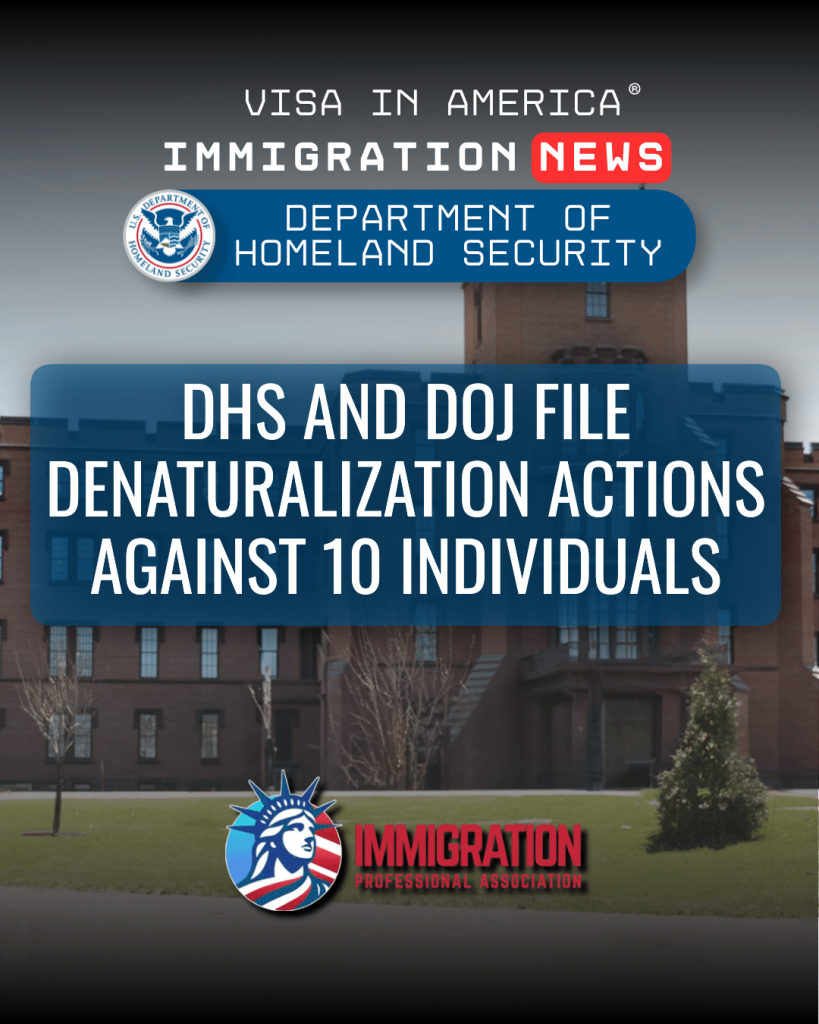
The U.S. Department of Homeland Security and the Department of Justice announced on July 20, 2026, that they have filed denaturalization complaints against ten naturalized U.S. citizens in federal district courts across the country. The complaints, filed over the preceding 30 days, allege that each individual procured their citizenship unlawfully — primarily through concealment of criminal conduct, false testimony under oath, or identity fraud during the naturalization process. This wave of denaturalization actions represents what the current administration has characterized as the largest coordinated denaturalization effort in U.S. history, and it puts the legal standards governing how citizenship can be revoked into sharper focus for naturalized citizens, permanent residents, and immigration practitioners alike.
The Legal Framework for Denaturalization
Denaturalization — the revocation of naturalized citizenship — is authorized under the Immigration and Nationality Act. The statute permits the government to cancel a certificate of naturalization if the citizenship was illegally procured or was procured through concealment of a material fact or willful misrepresentation. These are not new grounds; they have existed in federal immigration law for decades. What is relatively rare is the scale and coordination with which the government pursues these actions, which historically have been filed sporadically and in limited numbers.
The naturalization process itself requires applicants to demonstrate, among other things, that they have been a person of good moral character during the statutory period — typically five years — preceding the application. Applicants must truthfully answer questions about their criminal history, prior immigration filings, and use of aliases. Providing false answers during a naturalization interview, or on the N-400 application, constitutes false testimony under oath and a misrepresentation of a material fact. Both are independent statutory grounds for denaturalization.
Complaints Filed Against Ten Individuals in Multiple Districts
The ten complaints filed by DHS and DOJ cover a range of alleged misconduct. Several individuals are accused of committing serious criminal offenses — including child sexual abuse, Medicare fraud, and cocaine trafficking — before or during the good moral character period required for naturalization, and then affirmatively concealing those offenses on their applications or during interviews. Others are accused of using false identities or purchasing fraudulent identity documents to obtain permanent residency and ultimately citizenship. In at least one case, an individual is alleged to have filed applications under multiple aliases, with fingerprint analysis later confirming the identities belonged to the same person.
The DOJ’s Acting Attorney General and Assistant Attorney General for the Civil Division both indicated in their statements that additional denaturalization complaints are forthcoming, signaling that these ten cases are not the end of this enforcement cycle but rather part of an expanding initiative.
It is important to note, as the official announcement itself states, that the claims in these complaints are allegations only. No court has made a finding of liability in any of these cases. Denaturalization is a civil judicial proceeding, and each defendant retains the right to contest the complaint in federal district court.
Who Is Affected
The individuals directly named in these complaints are the ten respondents, whose cases are now pending in federal courts including the Southern District of Florida, Northern District of Georgia, Northern District of Texas, Southern District of Texas, District of Utah, and Western District of Washington, among others.
More broadly, these actions are relevant to any naturalized citizen who has a prior criminal history, prior use of aliases in immigration filings, or any discrepancy between what was disclosed during their naturalization process and what is reflected in law enforcement or government records. Lawful permanent residents currently preparing or planning to file for naturalization are also directly affected in the sense that this enforcement climate reinforces exactly how consequential truthful disclosure on the N-400 is.
Employers, sponsors, and family members of naturalized citizens are indirectly affected to the extent that denaturalization can eventually expose a former citizen to removal proceedings once citizenship is revoked.
What This Means for Applicants and Naturalized Citizens
The legal standard underlying these cases is not new, but the enforcement intensity is. For anyone who has already naturalized and disclosed everything truthfully, these actions present no new legal exposure — the denaturalization statute reaches only fraud or illegality in the procurement of citizenship, not conduct that arises entirely after naturalization is lawfully obtained.
For permanent residents currently in or approaching the naturalization process, these cases serve as an unambiguous reminder that the N-400 application and interview carry significant legal weight. Questions about arrests, criminal charges, criminal convictions, use of other names, and prior immigration applications all require accurate, complete answers. The statutory good moral character period covers the five years before filing, but several of these complaints involve conduct the government argues predated that window — underscoring that officers and investigators may look beyond the formal statutory period when evaluating whether an applicant was truthful.
For naturalized citizens who are aware of undisclosed information in their immigration history, the question of whether and how to address that is a genuinely complex legal matter. No article can substitute for individualized legal counsel on a question that carries stakes this significant.
One procedural point worth understanding: denaturalization is a civil action filed by the United States in federal district court, not an administrative USCIS proceeding. That means the government must prove its case before a federal judge. It is not an automatic or summary process, and defendants have full rights to contest the allegations.
What to Watch For Next
The statements from DOJ leadership explicitly anticipate additional complaints. Stakeholders should monitor further announcements from both DHS and the DOJ Civil Division regarding the pace and targets of this initiative. For cases already filed, federal district court proceedings will unfold on their individual dockets — outcomes will vary depending on the facts alleged, the evidence available, and whether defendants contest or do not contest the complaints. No specific timeline for those proceedings has been announced.
How Immigration Professional Association Can Help
Denaturalization actions and the underlying question of what must be disclosed during the naturalization process sit at the intersection of criminal law and immigration law — and it is an area where incomplete information or a misunderstanding of what “material” means can have irreversible consequences. Immigration Professional Association works with permanent residents preparing naturalization applications, helping clients understand exactly what the N-400 requires and how prior history — including arrests that did not result in conviction, expunged offenses, and prior immigration filings — should be evaluated before submitting anything to USCIS.
We also work with naturalized citizens who have questions about their own records and whether anything in their background warrants a closer look in this enforcement climate. If you are approaching the naturalization process and have any uncertainty about your disclosure obligations, or if you are a naturalized citizen with concerns about your immigration history, we encourage you to speak with our team before making any decisions. Contact Immigration Professional Association to schedule a consultation specific to your naturalization or citizenship questions.