Introduction: FY2026 Blanket L RFE Rate and Approval Data
USCIS data released for fiscal year 2026 shows a 98.1% approval rate for blanket L petitions. This covers the first three quarters of the fiscal year, from October 2025 through June 2026. The figures come from the agency’s quarterly I-129 Request for Evidence report, published by the Chief Data and Analytics Office. That report also allows calculation of the blanket L RFE rate for the same period. For multinational companies that rely on the blanket L process to transfer personnel to U.S. operations, this blanket L petition approval rate is a meaningful data point for workforce planning. It also shows what the adjudication environment currently looks like at the ground level.
Background on the Blanket L Process
The blanket L designation is an alternative to the standard individual L-1 petition process. It is available to multinational employers that meet certain qualifying criteria related to size, U.S. presence, and intracompany transfer volume. Under a blanket L approval, the company — rather than each individual employee — holds the primary USCIS approval. Individual transferees seeking L-1A (manager or executive) or L-1B (specialized knowledge) classification can then seek a visa directly through a U.S. consulate abroad. They do this by presenting the company’s blanket approval, rather than requiring USCIS to adjudicate each case separately.
The blanket process shifts much of the adjudication workload to U.S. consulates rather than USCIS. So the I-129 filings captured in this dataset reflect petitions filed to obtain or extend the blanket L approval itself — not the individual L-1 beneficiary adjudications that flow from it.
What the Data Shows About the Blanket L RFE Rate
Across the first nine months of fiscal year 2026, USCIS received 998 blanket L petitions. It completed adjudications on 990 of them. USCIS approved 971 of those completed cases and denied 19, producing the 98.1% overall approval rate. The 150 cases listed as pending at the end of June 2026 are filings still awaiting a decision as of that date.
The monthly picture is notably consistent. Approval rates ranged from a low of 97.1% in February to a high of 100.0% in April. In April, USCIS completed 110 decisions with zero denials. No single month showed a sharp drop in approvals or a spike in denials. Nothing suggests a change in adjudication posture.
The blanket L RFE rate is the RFE dimension of the data that deserves particular attention. Of the 990 total completions, 224 — or 22.6% — involved a Request for Evidence. USCIS ultimately approved 208 of those cases that received an RFE. That is a 92.9% approval rate among RFE cases when measured against total RFE completions. Expressed as a share of all completions, approved-with-RFE cases account for 21.0% of the total. This means that roughly one in five approved petitions traveled through an RFE before reaching approval. That is a significant proportion that shapes how companies should think about the process.
USCIS methodology notes that it counts petitions with multiple RFEs only once. It also notes that some approvals and denials may involve petitions received in earlier periods, and that the L-1A and L-1B individual petition reports remain separate from this blanket filing dataset.
Form I-129 Requests for Evidence — FY2026 Q3 Infographics
The three charts below break down Form I-129 Requests for Evidence (RFE) data for the third quarter of fiscal year 2026, covering all classifications, the breakdown by form, and the approval rate for petitions that received an RFE. Swipe or scroll the charts sideways, or use the arrows and dots below to move between them. Each chart can be opened at full size in a new tab.
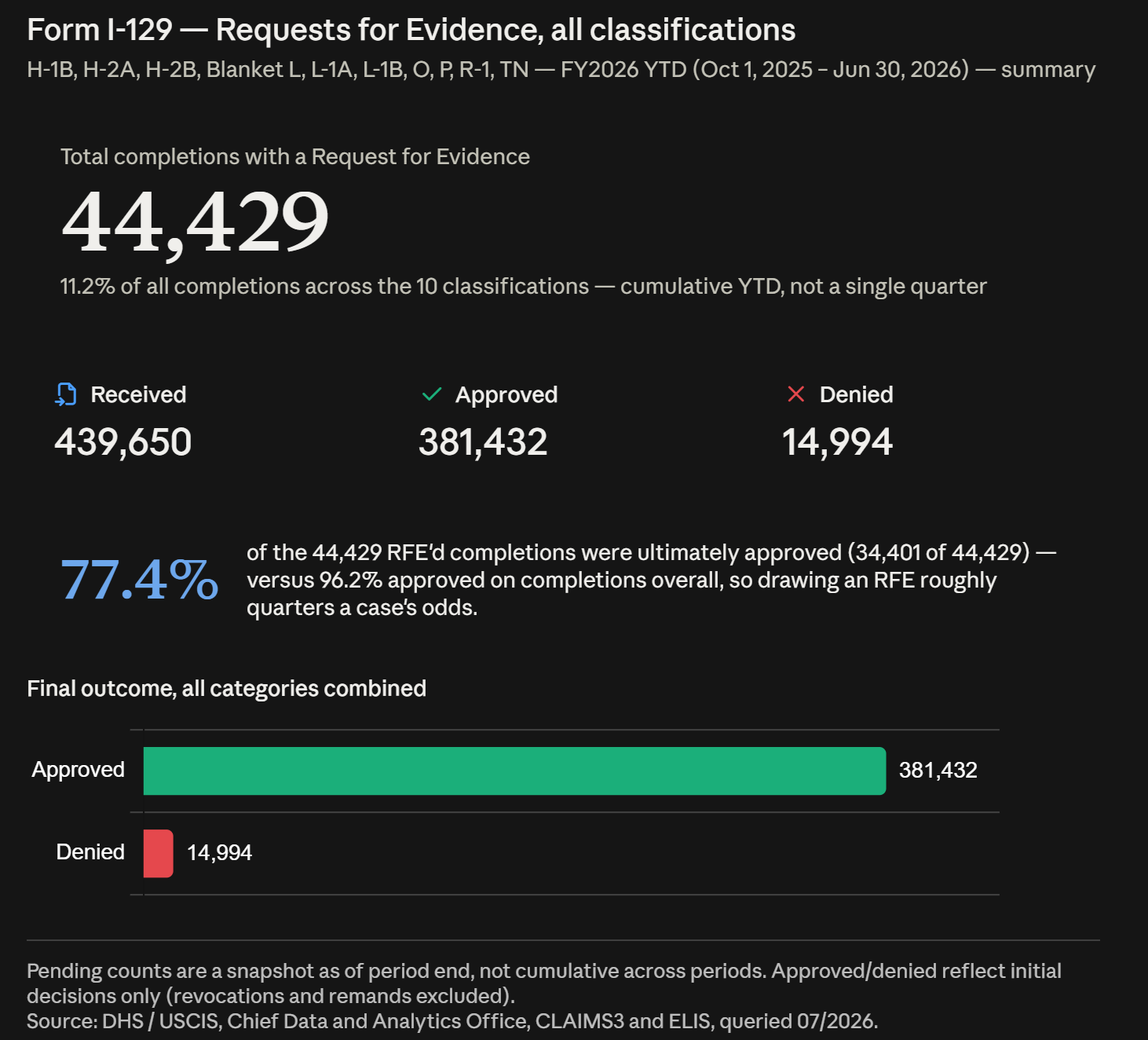
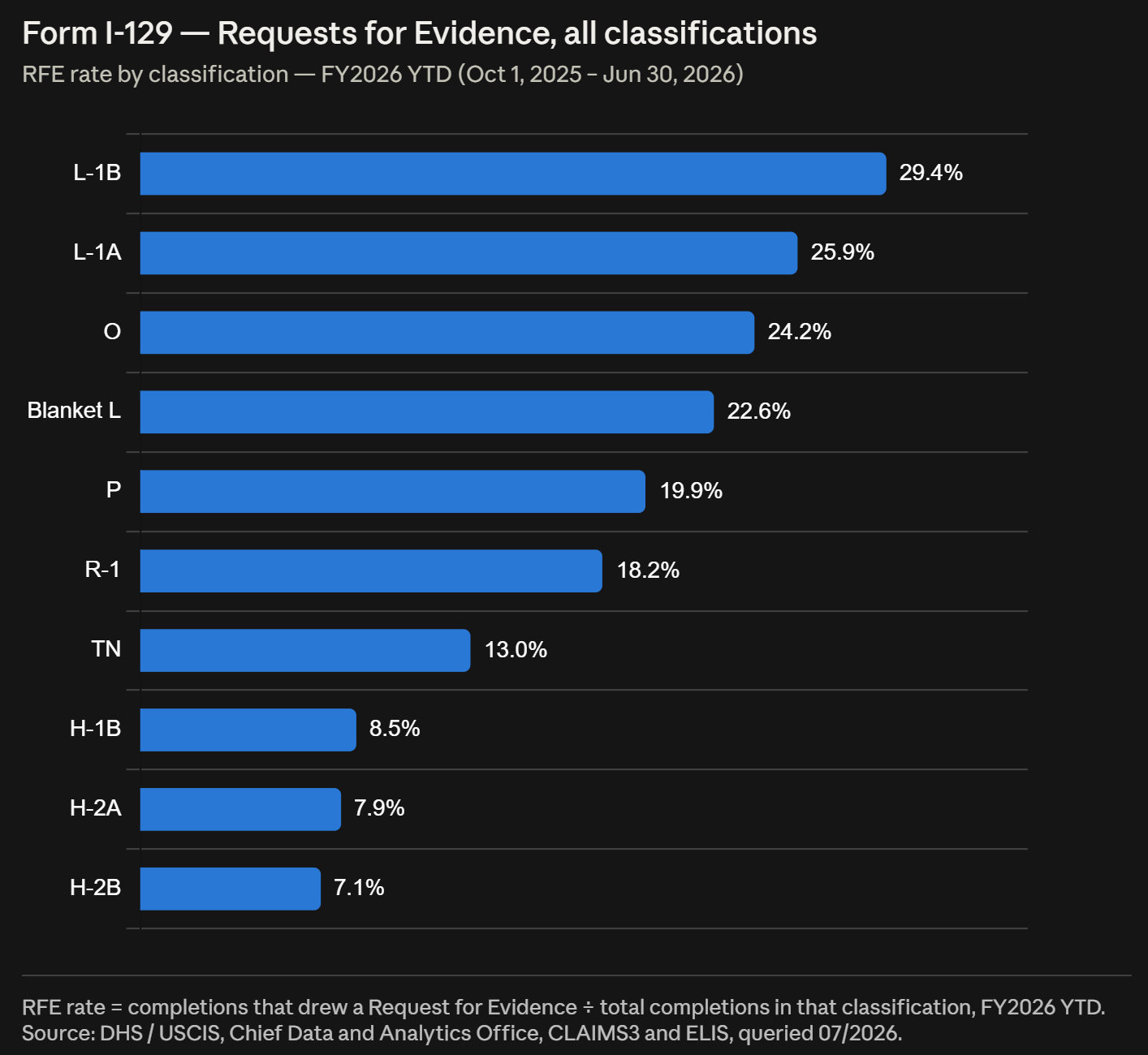

Source: DHS / USCIS, Office of Performance and Quality — CLAIMS3 and ELIS data, queried July 2026. The underlying quarterly reports are published on the USCIS Immigration and Citizenship Data page.
Who Is Affected by the Blanket L RFE Rate
Multinational employers who hold or are seeking a blanket L approval are the primary audience for this data. These are typically large organizations with substantial U.S. operations and a documented history of L-1 transfers. They include companies in technology, manufacturing, financial services, consulting, and other sectors with significant cross-border workforce movement.
HR professionals and global mobility teams at these companies use blanket L approvals to streamline the international assignment process. This applies to managers, executives, and specialized knowledge workers. The data does not affect individual L-1A or L-1B petitioners who lack coverage under a blanket approval. USCIS tracks those filings separately and excludes them from this report.
Immigration counsel advising multinational clients will also find the RFE rate relevant. An RFE rate above 22% is worth monitoring. This is true even though the overwhelming majority of those RFEs result in approval. It signals that adjudicators are requesting supplemental evidence in a meaningful share of cases. That has direct implications for preparation timelines and documentation strategy.
Practical Implications of the Blanket L RFE Rate
The 98.1% approval rate reflects a favorable adjudication environment for blanket L petitions at this stage of fiscal year 2026. Employers considering whether to pursue or renew a blanket L approval — rather than filing individual I-129 petitions for each L-1 transfer — now have a current, data-supported picture of what to expect at the USCIS level. That said, the blanket approval is only one part of the overall blanket L pathway. Consular processing for individual beneficiaries introduces a separate set of variables that this USCIS dataset does not capture.
The 22.6% blanket L RFE rate is the figure that practical planning should focus on most carefully. Nearly one in four completed petitions triggered a request for additional documentation before USCIS reached a decision. For companies with fixed business timelines — an executive scheduled to relocate, a project launch dependent on a key transfer — an unexpected RFE can add weeks. Robust initial filing packages that anticipate common RFE triggers reduce that risk materially.
Employers should also remember that blanket L approvals and renewals are not the same as the individual beneficiary process. Even a company with an active, USCIS-approved blanket L must ensure each individual transferee meets the qualifying criteria for their specific classification when presented to a consulate. Consular officers exercise independent judgment on individual eligibility. A strong blanket approval does not guarantee that officers will approve every beneficiary application at the visa interview stage.
What to Watch For Next in the Blanket L RFE Rate
USCIS publishes this data on a quarterly basis. The next release will cover October 2025 through September 2026, completing the full fiscal year 2026 picture. Stakeholders should monitor whether the blanket L RFE rate remains in the 22–23% range or shifts. They should also watch whether the consistently high approval rates of this period continue into the final quarter. Analysts would find any notable movement worth analyzing. Relevant context includes agency staffing, adjudication policy changes, or shifts in the composition of petitions that employers file.
A specific effective date or policy change is not at issue in this release. The data reflects existing adjudication practice, not a new rule or regulatory development.
How Immigration Professional Association Can Help
For multinational employers navigating the blanket L process, data like this is most useful when it informs a concrete filing strategy. A general awareness that approval rates are high is not enough. At Immigration Professional Association, we work directly with HR teams and global mobility professionals. Together we develop blanket L packages that withstand the RFE environment the data describes. That means going beyond minimum documentation thresholds. It means presenting a record that anticipates the questions adjudicators are most likely to ask.
Whether your company is pursuing an initial blanket L approval, preparing for a renewal, or trying to understand why a prior petition generated an RFE, our team can help. We offer the kind of detailed, case-specific analysis that aggregate statistics alone cannot provide. We also assist with the individual beneficiary side of the process. This helps ensure that employees your company intends to transfer position themselves as strongly as possible at a U.S. consulate under your blanket approval.
If this fiscal year 2026 blanket L data has prompted questions about your company's international transfer program, Immigration Professional Association welcomes the conversation. Contact us to discuss your specific blanket L situation. Speak with an attorney who understands where these cases succeed and where they stall.