USCIS Announces Cap Reached for Second-Half FY 2026 H-2B Petitions and Opens Path for Limited Supplemental Filings
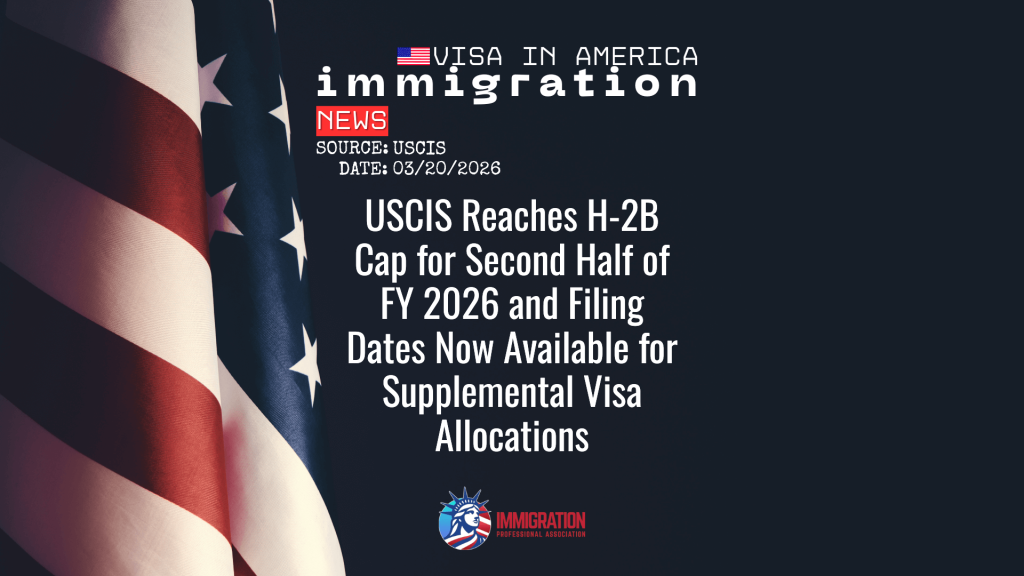
U.S. Citizenship and Immigration Services (USCIS) has confirmed that it has received a sufficient number of petitions to meet the statutory H-2B cap for the second half of fiscal year (FY) 2026. Consequently, the agency no longer accepts new cap-subject H-2B petitions for this fiscal year’s portion.
Importantly, the announcement affects employers hiring foreign nationals for temporary nonagricultural positions in FY 2026’s latter half. Once the numerical limit is reached, USCIS rejects cap-subject petitions filed subsequently for that period.
USCIS update outlines filing dates and guidance for supplemental H-2B visa allocations under temporary authority. These supplemental numbers are limited and subject to specific eligibility criteria.
Understanding the H-2B Cap and Second-Half Allocation
The H-2B visa program permits U.S. employers to hire foreign workers to fill temporary nonagricultural jobs, including seasonal, peak-load, intermittent, or one-time occurrence needs. Federal law limits H-2B visas to 66,000 annually, split between fiscal year’s halves.
The first half covers October 1-March 31; the second half covers April 1-September 30. Once the statutory limit is met, USCIS stops accepting new cap-subject filings.
Exempt petitions, like certain returning workers, may continue if authorized under temporary provisions or exemptions. However, cap closures directly affect most employers who rely on cap-subject numbers.
Supplemental H-2B Visas and Filing Windows
In addition to the standard annual cap, Congress has at times authorized the Department of Homeland Security to make additional H-2B visas available for a given fiscal year. Supplemental allocations are limited and often prioritize returning workers or certain countries’ nationals.
USCIS has announced filing dates tied to these supplemental allocations for FY 2026. Petitioners must meet eligibility requirements, including returning worker conditions or country-based restrictions.
Because supplemental allocations are numerically limited and frequently subject to strict evidentiary and timing requirements, employers must ensure that petitions are complete, timely filed, and supported by valid temporary labor certifications and documentation of temporary need.
Practical Considerations for Employers and Workforce Planning
Employers in industries such as hospitality, landscaping, seafood processing, construction, and other seasonal sectors commonly depend on H-2B workers to meet peak demand. With the cap reached, businesses must evaluate eligibility for supplemental allocation.
Timing is critical in the supplemental context. When filing windows open, USCIS may receive high volumes of petitions within a short timeframe. Incomplete filings or documentation errors can result in rejections or missed opportunities under limited allocations.
Employers should review H-2B compliance, including labor certification validity, wage adherence, and job description accuracy.
For businesses that were still preparing regular cap filings for late FY 2026 start dates, contingency planning may be necessary. The authority may need to consider alternative staffing strategies or future filing cycles depending on operational timelines and eligibility for supplemental numbers.
Ongoing Monitoring of H-2B Developments
The court’s cap reach announcements do not change the statutory framework governing H-2B petitions, but they significantly affect filing strategy and workforce planning. USCIS alert outlines supplemental filing dates and eligibility for H-2B workers in FY 2026’s second half.
Monitor agency updates and align planning with cap status and allocation procedures for visa availability.