Case Overview
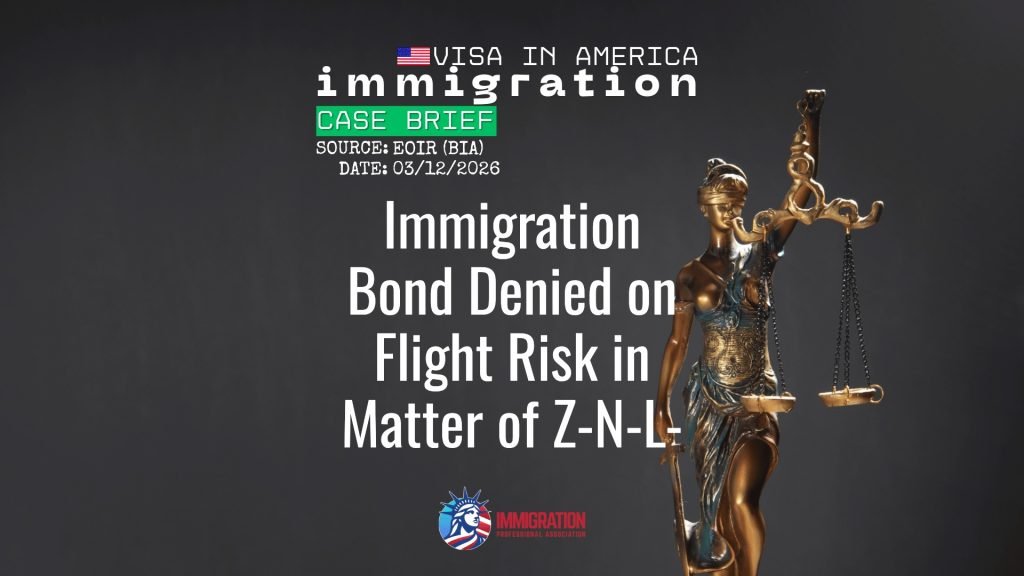
Matter of Z-N-L-, decided by the Board of Immigration Appeals on March 12, 2026, and published as Interim Decision. It is a bond and custody determination involving a native and citizen of China in removal proceedings before the Executive Office for Immigration Review. Importantly, Judges Hunsucker, Owen, and Gemoets considered if conflicting residence evidence and unverified sponsorship showed a bond flight risk. Notably, the decision follows Matter of Akhmedov, reinforcing that address discrepancies alone can defeat bond hearing proof.
Matter of Z-N-L- holds that unresolved residence discrepancies show flight risk, justifying detention without bond. The Board vacated the Immigration Judge’s September 22, 2025, decision that had granted bond in the amount of $7,500, and ordered the respondent held in DHS custody without bond pending resolution of the removal proceedings.
Key Facts
Specifically, DHS agents found the respondent, a Chinese citizen, at an illegal marijuana site in Oklahoma. Additionally, a Form I-213 documented the respondent’s Oklahoma residence at apprehension. Moreover, the respondent’s bond request worksheet described detention as “at [his] residence,” reinforcing the Oklahoma connection.
However, in an asylum application, the respondent claimed to reside in California. Furthermore, a sponsor, claiming to be the respondent’s cousin, stated they lived at the same California address. Importantly, the authority did not submit any documentary evidence to corroborate the claimed familial relationship between the respondent and the alleged sponsor. The record lacks the respondent’s entry date, residence length, or asylum application history, only noting it was pending.
The Immigration Judge conducted a bond hearing and, on September 22, 2025, ordered the respondent’s release upon posting a $7,500 bond, having determined that the respondent met his burden of showing he was neither a danger to persons or property nor a flight risk that the bond amount could not adequately address. DHS appealed the decision to the Board of Immigration Appeals.
Legal Issues Presented
The Board questioned if the Immigration Judge erred in finding the respondent met the burden for bond release. The analysis focused on conflicting residence evidence, placing the respondent in Oklahoma and California. The Board questioned if unverified sponsorship and a pending asylum application showed the respondent wasn’t a flight risk.
A legal question was if the BIA reviews flight risk determinations de novo or only for clear error. The Board considered if a pending asylum application mitigates flight risk under the Matter of Guerra framework.
Legal Reasoning and Analysis
Governing Standard of Review
The Board started by confirming the standard of review. The BIA judges flight risk de novo, while officials review factual findings for clear error. This distinction allows the Board to assess flight risk independently, not deferring to an Immigration Judge’s conclusion.
Application of De Novo Review
The Board found the Immigration Judge overlooked key evidence: conflicting Oklahoma and California addresses in the respondent’s records. The Board cited Matter of Akhmedov, noting residence discrepancies and address notice failures establish flight risk precluding bond. The Board noted inconsistent evidence about the respondent’s fixed U.S. address in Matter of Z-N-L-.
Sponsorship Evidence
The Board reviewed the respondent’s sponsorship evidence. Matter of Dobrotvorskii states sponsor evidence relates to a fixed address, a flight risk factor under Matter of Guerra. In Matter of Z-N-L-, the sponsor claimed to be the respondent’s cousin, but no evidence verified this relationship. The Board found unverified sponsorship insufficient to address residence discrepancies, failing to meet the fixed-address burden.
Asylum Application and Flight Risk
The Board reviewed the respondent’s pending asylum application. The respondent argued that an affirmative asylum claim with USCIS incentivized future appearances, reducing flight risk. The Board cited Matter of R-A-V-P- to reject the idea that relief applications ensure hearing appearances. The Board further cited Matter of E-Y-F-G- states that even granted relief may not mitigate flight risk. Securing a benefit doesn’t reliably overcome deficiencies leading to a flight risk finding.
Conclusion and Limitations of the Decision
The Board concluded the respondent didn’t prove he isn’t a flight risk or that a bond could mitigate it. The Board vacated the bond grant and ordered the respondent held in DHS custody without bond.
The record lacks the respondent’s entry date, asylum case history, or danger findings, resolved in his favor before appeal. This lack of information highlights the challenges in fully understanding the context of the case. The Board’s decision focuses only on flight risk, not dangerousness, assessing if bond release was appropriate.
Practical Implications
Consequences of Inconsistent Records
The Matter of Z-N-L- decision impacts foreign nationals with inconsistent address records in removal proceedings. This decision highlights the importance of maintaining accurate and consistent records in immigration. Material residence discrepancies, like not updating court addresses, can justify a flight risk finding that no bond cures. Minor oversights can profoundly impact an individual’s immigration status.
Burden of Proof at Bond Hearings
At a bond hearing, the respondent, not DHS, must prove the absence of flight risk. Proactive documentation of a stable U.S. residence is crucial for bond hearings, including leases, utilities, and employment records. Anticipate, explain, and resolve document inconsistencies with evidence before the hearing.
Sponsorship Evidence Requirements
The decision also imposes a higher standard on sponsorship evidence. A sponsor’s affidavit alone isn’t enough; the respondent must document the relationship. Absent verified sponsorship, even a plausible family connection will not suffice to establish the fixed-address factor under Matter of Guerra. Practitioners should collect verifiable documentation of the sponsor’s relationship to the respondent before any bond proceeding.
Implications for Asylum Seekers
For asylum seekers, a pending application alone won’t mitigate a flight risk determination, per Matter of Z-N-L-. The Board’s reliance on R-A-V-P- and E-Y-F-G- confirms the principle applies broadly, despite prior relief findings. Asylum applicants with address inconsistencies should seek legal representation before any bond hearing.
Importance of Address Reporting Compliance
This decision highlights the need for consistent and timely address reporting in removal proceedings. Under 8 C.F.R. § 1003.15(d), respondents have a continuing obligation to notify the Immigration Court of changes in address. Non-compliance or suggestive records can lead to detention without bond, despite the amount offered.
How can an immigration lawyer from the Immigration Professional Association help?
Bond hearings need precise preparation, understanding of BIA’s flight risk standards, and addressing evidentiary gaps early. Immigration Professional Association attorneys know the bond framework and can resolve address or sponsorship inconsistencies early. The firm’s professionals prepare bond packages with sponsor documentation, verified residence, and consistent filings for BIA standards.
For those in DHS custody, attorneys can assess changed circumstances for a new bond hearing and represent clients effectively. Attorneys can help asylum seekers with discrepancies present credible evidence of a fixed U.S. address and sponsor relationships. Attorneys advise on documentation for sponsorship claims in bond proceedings, aiding families and support networks. Those fearing detention without bond should consult an Immigration Professional Association attorney early in the removal process.