USCIS Hits Limit for First FY 2026 Supplemental Returning Worker H-2B Allocation
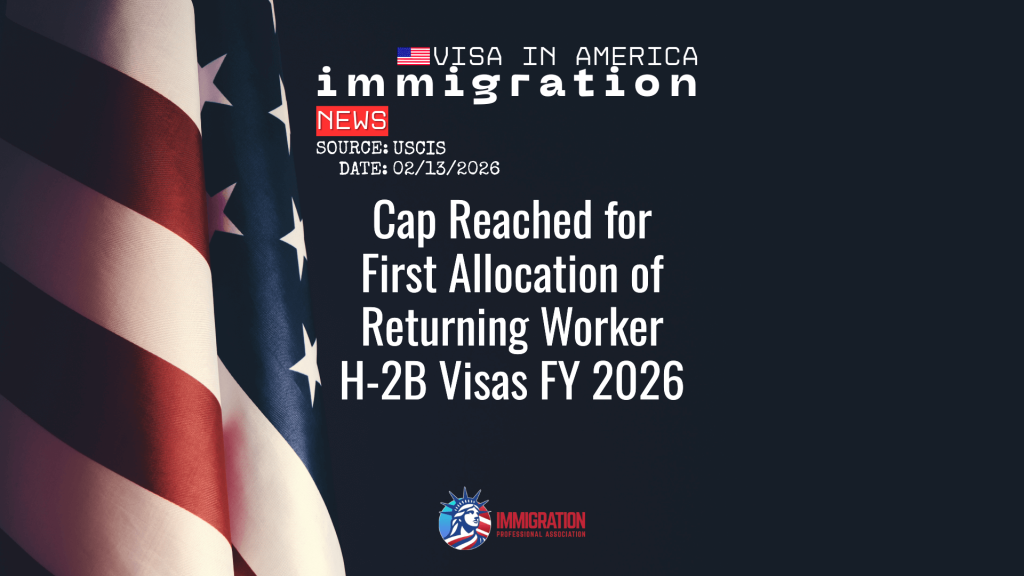
U.S. Citizenship and Immigration Services (USCIS) has announced that it has received sufficient petitions to meet the 18,490 additional H-2B visas allocated for returning workers under the fiscal year (FY) 2026 supplemental temporary final rule (TFR). This means the 2026 Cap for H-2B Visa has now been reached. This allocation applied to employment start dates from January 1 through March 31, 2026.
Consequently, USCIS has ceased accepting cap-subject H-2B petitions for this specific returning worker allocation. This applies to petitions filed for the designated employment period. The agency confirmed the cap closure in a recent update on its newsroom page.
Background on 2026 Cap for H-2B Visa
The H-2B program allows U.S. employers to employ foreign nationals for temporary nonagricultural work. This is applicable when there are insufficient U.S. workers who are able, willing, qualified, and available. Each fiscal year, Congress sets a statutory cap of 66,000 H-2B visas. This cap is typically divided between two halves of the fiscal year.
In recent years, the Department of Homeland Security has worked together with the Department of Labor. Together, they have utilized their authority to issue supplemental H-2B visas through temporary final rules. For FY 2026, USCIS made additional visas available. These included allocations reserved for returning workers. A returning worker is generally defined as a foreign national who was previously issued an H-2B visa or otherwise granted H-2B status in one of the designated prior fiscal years identified in the rule.
The first FY 2026 returning worker allocation covered start dates from January 1 to March 31, 2026. USCIS confirms that this portion of the supplemental cap has been fully used.
Practical Implications for Employers
2026 Cap for H-2B visas means that employers seeking H-2B workers with employment start dates within the January through March 2026 window can no longer file new cap-subject petitions under this specific returning worker category.
Employers with seasonal or peak-load needs during early 2026 must carefully evaluate whether they qualify under any remaining allocations provided in the FY 2026 supplemental rule. They must also evaluate whether their workforce planning must shift to later start dates, if available. Furthermore, petitioners must ensure that any alternative filings align with valid temporary labor certifications. They also need to meet all regulatory timing and documentation requirements.
This development underscores the speed at which H-2B numbers can be exhausted, particularly in high-demand industries such as hospitality, landscaping, seafood processing, and construction support services.
Ongoing Compliance and Eligibility Standards
Although this announcement affects only the first returning worker allocation for the specified period, all statutory and regulatory eligibility requirements remain in place for H-2B filings. Petitioners must continue to demonstrate a qualifying temporary need, whether seasonal, peakload, intermittent, or one-time occurrence.
In addition, for any allocation limited to returning workers, employers must properly document that each beneficiary meets the definition outlined in the applicable temporary final rule. USCIS continues to review petitions for completeness, timeliness, and substantive eligibility.
Continued Demand for H-2B Visas in FY 2026
The rapid reach of the cap reflects continued demand for nonagricultural temporary workers and ongoing labor shortages in certain sectors of the U.S. economy. While the cap closure does not affect all H-2B filings or other employment-based visa categories, it serves as a reminder that supplemental allocations are finite and tied to specific eligibility criteria and timeframes.
USCIS will continue to provide updates regarding any additional FY 2026 allocations or cap developments. Employers, HR professionals, and legal practitioners should monitor official agency announcements closely as the fiscal year progresses.