Introduction
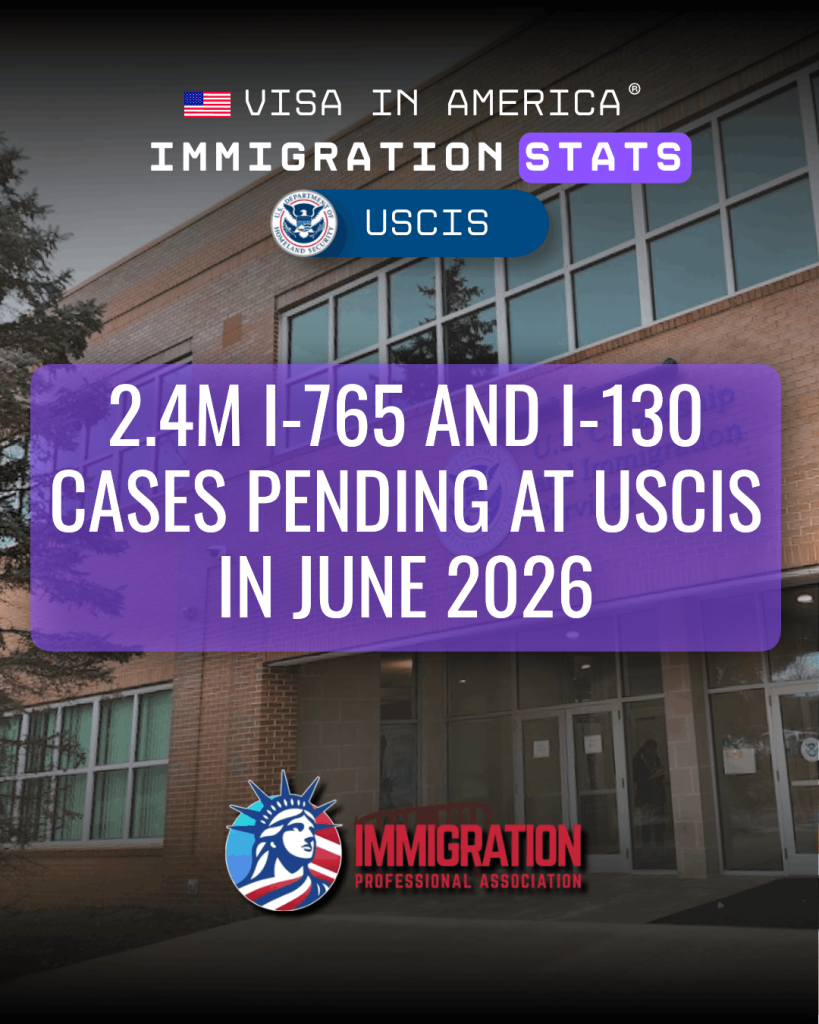
USCIS’s June 2026 congressional reporting data reveals a system under sustained pressure: more than 2.4 million I-765 Employment Authorization and I-130 Petition for Alien Relative cases were pending at the end of the month, with millions more queued across the full range of immigrant and benefit applications. Released as part of USCIS’s FY2022 Appropriations Act reporting requirement, the dataset offers one of the most granular monthly snapshots available of agency-wide processing volume — and the picture it paints matters directly to applicants, employers, and families waiting on life-defining decisions.
Background
USCIS is required to report application processing data to Congress under the Consolidated Appropriations Act of 2022. Each monthly release covers forms received, approvals, denials, total pending caseload, cases pending over six months, and average processing time across the agency’s major benefit categories. The data is drawn from USCIS’s ELIS and CLAIMS3 case-tracking systems and was queried in July 2026, reflecting conditions as of the end of June. Because the report captures a static snapshot rather than a rolling calculation, pending totals cannot be reconstructed by adding or subtracting figures from prior months — the agency notes this limitation explicitly.
What the June 2026 Data Shows
The I-130, the foundational petition for family-based immigration, carried a pending backlog of approximately 2.43 million cases at the end of June. Of those, roughly 2.12 million — about 87 percent — had been pending for more than six months. USCIS received 54,503 new I-130 petitions during the month, approved 28,945, and denied 5,362, leaving the overall pending count essentially unmoved. The average processing time for completed I-130 cases in June was 17.1 months.
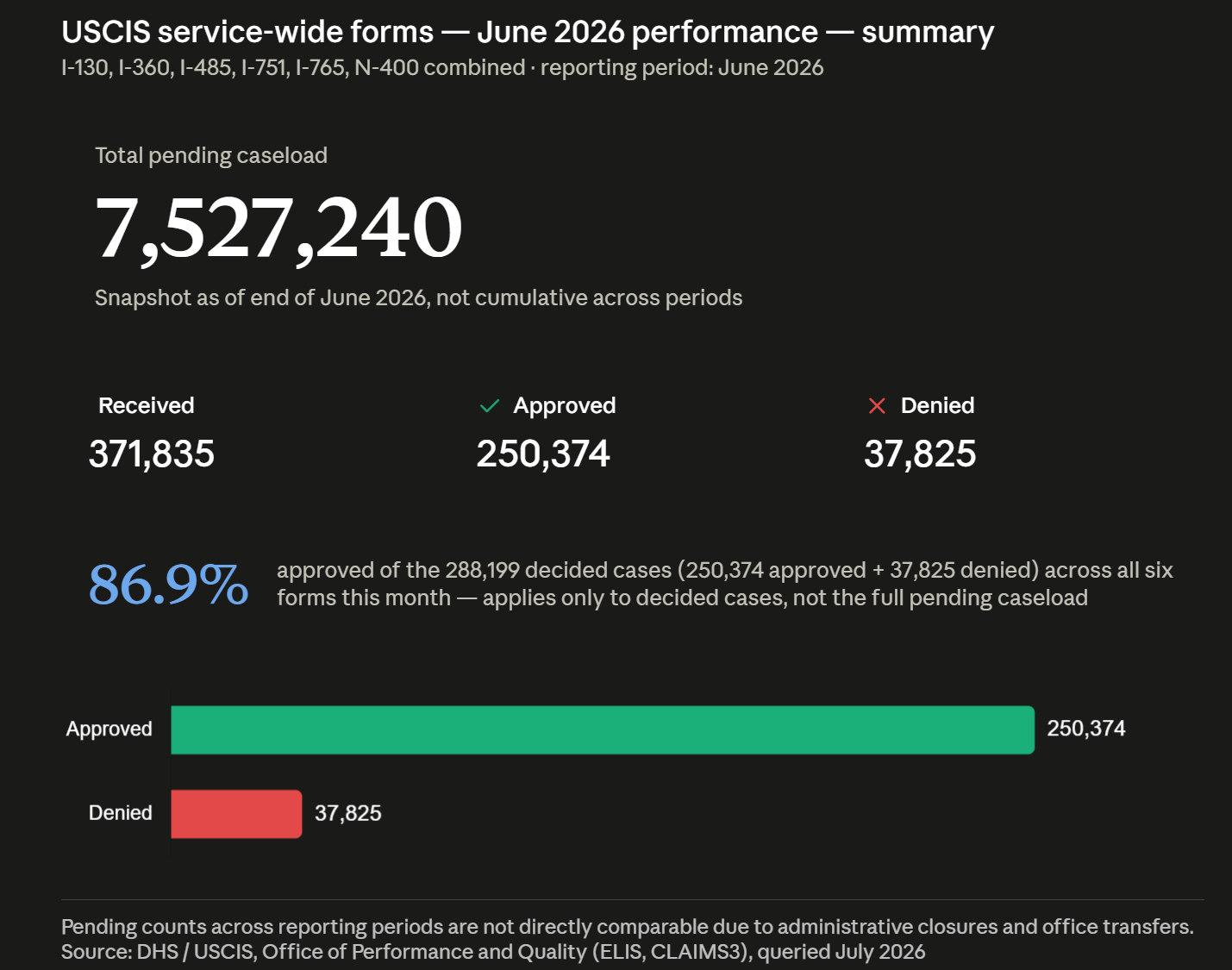
The I-765 Employment Authorization Document application showed a pending caseload of approximately 2.11 million, with 1.37 million of those — nearly 65 percent — waiting more than six months. Despite an approval output of nearly 160,000 during the month and an average processing time of just 5 months for completed cases, new receipts of 175,621 are keeping pressure on the queue.
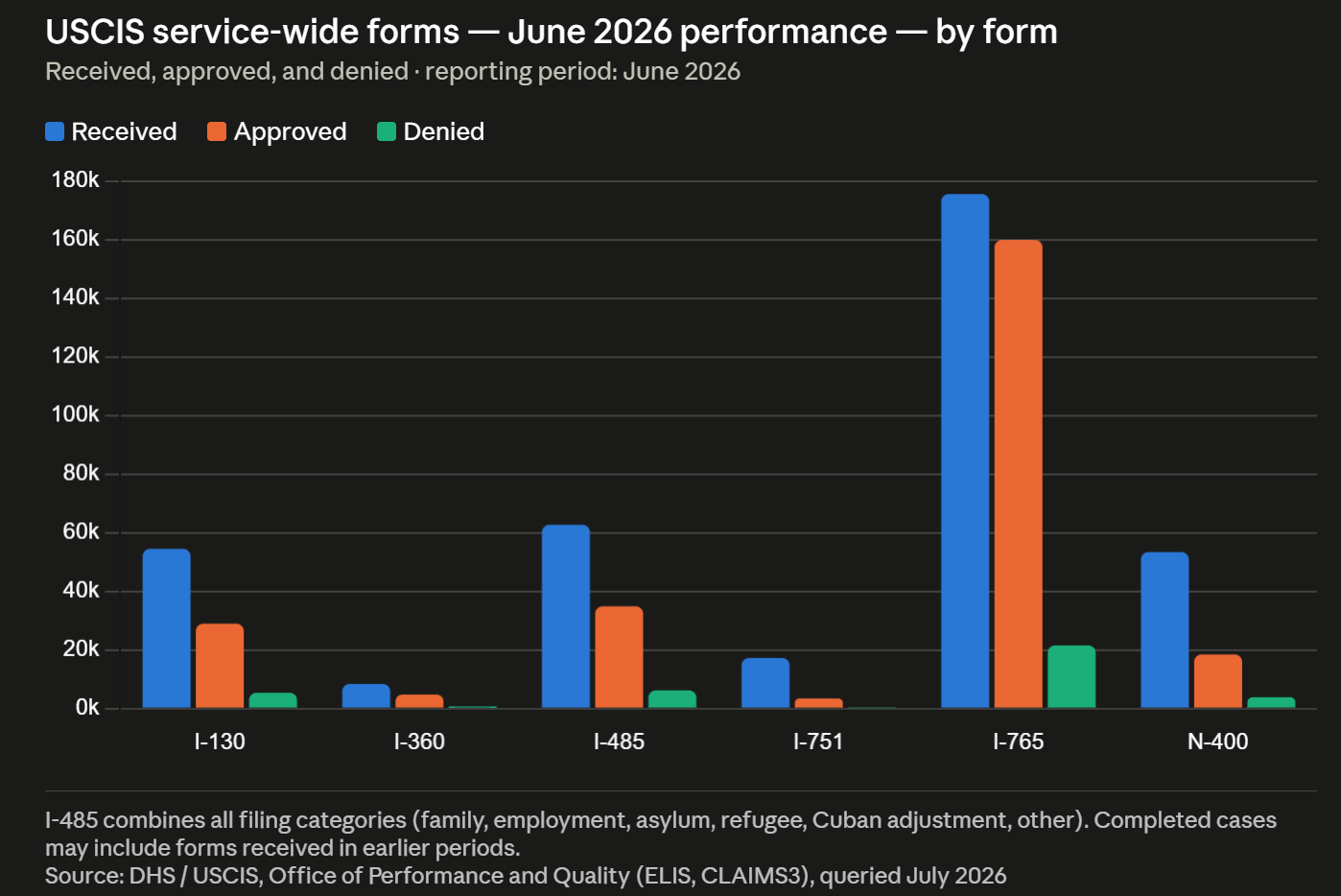
Family-based I-485 adjustment of status applications carried 610,101 pending cases with an average processing time of 11.4 months. Employment-based I-485 filings showed 270,157 pending with a 10-month average. Asylum-track I-485 cases and refugee-track I-485 cases both carried averages exceeding 29 months, reflecting the separate and substantially longer processing pipeline for those categories. Cuban adjustment cases showed a pending count of 355,371 with a 21.5-month average.
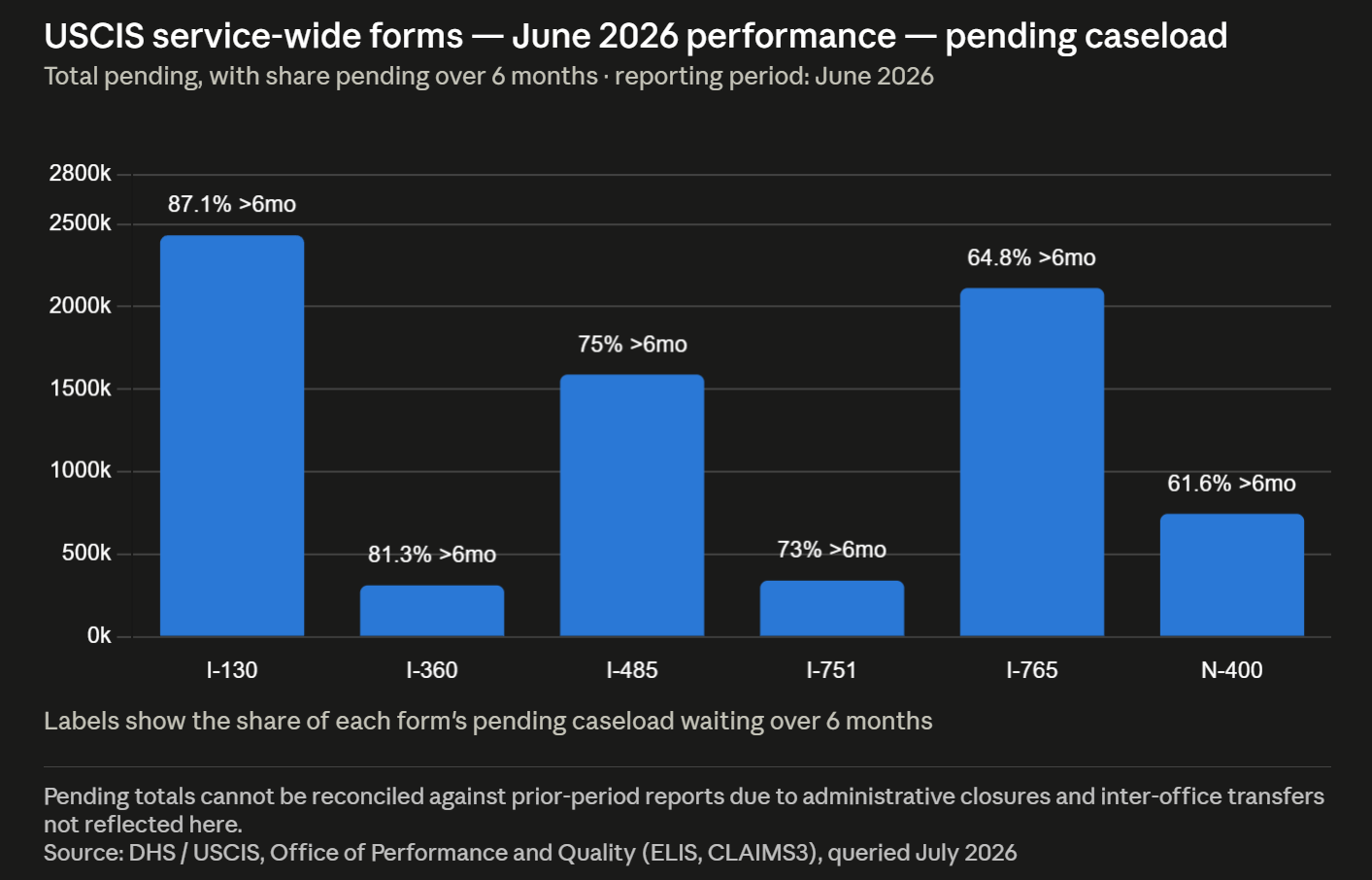
The I-751 Petition to Remove Conditions on Residence had 339,830 pending cases and an average processing time of 22.7 months, with nearly 248,000 of those pending beyond six months. N-400 naturalization applications carried 744,412 pending cases at a 10.7-month average, with 458,485 over the six-month threshold. The I-360 petition category held 311,184 pending cases at 10.7 months average.
Who Is Affected
The data touches virtually every category of immigration benefit seeker, but several groups face the most acute delays. U.S. citizens and lawful permanent residents who have filed I-130 petitions for family members abroad are dealing with a 17-month average wait before their petition is even completed — and that is before any consular or visa queue processing begins. Spouses and children waiting on I-130 approval are among the most directly affected.
Employees and employers relying on work authorization renewals face a structurally difficult situation. An average processing time of five months for completed I-765s sounds manageable in isolation, but with 1.37 million cases already past the six-month mark, the average obscures a significant portion of applicants who are waiting far longer. Workers whose employment authorization expires during the gap between filing and approval may face gaps in work eligibility that carry real employment consequences.
Conditional residents who filed I-751 petitions to remove conditions on their green cards are waiting an average of 22.7 months for completion. Given that conditional residency itself is time-limited, this cohort is particularly sensitive to USCIS processing pace. Naturalization applicants, a group often assumed to face simpler processing than immigrant petitions, are experiencing a 10.7-month average — substantial for a benefit many have waited years to become eligible to seek.
Those in asylum-based and refugee-based adjustment categories face the longest average processing times of any I-485 subcategory, both above 29 months, reflecting both the complexity of those cases and the particular resource demands they place on adjudicators.
Practical Implications
For anyone with a case pending at USCIS, the most important takeaway from this dataset is that current averages are calculated from cases completed during June — not from the full pending queue. The 2.12 million I-130 cases that have been waiting more than six months are not all on a 17.1-month trajectory; many have already exceeded that average considerably. Applicants should be cautious about interpreting the published average as a prediction of their own remaining wait time.
For employers managing immigration-dependent workforces, the I-765 data reinforces the urgency of timely renewal filings. A five-month average completion time, combined with a backlog where 65 percent of cases exceed six months, means that filing on the earliest permissible date is not a procedural nicety — it is an operational necessity for maintaining uninterrupted employment authorization.
I-751 filers should ensure their conditional green card extends their status through the pending period and that they retain evidence of timely filing. The 22.7-month average suggests a meaningful window during which the conditional resident’s status technically rests on their receipt notice rather than a valid card.
The naturalization processing average of 10.7 months, against a pending count exceeding 744,000, means prospective citizens should factor realistic timelines into any planning tied to naturalization — including travel document needs, civic participation, and derivative citizenship for minor children.
What to Watch For Next
USCIS publishes this congressional report monthly, and stakeholders should track whether the pending totals for I-130 and I-765 stabilize, grow, or begin to reduce in subsequent releases. Given the scale of the over-six-month categories across virtually every form type, further guidance on processing initiatives, staffing changes, or policy adjustments affecting these queues would be significant. A specific forecast for when backlogs may decrease has not been announced, and no regulatory or administrative action addressing these caseloads is indicated in the current report.
How Immigration Professional Association Can Help
The numbers in this report represent real cases — petitions for families separated by borders, work permits that determine whether someone can keep their job, green card applications that have been in process for years. Understanding where your case sits within these queues, what options you have if processing has stalled, and how to protect your status during extended waits requires more than reading averages.
Immigration Professional Association works regularly with individuals and employers navigating exactly these circumstances: I-130 petitions for family members, employment authorization renewals for workers and their dependents, adjustment of status filings across family and employment categories, I-751 conditional residence petitions, and naturalization applications. Our team understands the procedural tools available when cases approach or exceed USCIS’s published processing benchmarks, including the circumstances under which inquiries and formal requests may be appropriate.
If your case appears in one of the categories reflected in this June 2026 data — or if you are planning a filing and want to understand realistic timelines before you begin — we invite you to reach out to Immigration Professional Association to discuss what the current processing environment means for your specific situation.