Introduction
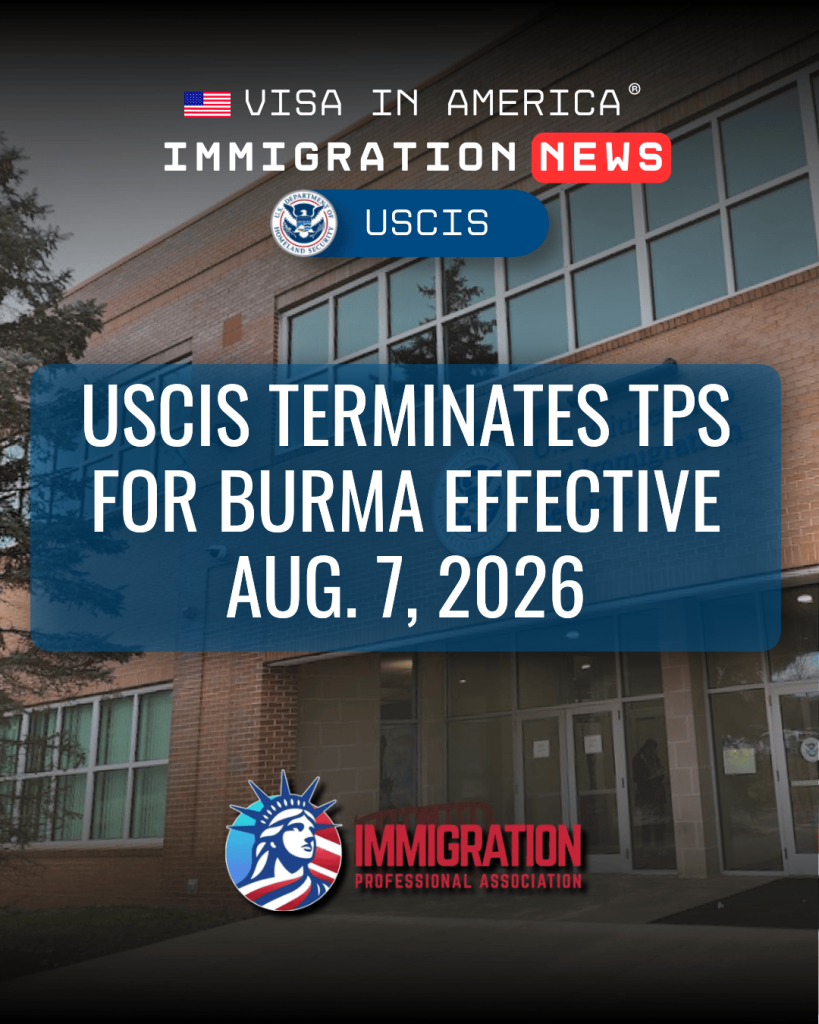
USCIS has officially terminated Temporary Protected Status for Burma (Myanmar), with the termination taking effect on August 7, 2026. The decision, originally made by former Secretary of Homeland Security Kristi Noem following a review of country conditions and interagency consultations, was published in the Federal Register on November 25, 2025. The TPS Burma termination now carries full legal force, accelerated in part by a June 2026 U.S. Supreme Court ruling in a related case. For Burmese nationals currently in the United States under TPS protection, this is not an abstract policy development — it ends their legal status and work authorization immediately.
Background
Temporary Protected Status is a humanitarian designation that allows nationals of certain countries to live and work legally in the United States when conditions in their home country — such as armed conflict, environmental disasters, or other extraordinary circumstances — make safe return impossible or dangerous. Burma was designated for TPS due to the severe instability and humanitarian crisis that has followed the military coup of February 2021, which displaced hundreds of thousands and produced ongoing violence and political repression.
TPS designation does not create a permanent immigration pathway. It is, by statute, a temporary and discretionary status that the Secretary of Homeland Security has the authority to extend, redesignate, or terminate based on current country conditions. Holders generally receive renewable periods of protection and corresponding Employment Authorization Documents (EADs) that allow them to work lawfully in the United States.
What Is Changing
The Burma TPS designation is now terminated. Former Secretary Noem concluded that Burma no longer met the statutory conditions for continued TPS designation, a determination originally published in the Federal Register as 90 Fed. Reg. 53378 on November 25, 2025. That Federal Register notice initiated the termination process, and as of August 7, 2026, the termination is in full effect.
A significant legal development preceded the termination taking effect: on June 25, 2026, the U.S. Supreme Court issued a decision in Mullin v. Doe, a case involving TPS terminations more broadly. USCIS has characterized that ruling as favorable to the government’s position, and the Burma termination now proceeds under the legal framework the Court’s decision affirmed.
Critically, USCIS has made clear that Employment Authorization Documents bearing category codes A12 or C19 that were issued to TPS Burma beneficiaries are no longer valid as of the termination date.
Who Is Affected
Burmese nationals currently holding TPS status are directly and immediately affected. Their protected status has ended, and they no longer have a valid TPS-based basis to remain in the United States. Employers who have Burmese TPS holders on their workforce are equally affected, because EADs issued under TPS Burma category codes A12 or C19 are now invalid for I-9 employment eligibility verification purposes. Continuing to employ someone whose work authorization document has expired creates legal exposure for the employer.
This termination does not automatically affect Burmese nationals who hold other valid immigration status — such as a valid nonimmigrant visa, a pending adjustment of status, or an approved immigrant petition. Those individuals’ ability to remain in the United States depends on the terms of their separate immigration status, not TPS. However, individuals who relied solely on TPS as their basis for presence and work authorization have no standing buffer remaining.
The USCIS SAVE system — used by government agencies and employers to verify immigration status — has been updated to reflect this termination, superseding an earlier SAVE alert from August 3, 2026.
Practical Implications
For former TPS Burma beneficiaries, the first and most urgent concern is their current immigration status. Anyone whose only basis for lawful presence was TPS Burma is now without legal status in the United States and faces potential removal proceedings. The priority is to determine, with qualified legal assistance, whether any other immigration pathway exists — such as asylum, a family-based petition, or another form of relief.
Employers conducting I-9 reverification must treat A12 and C19 category EADs issued to Burma TPS holders as expired. An I-9 that previously reflected a valid TPS-based EAD now requires updated documentation. Employers who do not reverify on a timely basis face potential I-9 compliance violations. HR teams should audit their workforce rosters to identify any employees whose work authorization was tied exclusively to Burma TPS and take appropriate action.
The Supreme Court’s decision in Mullin v. Doe is also worth noting for those who had hoped litigation might forestall this or similar terminations. While the full opinion is not quoted in available sources, USCIS’s characterization of the ruling as favorable to TPS terminations suggests that courts are unlikely to serve as a near-term avenue for relief in Burma-specific challenges. Individuals should not assume that pending or new litigation will provide a legal shield against the effects of this termination.
There is no winddown or grace period mentioned in the USCIS guidance — the termination is stated as effective August 7, 2026, and EADs are described as no longer valid from that date.
What to Watch For Next
Former TPS Burma beneficiaries and their employers should monitor whether USCIS or the Department of Homeland Security issues additional guidance on specific scenarios — such as pending applications or appeals that were in process at the time of termination. USCIS has archived its dedicated TPS Burma page, which suggests the agency considers the matter administratively closed at this stage, but supplementary guidance on edge cases is possible.
Stakeholders should also follow the full published opinion in Mullin v. Doe, as its reasoning may inform challenges to other TPS terminations currently in the courts or in the administrative pipeline. Immigration law organizations and advocacy groups are expected to respond to this ruling with further analysis in the coming weeks.
How Immigration Professional Association Can Help
This termination creates an immediate and serious legal situation for Burmese nationals currently in the United States. The window for exploring alternative options is not unlimited, and the difference between acting promptly and waiting can determine whether a person has a viable path forward — whether through asylum, a pending family petition, a change of status, or another form of relief.
Immigration Professional Association has direct experience helping individuals navigate status transitions, including situations where a prior protection has ended and a new pathway must be identified quickly. We also work with employers managing I-9 compliance obligations when an employee’s work authorization basis changes — a task that is time-sensitive and carries real legal risk if handled incorrectly.
If you or someone you employ held TPS status based on Burma and needs to understand what options remain following this termination, we encourage you to contact Immigration Professional Association promptly. This is exactly the kind of situation where experienced legal guidance — focused specifically on Burma TPS termination and its aftermath — makes a material difference.