Introduction
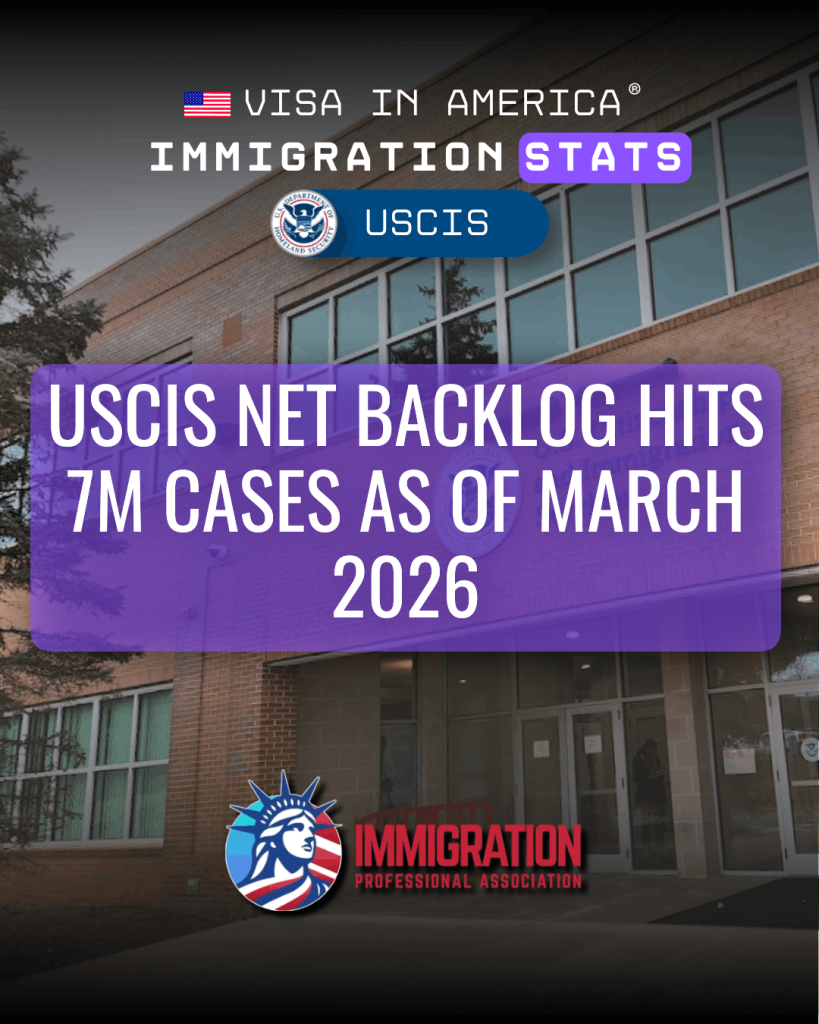
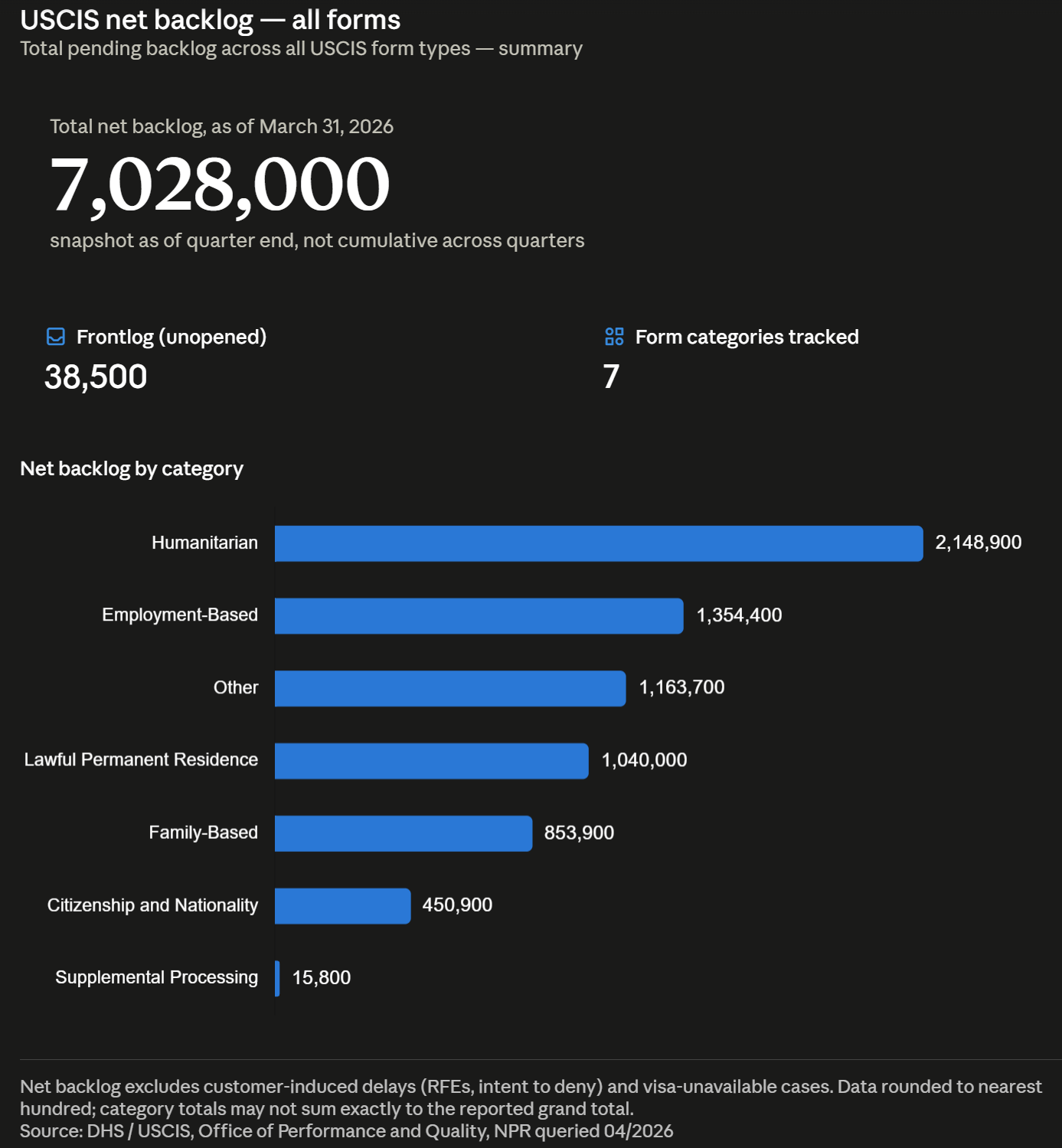
The U.S. Citizenship and Immigration Services reported a net backlog of approximately 7,028,000 cases as of March 31, 2026, according to the agency’s Fiscal Year 2026 Second Quarter backlog and frontlog data. Released by USCIS’s Office of Performance and Quality, the report provides a form-by-form breakdown of pending applications across every major immigration benefit category — from family petitions and employment authorizations to asylum claims and naturalization. For millions of applicants and the employers, families, and legal professionals supporting them, the USCIS case backlog remains one of the most consequential factors shaping immigration timelines in the United States today.
Background
USCIS tracks two related but distinct metrics: gross backlog and net backlog. The gross backlog counts all cases pending beyond the agency’s acceptable processing benchmarks that remain within government control. The net backlog refines that number further by subtracting cases delayed due to applicant-side factors — such as pending Requests for Evidence or cases placed on hold because a visa number is not yet available. The figure released in this report, roughly 7.03 million cases, reflects the net backlog: the portion of the delay that falls squarely on the agency’s processing capacity rather than on applicant responsiveness or congressional visa limits.
This reporting requirement was established under the Consolidated Appropriations Act of 2022, which directed USCIS to produce regular public backlog disclosures. The quarterly release has since become a key transparency benchmark for immigration stakeholders seeking to understand system-wide processing pressure.
What the Data Shows
The 7-million-case net backlog as of March 31, 2026, spans virtually every corner of the immigration system, with several categories carrying particularly high volumes. Asylum applications filed with USCIS on an affirmative basis account for approximately 1,328,400 pending cases — the single largest line item in the report. This figure covers only affirmatively filed I-589 applications and does not include the far larger universe of defensive asylum claims pending before the Executive Office for Immigration Review in immigration courts.
Employment Authorization Documents represent another enormous concentration of backlog. The “All Other” I-765 category alone carries approximately 735,900 pending cases, while EAD applications tied to Adjustment of Status filings account for an additional 414,000. Together, work authorization delays affect not just applicants themselves but the U.S. employers who depend on their legal ability to work.
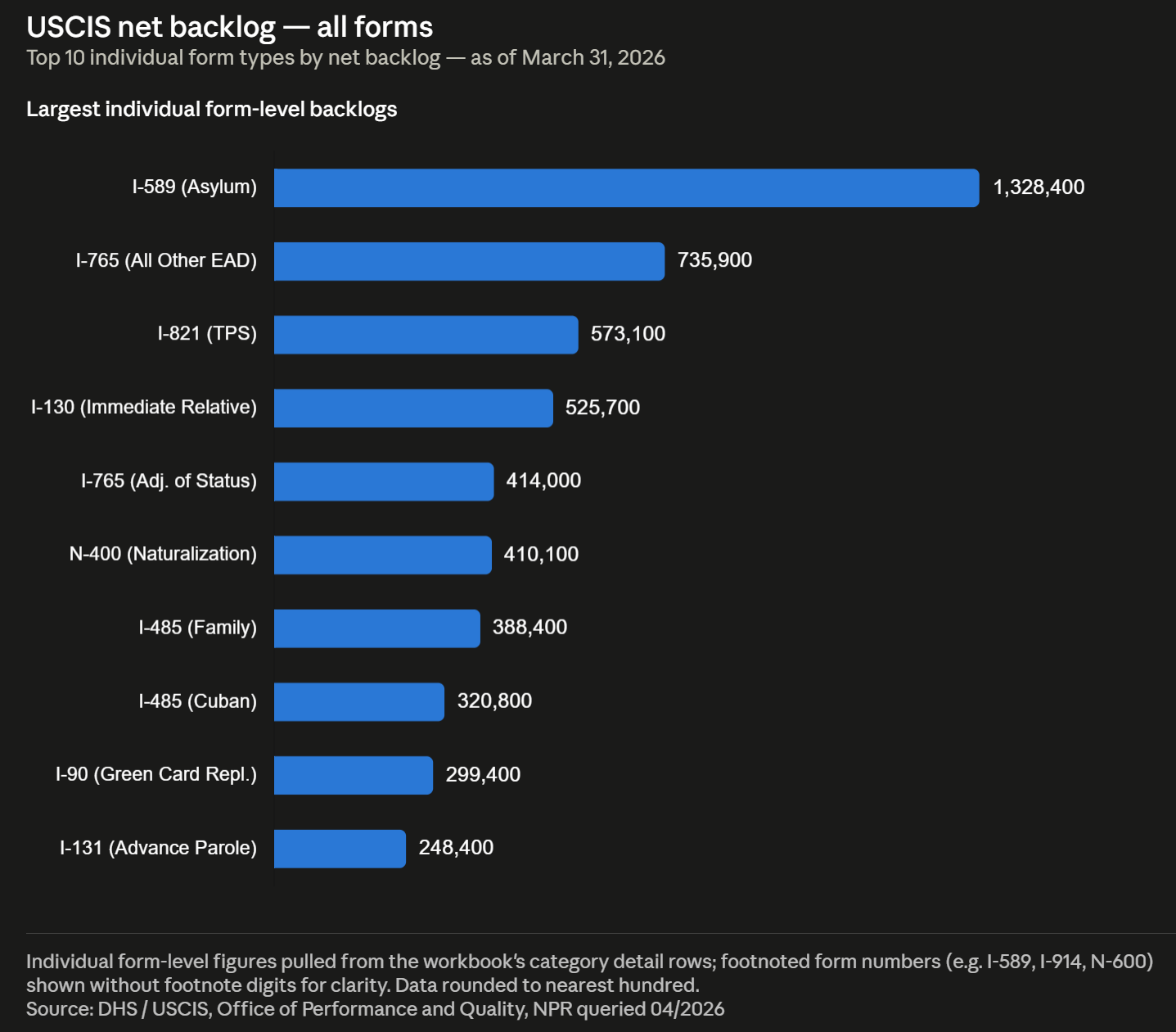
Temporary Protected Status applications stand at approximately 573,100 pending. Immediate relative I-130 petitions total roughly 525,700, and naturalization applications (non-military) sit at approximately 410,100. The Advance Parole category under I-131 shows around 248,400 pending, and general travel document applications carry an additional 93,900. Pending I-485 adjustment of status applications total in the hundreds of thousands across all subcategories, with Cuban adjustment cases representing the largest single I-485 line at approximately 320,800, followed by family-based adjustment at 388,400.
Notably, several categories show zero net backlog as of this reporting period, including Gold Card immigrant petitions (I-140G), DACA-based employment authorization, and certain investor program forms. The I-800 Convention adoptee classification also shows a zero net backlog.
Who Is Affected
The breadth of this backlog data means that nearly every segment of the immigrant and nonimmigrant population faces some level of USCIS processing delay. Family-based petitioners — including U.S. citizens sponsoring spouses or children and lawful permanent residents sponsoring preference relatives — are waiting on over half a million I-130 petitions. Conditional residents seeking to remove conditions through the I-751 process face a backlog exceeding 218,000 cases.
Employment-based applicants and their sponsoring employers encounter delay across multiple form types simultaneously: the I-129 for nonimmigrant workers, the I-140 for immigrant worker petitions, and the I-485 for adjustment of status, along with associated EAD and advance parole applications. For workers in H-1B status or other time-limited categories, these compounding delays carry real legal risk if their underlying status lapses before downstream applications are adjudicated.
Humanitarian applicants — including asylum seekers, TPS holders, T visa applicants, and U visa petitioners — face some of the steepest individual backlogs in the report. The U nonimmigrant (I-918) category shows approximately 126,200 pending petitions, and T nonimmigrant status applications carry roughly 81,100 cases. Investors pursuing EB-5 through regional centers (I-526E) face approximately 7,300 pending cases, while the legacy direct EB-5 program remains largely wound down with only 200 pending petitions.
The report is less directly relevant to applicants whose cases are currently delayed for applicant-side reasons, since those cases are excluded from the net backlog figure by definition. However, once those RFE responses or missing documents are submitted, those cases flow back into the net backlog pool.
Practical Implications
For applicants, this data reinforces the importance of filing as early as legally permissible and ensuring submissions are complete and well-documented from the outset. Any applicant-side delay — an incomplete filing, a slow RFE response, missing biometrics — adds to the timeline on top of an already substantial agency-side queue.
For employers managing sponsored workers, the persistence of EAD backlogs in the 400,000-to-735,000 range across subcategories means that H-4 EAD holders, adjustment-of-status applicants, and other work-authorized populations may experience gaps in employment authorization even where their underlying legal status remains intact. Employers should factor in extended lead times when onboarding foreign national employees who are mid-process, and should work with counsel to evaluate whether premium processing is available for any applicable form types.
For naturalization applicants, approximately 410,100 cases are pending beyond acceptable benchmarks. Given that naturalization confers the right to vote, access to certain federal benefits, and freedom from future immigration enforcement, the practical stakes of a year-plus wait are significant for the individuals affected.
The data does not include information on average processing times by form type or by field office, and it does not break down how long individual cases within the backlog have been pending. Applicants seeking to understand where their specific case stands within the queue should consult USCIS processing time tools directly or work with an immigration attorney who can evaluate case-specific circumstances.
What to Watch For Next
USCIS publishes net backlog and frontlog data on a quarterly basis in response to the statutory disclosure requirement. The next release covering Fiscal Year 2026, Quarter 3 is expected to reflect data through June 30, 2026, and will offer the clearest comparable picture of whether system-wide backlog is increasing, decreasing, or holding steady. Stakeholders tracking specific categories — particularly TPS, asylum, and EAD processing — should monitor those releases as well as any USCIS staffing, policy, or fee rule changes that might affect processing capacity. Further agency guidance on processing prioritization for high-volume categories is anticipated, though no specific announcements have been made at this time.
How Immigration Professional Association Can Help
Managing an immigration case through a system with 7 million pending applications requires more than patience — it requires strategy. At Immigration Professional Association, we work regularly with individuals, families, and employers who are navigating the realities of extended USCIS processing timelines across exactly the form types that appear in this report: I-130 family petitions, I-485 adjustment applications, employment authorization documents, naturalization cases, and employment-based immigrant petitions.
We understand how compounding delays across linked applications — an I-140 waiting while an I-485 sits, or an EAD pending while work authorization is about to lapse — can create real urgency for real people. Our team helps clients assess where they stand in the process, identify whether premium processing or other mechanisms might accelerate specific filings, and build complete, well-prepared applications that reduce the risk of RFE-based delays that can push a case even further back in the queue.
If you are currently waiting on a pending USCIS application or expecting to file soon and want to understand how current backlog conditions may affect your timeline, we encourage you to reach out to Immigration Professional Association. This is precisely the kind of planning conversation our team is equipped to have — grounded in current data, tailored to your situation, and focused on moving your case forward as efficiently as the system allows.