Introduction
A newly released USCIS data report covering fiscal year 2026 through the second quarter reveals that the T visa backlog has surpassed 107,000 pending applications — a figure that would have been unimaginable just a few years ago. As of the end of March 2026, USCIS reported 106,957 total pending I-914 applications across both principal applicants (T-1 visa holders who are direct survivors of severe forms of trafficking) and their qualifying family members. The T visa backlog has grown at a pace that now fundamentally reshapes what applicants and their advocates should expect from this humanitarian protection process.
Background
The T Visa and What It Was Designed to Do
Congress created the T nonimmigrant visa through the Trafficking Victims Protection Act of 2000 to provide legal protection and immigration relief to survivors of severe forms of human trafficking who cooperate with law enforcement. The T-1 classification covers the primary victim, while derivative T-2 through T-6 classifications cover eligible family members depending on the victim’s age. The program has always operated within a statutory annual cap of 5,000 T-1 visas, though that ceiling has never historically been reached in practice.
For most of its existence, the T visa program processed a modest volume of applications each year. Annual receipts stayed in the low thousands through 2022, and pending case counts — while sometimes elevated — remained broadly manageable. That baseline no longer applies.
What the Data Shows
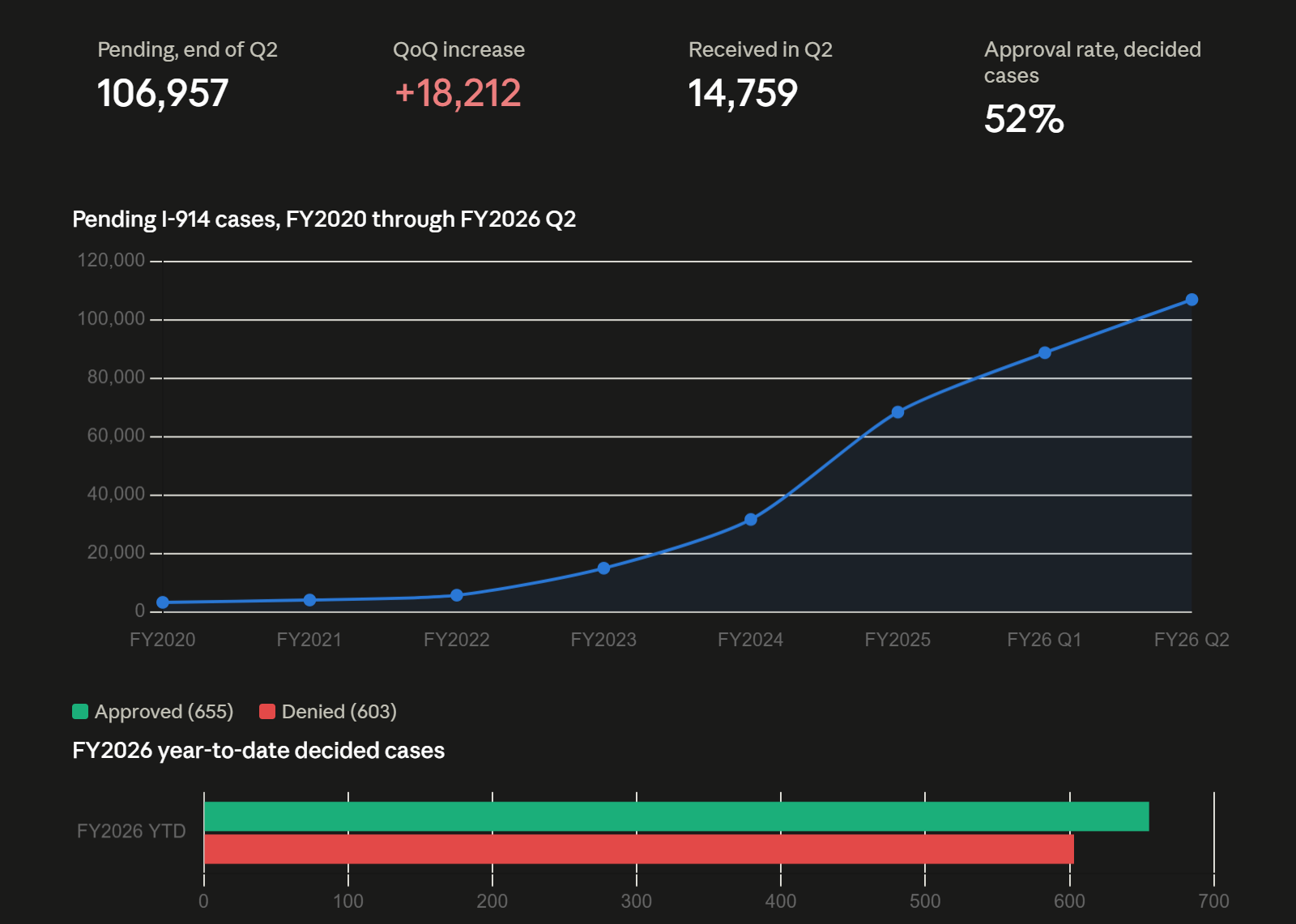
A Backlog Built Over Three Years of Accelerating Demand
The USCIS quarterly data table tells a clear story of accelerating intake against a backdrop of relatively flat adjudication. In fiscal year 2022, the agency received approximately 4,935 total applications and approved about 3,034. By fiscal year 2023, receipts surged to roughly 13,574 while approvals reached only 3,676. Fiscal year 2024 saw nearly 23,754 applications received against 6,178 approvals — and the pending total nearly doubled to 31,648 by year end.
Fiscal year 2025 marked the inflection point. USCIS received approximately 55,924 total applications in a single year while approving only 2,945 and denying 3,500. The pending queue closed fiscal year 2025 at 68,410. In just the first two quarters of fiscal year 2026 — covering October 2025 through March 2026 — the agency received an additional 25,907 applications while approving only 655 total. The pending count rose from 68,410 at the close of fiscal year 2025 to 88,745 at the end of Q1 and then to 106,957 at the end of Q2.
Approvals in Q2 of fiscal year 2026 totaled just 340 for the combined principal and family member categories. Denials in the same period numbered 311. The gap between incoming applications and decisions rendered is not narrowing — it is widening.
Who Is Affected
Survivors, Families, and the Organizations That Serve Them
The most directly affected individuals are survivors of severe forms of human trafficking who have filed or are preparing to file Form I-914. Many are living in legal limbo — potentially eligible for work authorization and protection from removal while their cases pend, but facing an administrative queue that now stretches into the hundreds of thousands. Family members who have filed derivative applications share this burden, with their own pending count reaching 35,817 by the close of Q2 fiscal year 2026.
Nonprofit organizations, victim advocates, social service agencies, and legal aid providers who assist trafficking survivors are indirectly but significantly affected. Their clients’ wait times determine how long those clients remain vulnerable and under-resourced. Immigration attorneys handling these cases — including those at law firms — must also recalibrate their counseling around realistic processing timelines rather than historical benchmarks.
Employers who have extended bona fide job offers to T visa holders awaiting adjudication may face extended uncertainty around work authorization documentation. USCIS does provide bona fide determination notices in some circumstances that can support interim benefits, but that process itself operates under its own processing pressures.
Practical Implications
What Applicants and Advocates Should Understand Now
The first and most important implication of this data is that anyone filing a new I-914 today is entering a queue that did not meaningfully resolve even its earliest recent additions in a timely manner. Based on current approval rates and pending volumes, applicants should plan for multi-year processing timelines unless USCIS undertakes a significant operational shift. Attorneys counseling clients on this program should not rely on historical processing estimates in setting expectations.
Second, interim protections matter more now than they ever have. USCIS has the authority to issue bona fide determination letters that can trigger eligibility for certain benefits — including employment authorization and access to refugee assistance programs — while the full adjudication remains pending. Ensuring that an I-914 is as complete and well-documented as possible from the outset is critical to receiving a bona fide determination without unnecessary delays or requests for evidence.
Third, the denial rate, while lower in absolute terms than the approval rate, has been rising. In fiscal year 2025, denials for principal applicants reached 2,362 — more than six times the number of approvals that year. Preparing a thorough, well-supported application has never been more consequential, because a denial in this environment can mean years of waiting for an outcome that could have been avoided with stronger initial documentation.
Finally, applicants and attorneys should understand what the pending numbers do and do not reflect. USCIS notes that administrative closures and transfers between offices are not captured in the pending count, meaning the operational picture is complex and the pending figure is an estimate rather than a precise queue position.
What to Watch For Next
Fiscal year 2026 Q3 and Q4 data — covering April through September 2026 — will be the next meaningful indicators of whether USCIS is making any progress in reducing the backlog or whether the gap between receipts and decisions continues to widen. Stakeholders should also monitor any USCIS announcements regarding dedicated T visa adjudication staffing, processing policy updates, or changes to the bona fide determination review process. No official USCIS statement regarding a remediation plan for the current backlog is reflected in the data release, and a specific administrative response has not yet been announced.
How Immigration Professional Association Can Help
At Immigration Professional Association, our team works directly with trafficking survivors, their families, and the legal and social service professionals who support them. We understand both the formal requirements of the I-914 process and the human stakes involved in getting it right. In an environment where a poorly prepared application can mean years of additional waiting — or a denial that should never have happened — the quality of the initial filing matters enormously.
We can help survivors and their advocates assess eligibility, build comprehensive case packages designed to support bona fide determinations, and navigate interim benefit processes while the primary application is pending. We also work with organizations and employers who encounter T visa holders in the course of their work and need guidance on what protections and documentation apply.
If you or someone you are working with has a pending or planned I-914 application and wants to understand what the current backlog means for your specific situation, we encourage you to reach out to Immigration Professional Association. This is exactly the kind of moment where informed legal guidance makes a measurable difference.