Introduction
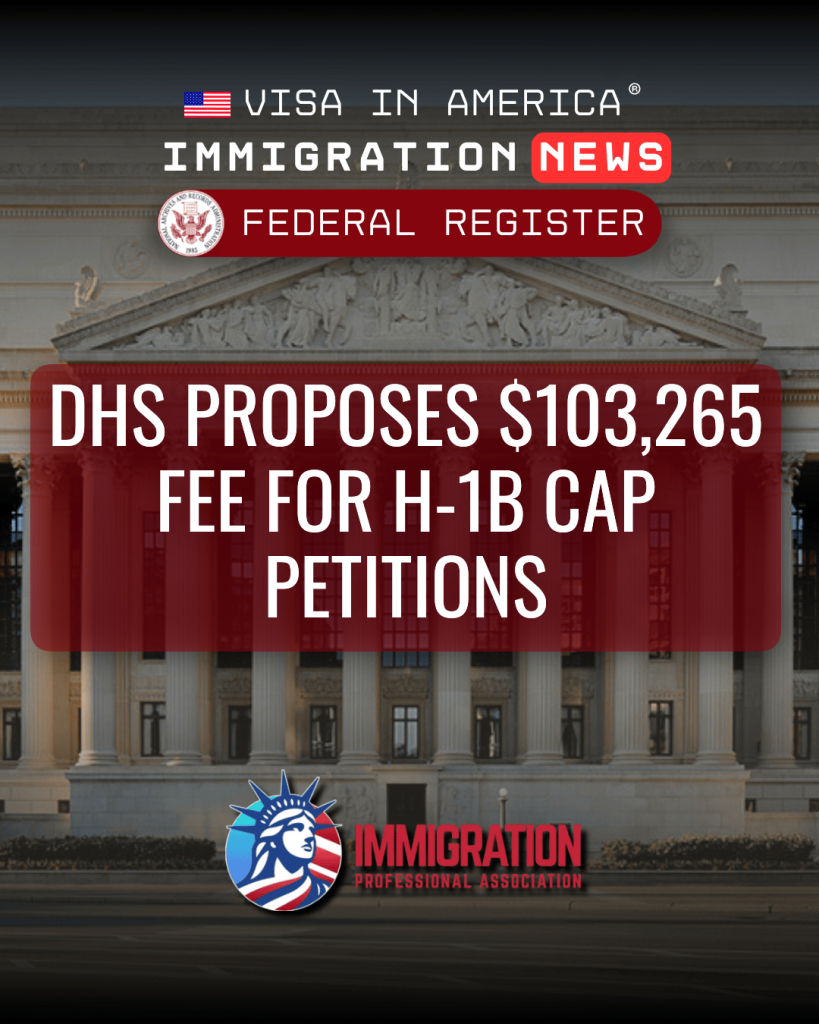
The Department of Homeland Security has proposed a $103,265 fee on every H-1B cap-subject petition. Petitioners file these petitions with U.S. Citizenship and Immigration Services. DHS published the proposal as a notice of proposed rulemaking in the Federal Register on August 24, 2026. The proposal would add this fee on top of all other currently required filing fees. That includes the base Form I-129 petition fee, statutory fees, and any separate payment requirements imposed by presidential proclamation. If finalized, this proposed H-1B cap fee would be the largest single fee addition in the history of the employment-based immigration system. That is true even before accounting for other required costs. Projected annual revenue would exceed $8.7 billion, flowing to six federal agencies.
Background
How the H-1B Program and Its Fee Structure Work Today
The H-1B program allows U.S. employers to hire foreign workers for a limited time in specialty occupations. These are roles requiring at least a bachelor’s degree or equivalent in a specific field. Congress caps initial H-1B admissions at 65,000 per fiscal year. An additional 20,000 slots are reserved for beneficiaries holding a qualifying U.S. master’s degree or higher. Because demand routinely overwhelms supply, USCIS conducts an annual lottery among registered petitioners to allocate available slots.
USCIS operates primarily on fee revenue. Fees charged to applicants and petitioners replenish the agency’s Immigration Examinations Fee Account. That account provides roughly 95 percent of the agency’s total funding. Congress established this model in 1988 and expanded it in 1990. It directed that fees fund the full cost of providing immigration adjudication and naturalization services. That includes services provided at no charge to asylum applicants and other immigrants.
Until now, fee calculations under this framework have focused on USCIS’s own operating costs. DHS has acknowledged that other agencies incur substantial expenses related to the lawful immigration system. These include ICE, CBP, the State Department, the Justice Department’s immigration courts, and the Department of Labor. Prior fee rules, however, have not directly recovered those costs through H-1B petition fees.
What Is Changing
The Proposed Fee and Its Rationale
DHS is proposing to add a standalone $103,265 fee applicable only to H-1B cap-subject petitions. These are the petitions subject to the annual lottery. This includes petitions eligible for the advanced degree exemption. The fee would not apply to cap-exempt petitions. These generally cover positions at nonprofit research organizations, government research organizations, and institutions of higher education.
The agency arrived at $103,265 by dividing the total identified annual costs across six federal agencies by the projected annual filing volume. Those costs total approximately $8.78 billion, and the projected volume is 85,000 cap-subject petitions. DHS is proposing to structure this as a separate regulatory line item at 8 CFR 106.2(a)(3)(xii). It would not fold the fee into existing fee categories. This is partly to facilitate tracking and allocation of the revenue.
DHS would distribute the proposed revenue across six agencies according to a cost-sharing framework. USCIS would retain approximately 34.2 percent ($3.0 billion). This addresses projected shortfalls in its operating budget and a transfer of costs previously funded by the premium processing account. EOIR — the immigration court system — would receive approximately 33.7 percent ($2.96 billion). This would fund 8,400 new positions and expanded court operations. DOL would receive 13.8 percent ($1.21 billion) and ICE 11.9 percent ($1.05 billion). The State Department would receive 5.5 percent ($484 million), and CBP 0.9 percent ($76.2 million).
DHS cites the ability-to-pay principle as a central justification for concentrating this burden on H-1B cap-subject petitioners. Employers who file these petitions must already pay workers the prevailing wage. According to USCIS data cited in the rule, that wage had a median annual value of $133,000 in FY 2025. The agency reasons that such employers can absorb an additional fee more easily than many other immigration benefit requestors.
Who Is Affected
Petitioners, Employers, and the Cap-Exempt Distinction
The proposed fee falls directly on U.S. employers filing H-1B cap-subject petitions on behalf of foreign national workers. This includes companies of all sizes. The rule explicitly states that the fee would apply to small entities as well as large ones. DHS is not proposing any exemption or discount for small businesses.
DHS’s own regulatory flexibility analysis found that 28,649 unique entities filed cap-subject H-1B petitions in FY 2025. Roughly 51 percent of them qualified as small businesses under SBA standards. Of those small entities, 76 percent would see a cost impact of over one percent of their annual revenue. DHS treats that threshold as significant for regulatory flexibility purposes. The agency estimates that finalizing the rule as proposed would significantly affect 11,051 small entities economically.
This proposal does not affect cap-exempt petitioners. Employers at nonprofit research organizations, government research organizations, and institutions of higher education file under the cap-exempt pathway. They would not owe the $103,265 fee. The rule also excludes H-1B extensions, amendments, and other petitions that are not cap-subject.
The fee would be payable at the time of filing the petition, not at registration. It would be in addition to all other applicable fees. If a separate proclamation-based payment obligation is in effect when an employer files a petition, the employer would owe both amounts at once.
Practical Implications
The New Cost Calculus for Sponsoring Employers
For employers that regularly sponsor H-1B workers, this proposal would fundamentally change the cost calculus of cap-subject petitions. This rule, if completed, would require employers to make a single payment of over $103,000 for a cap-subject H-1B petition. That figure excludes legal fees, LCA preparation, and the existing USCIS filing fee schedule. Employers that currently sponsor multiple H-1B workers each cap season would face aggregate fee obligations that could reach seven figures.
The rule remains in the proposed stage — it does not yet bind employers. USCIS must complete the public comment process, review submissions, and publish a final rule before the fee takes effect. DHS has not announced the timeline for completion. The final fee amount could also change based on comments DHS receives or revisions it makes to the cost calculations. DHS explicitly notes that it may adjust figures if concurrent rulemakings affect filing volumes or cost projections. These include a proposed DOL prevailing wage increase and the CBP biometric entry-exit fee.
Strategic timing considerations are already relevant. Registrations for the FY 2028 cap lottery would open in early 2027. Employers evaluating whether to participate should monitor whether DHS has finalized this rule and what the final fee amount will be. Petitioners who currently use premium processing should also take note. DHS is proposing to shift $1.2 billion in costs currently funded by the premium processing account to non-premium fee revenue — a structural change that could affect premium processing availability and pricing in future rulemakings.
One significant open question involves how this proposed fee interacts with a separate payment. Presidential Proclamation 10973 imposed that separate $100,000 payment. A federal district court in Massachusetts vacated that payment in June 2026. The government’s appeal remains pending before the First Circuit. DHS notes that if [it/the government] reinstates the proclamation payment and completes this rule, employers would owe both amounts. Total additional payments could then exceed $200,000 per cap-subject petition. DHS bases the two requirements on different legal authorities and tracks them separately.
Employers and HR professionals should also recognize that DHS projects filing volume will remain at approximately 85,000 cap-subject petitions per year even with the fee in place. DHS cites economic analysis suggesting demand would remain inelastic at this price level. However, the agency acknowledges that actual filings could fall short of projections, particularly among smaller employers who may choose not to use the cap-subject pathway.
What to Watch For Next
The public comment period for this proposed rule closes on September 24, 2026. Commenters must submit comments in English through the Federal eRulemaking Portal under DHS Docket No. USCIS-2026-0298. Stakeholders who wish to influence the final rule — including employers, industry associations, immigration attorneys, and advocacy organizations — should monitor the docket and consider submitting substantive comments referencing specific provisions and supported by data or legal authority.
DHS has not announced a specific effective date for any final rule. The agency has indicated it will incorporate revisions to cost allocations and fee amounts as necessary to account for the effects of related rulemakings, including the DOL prevailing wage proposal and any changes arising from the H.R.1 reconciliation legislation fee provisions. It also expects to develop further guidance on interagency reimbursement agreements — governing how collected revenue will flow from USCIS to ICE, EOIR, DOS, DOL, and CBP — before any final rule takes effect.
How Immigration Professional Association Can Help
This proposed rule would represent a sea change in the cost structure of H-1B sponsorship, and for employers making workforce planning decisions today, the uncertainty around its finalization is itself a business issue. Immigration Professional Association works directly with employers navigating H-1B cap strategy — from registration and lottery preparation through petition filing, compliance, and long-term workforce planning.
If your organization currently sponsors H-1B workers or is considering doing so, now is the time to evaluate how a $103,265-per-petition fee would affect your hiring model, your budget cycles, and your approach to cap-exempt alternatives. Our team can walk through what the proposed changes would mean for your specific situation, identify cap-exempt options where applicable, and help you understand how related proposed changes — including the DOL prevailing wage proposal — interact with this rulemaking.
For employers who want to participate in the public comment process, we can help you understand how to submit substantive, docket-compliant comments that accurately reflect the impact on your workforce and business.
Contact Immigration Professional Association to discuss how this proposed rulemaking affects your H-1B sponsorship strategy and what steps make sense to take now, before DHS publishes a final rule.