Introduction
USCIS released updated employment-based green card inventory data in July 2026. It reflects pending I-485 adjustment of status applications as of June 6, 2026. The data is drawn from USCIS’s internal case management systems and published by the agency’s Chief Data and Analytics Office. It reveals that the China EB-1 backlog now extends into priority dates from 2023 — a development that marks a meaningful shift for one of the most competitive immigrant visa categories. For Chinese nationals pursuing employment-based permanent residence, the June 2026 USCIS inventory data confirms what many practitioners have observed anecdotally. Even the first preference category, historically reserved for the most accomplished foreign nationals, is no longer immune to significant wait times for China-born applicants.
How Employment-Based Backlogs Form
Employment-based green cards are subject to per-country annual limits under U.S. immigration law. No single country may use more than seven percent of the total employment-based immigrant visas issued in a fiscal year, regardless of how many applicants qualify for a given preference category. For high-demand countries like China and India, this cap creates backlogs unrelated to the merits of individual petitions. Backlogs instead reflect only the volume of applicants sharing the same country of birth.
The first preference category, EB-1, covers priority workers. This includes individuals with extraordinary ability, outstanding professors and researchers, and multinational executives and managers. EB-1 petitions do not require labor certification, the most time-consuming step in the employment-based process. Because of this, the category has historically moved faster than EB-2 or EB-3. For most countries, EB-1 remains current. For China-born nationals, that has not been true for several years. The June 2026 data shows the backlog continuing to deepen.
USCIS began publishing regular inventory snapshots of pending I-485 applications. The goal was to give applicants, employers, and practitioners a clearer picture of where the queue stands. The data released in July 2026 was queried against the Visa Bulletin dates in effect for June 2026. It is the most current public view available of the adjustment backlog by preference category and priority date year.
A Backlog That Now Reaches 2023 for China EB-1
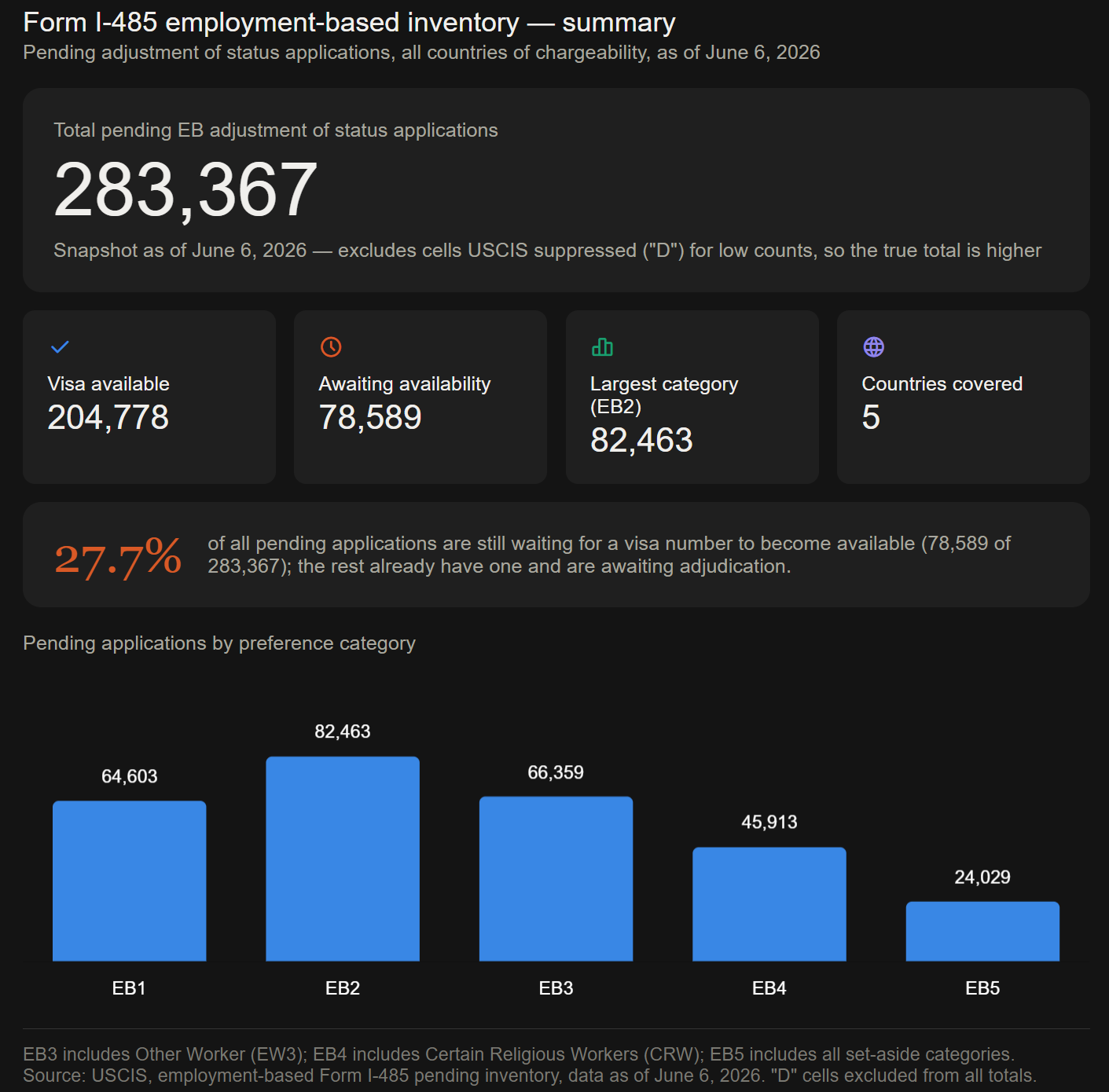
The most significant finding in the June 2026 inventory is the distribution of China EB-1 applications with “Available” visa status. Cases with priority dates throughout calendar year 2022 appear across the data. Application counts run into the dozens per month. Priority dates from 2023 show the largest concentrations, with hundreds of pending cases per month. This is especially true in the first half of 2023, with figures reaching into the 500s and 700s for some months. Cases from 2024 onward carry zero “Available” counts. This means those applicants are not yet within reach of an immigrant visa number under the current Visa Bulletin.
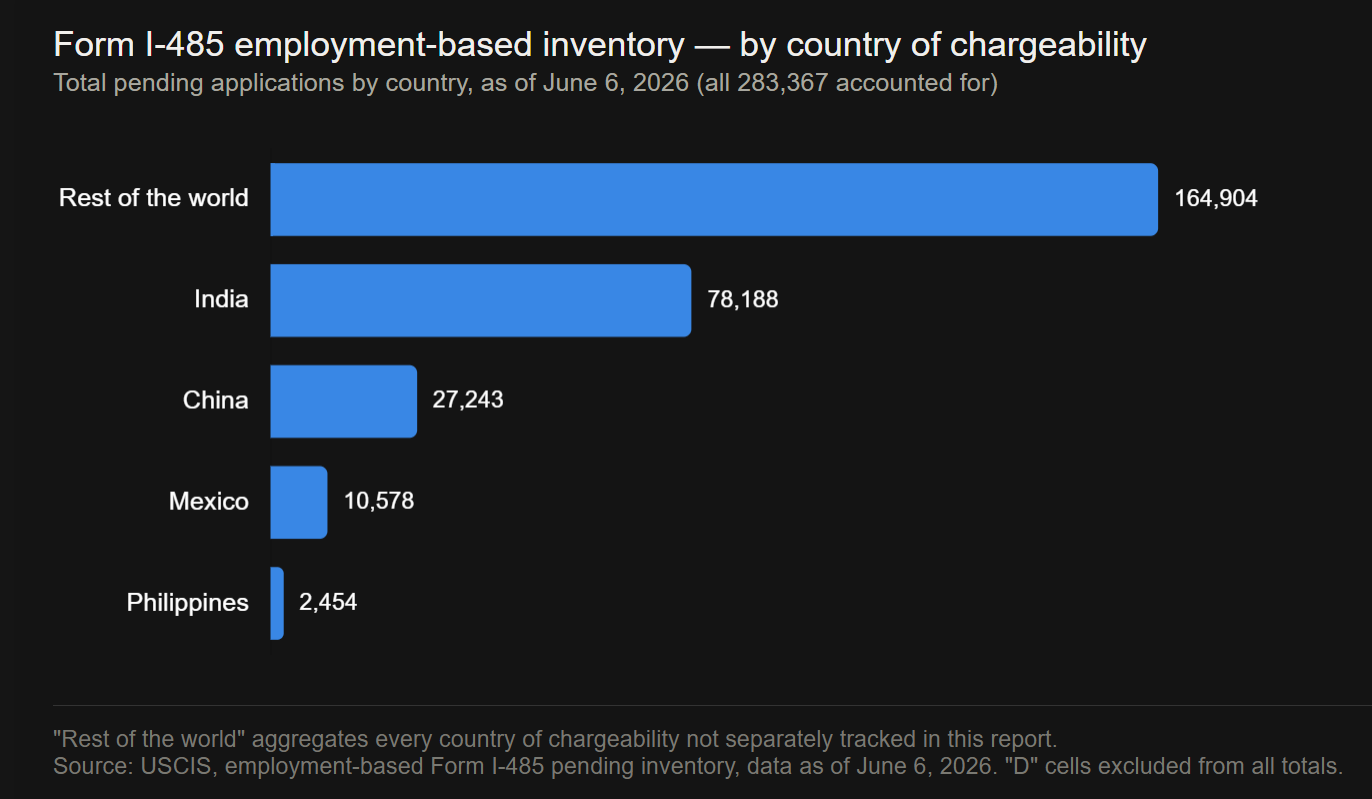
The data also shows a substantial “Awaiting Availability” category for China EB-1. Cases bearing 2023 priority dates — specifically from June through November 2023 — sit in a holding status, meaning a visa number is not yet available even though applicants have filed their I-485. Those month-by-month counts range from roughly 486 to 667 applications. Cases from years prior to 2022 appear in smaller numbers across most months. Many are suppressed by USCIS’s disclosure threshold (marked “D” in the data), indicating counts below the agency’s minimum reporting threshold.
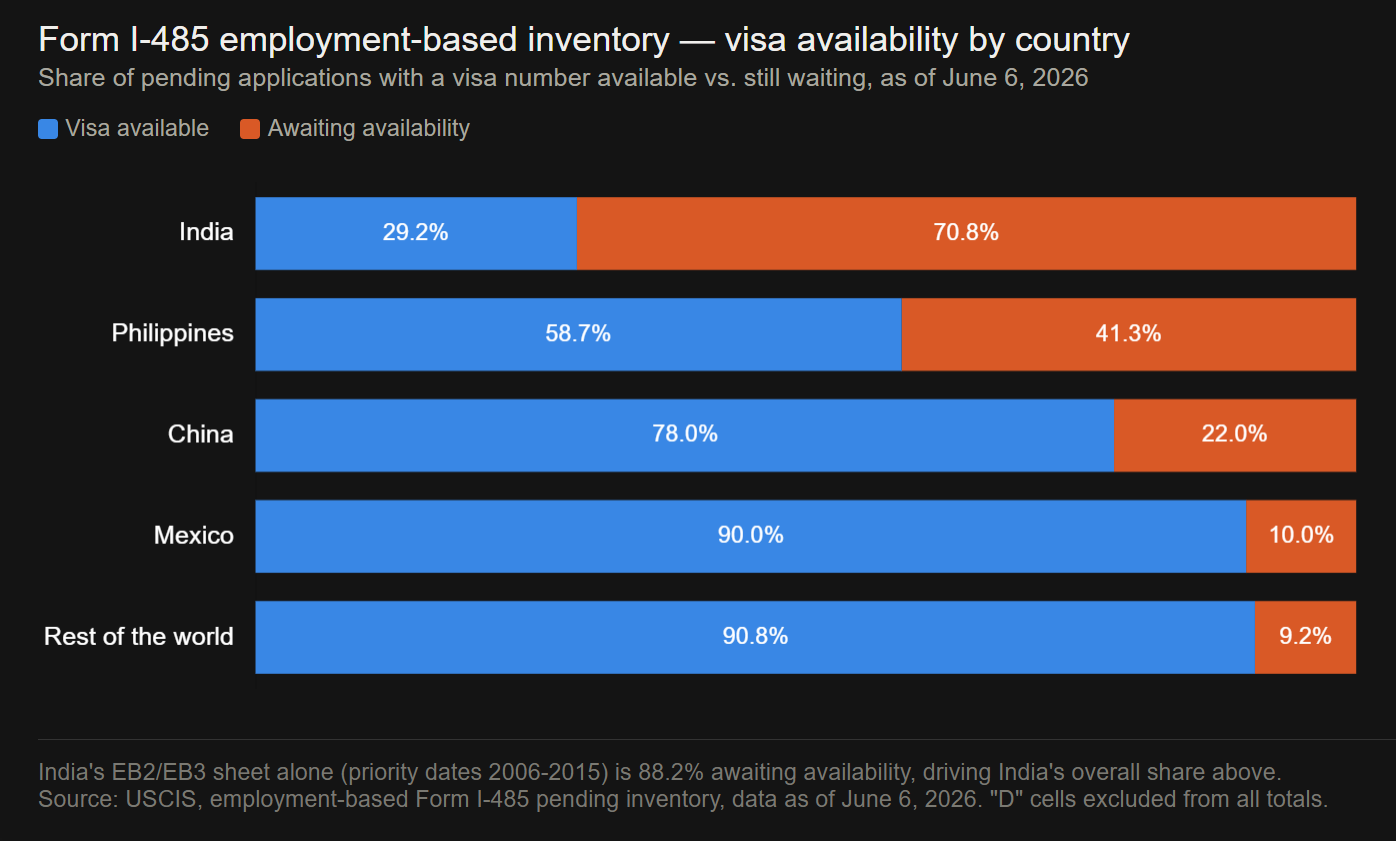
For China EB-2, the data shows available cases concentrated in 2021 and 2022, with substantial pending volumes. Many individual months show over 100 applications with available status in 2022, and several months in the 2021 column carry counts in the 50s to 193 range. The EB-2 “Awaiting Availability” entries appear for the final months of 2022, with counts ranging from roughly 296 to 581. For China EB-3, 2021 and 2022 priority dates similarly account for most of the available caseload. 2022 shows the densest concentration.
For the EB-5 investor categories, the picture is notably different by subcategory. The reserved set-asides — rural (20%), high unemployment (10%), and infrastructure (2%) — show pending applications across a much more recent range of priority dates. These include 2024, 2025, and even some 2026 filings. Priority dates from prior years concentrate almost entirely in the unreserved EB-5 pool for China. The prior-years column alone shows over 1,100 applications in September.
Chinese Nationals Across Multiple Preference Categories
The most directly affected individuals are Chinese nationals. This includes those who have filed or are preparing to file I-485 applications in the EB-1, EB-2, or EB-3 categories. The data confirms that EB-1 applicants with China as their country of chargeability and priority dates in 2023 are now in the queue but not yet current. Those from 2024 onward have no available visa numbers under current Visa Bulletin dates. This matters especially for those who assumed an approved EB-1 petition would translate quickly into permanent residence.
Employers who have sponsored employees from China under the EB-2 or EB-3 categories face extended periods of uncertainty. Sponsored workers must maintain valid nonimmigrant status — often H-1B — while their I-485 applications remain pending or their priority dates remain unavailable. Human resources and global mobility teams at companies with China-born talent should account for this. This matters when planning visa renewals, international travel, and workforce continuity.
EB-5 investors from China face a split picture depending on which subcategory they entered. Investors in the reserved set-asides appear to have meaningfully shorter queues than those in the unreserved pool. This is particularly true for the rural and high-unemployment categories introduced under the EB-5 Reform and Integrity Act of 2022. Investors in the unreserved category, by contrast, face a backlog stretching back many years.
These per-country backlogs generally do not affect individuals born outside China, including those with professional connections to China. This dataset does not include them.
Planning Around a Deeper Queue
For China-born professionals with EB-1 priority dates in 2023, the June 2026 inventory data suggests they are approaching visa availability. They have not yet reached it. The concentration of “Awaiting Availability” cases in mid-to-late 2023 indicates that Visa Bulletin movement into those months is a near-term planning horizon. The pace of advancement, though, depends on annual visa usage patterns and fiscal year dynamics that the inventory data alone cannot predict.
Applicants with priority dates in 2022 who are in EB-1 and have not yet received final adjudication of their I-485 should take two steps. They should confirm their applications remain properly pending and that they have addressed any requests for evidence. The sizable volumes of 2022-dated cases still showing as available, rather than approved, suggest adjudication is ongoing for that cohort.
For EB-2 and EB-3 applicants with China chargeability and priority dates in 2021 or early 2022, the data shows meaningful pending volume. The tail of cases still working through the system suggests these applicants may soon face a period of increased adjudication activity if Visa Bulletin dates hold or advance. Applicants in this range should ensure their biometrics remain valid. They should also keep advance parole and employment authorization documents current, and properly report any address or employer changes.
One area where this data does not provide guidance is forward movement. How quickly the Visa Bulletin dates will advance is not determinable from the inventory snapshot. The data reflects current pending volume, not the rate of visa number allocation. Practitioners and applicants should continue monitoring the monthly Visa Bulletin published by the Department of State. Reviewing it alongside this inventory data gives a complete picture.
What to Watch For Next
USCIS expects to update this inventory data periodically. Stakeholders should monitor subsequent releases for shifts in the volume and distribution of pending applications, particularly whether the 2023 EB-1 “Awaiting Availability” cohort transitions into available status as Visa Bulletin dates move. The Department of State’s monthly Visa Bulletin will remain the controlling document for determining when a given priority date becomes current. Any retrogression or acceleration in the China EB-1 or EB-2 cutoff dates would directly affect the applicants visible in this inventory. USCIS will likely issue further guidance over the coming months. This could cover adjudication priorities or policy changes affecting adjustment of status processing, delivered through agency announcements.
How Immigration Professional Association Can Help
The June 2026 USCIS inventory data looks like numbers on a spreadsheet. It becomes meaningful only when someone translates it into a specific plan for a specific person. At Immigration Professional Association, we work regularly with Chinese nationals navigating multi-year employment-based backlogs. We help EB-1 petitioners understand where their priority dates stand relative to the pending queue, advise EB-2 and EB-3 applicants on maintaining valid status during extended wait periods, and counsel EB-5 investors on which set-aside categories may offer a more accessible path given their circumstances.
You may be a Chinese national with a pending or approved EB-1, EB-2, or EB-3 petition. Or you may be an employer managing sponsored employees whose green card timelines are affected by these backlogs. Either way, we invite you to reach out to Immigration Professional Association. Our team can review your priority date, your current visa status, and your filing history. This gives you a grounded, current assessment of where you stand, and what steps make sense right now given what the June 2026 data reveals.