Introduction to the VAWA I-360 Backlog
The VAWA I-360 backlog has reached a record high of 272,911 pending petitions. This is as of the end of the third quarter of Fiscal Year 2026, according to performance data published by U.S. Citizenship and Immigration Services. This figure represents the total number of Form I-360 petitions filed by VAWA self-petitioners. It includes abused spouses, children, and parents of U.S. citizens or lawful permanent residents who are awaiting a decision across all subcategories. The scale of this backlog has direct consequences for some of the most vulnerable individuals in the immigration system. Understanding the trajectory behind the VAWA I-360 backlog is essential for anyone currently navigating or planning a VAWA self-petition.
Background on VAWA Self-Petitions
The Violence Against Women Act authorizes certain noncitizen victims of abuse to petition for immigration relief independently. They can do so without the cooperation or knowledge of their abuser. This self-petition mechanism is filed on Form I-360. It covers three groups: spouses of abusive U.S. citizens or lawful permanent residents, children of abusive U.S. citizens or LPRs, and parents of abusive U.S. citizen sons or daughters. Approval of an I-360 does not itself grant status but is a gateway to applying for lawful permanent residence. Because petitioners file VAWA petitions confidentially and must establish abuse, the review process is inherently complex and resource-intensive.
Historically, pending caseloads remained relatively modest. Through most of the 2010s, total pending figures stayed below 25,000. That changed sharply starting around FY2021. A surge in new filings — particularly in the self-petitioning parent subcategory — began outpacing USCIS adjudicative capacity, setting the stage for the crisis-level backlog now reflected in the FY2026 data.
What the Data Shows About the VAWA I-360 Backlog
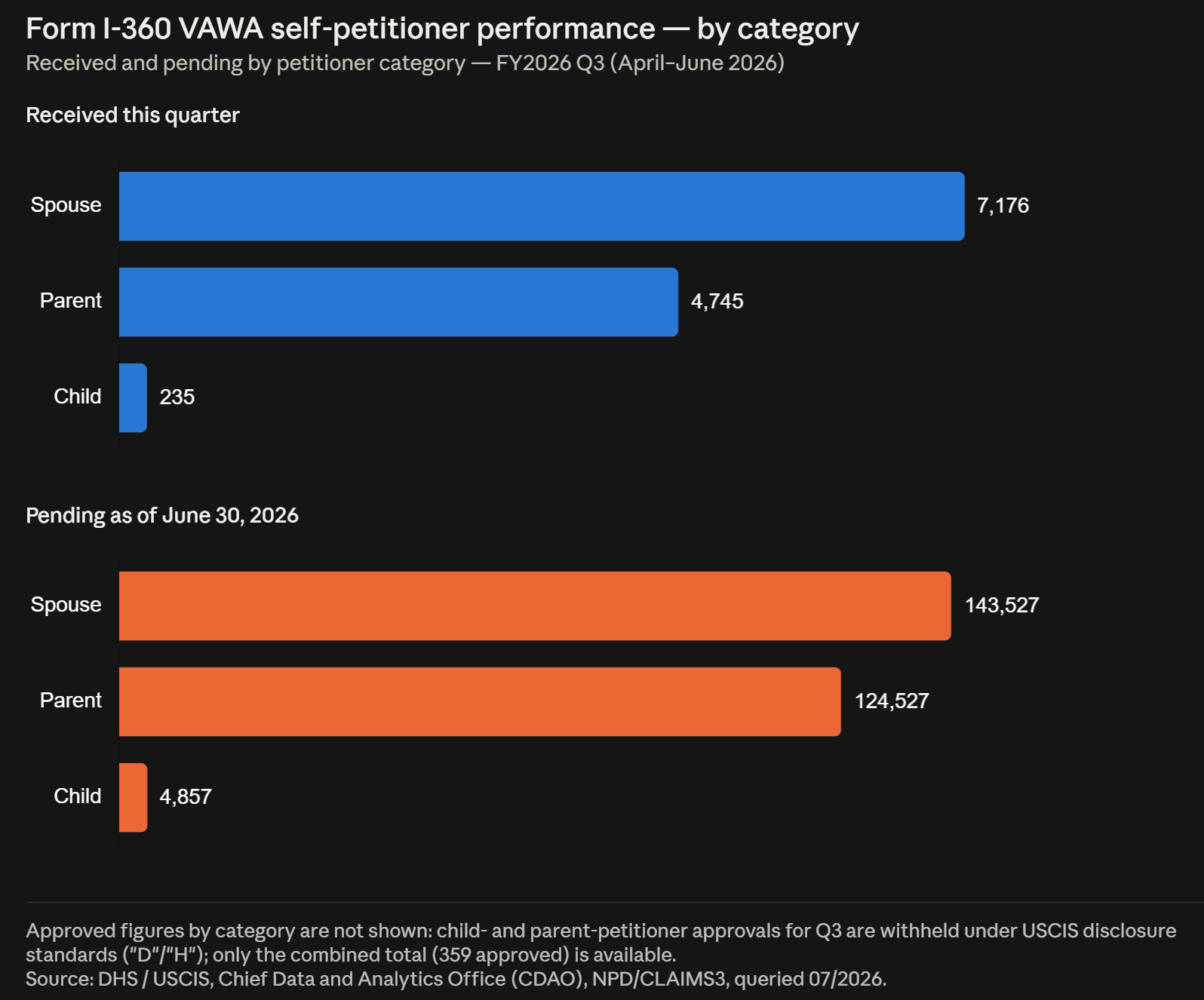
The USCIS performance data for FY2026 through the third quarter tells a consistent story. Approvals are falling far short of incoming volume. In Q3 alone — covering April through June — USCIS received 12,156 new petitions across all subcategories. It approved only 359 and denied 1,101. The quarter ended with a pending total of 272,911.

This growth trajectory is striking when viewed across fiscal years. Total pending counts stood at roughly 5,300 at the close of FY2010. By FY2023 it had crossed 104,000, and by the end of FY2025 it had reached approximately 194,500. The jump from that figure to over 272,000 in just three quarters of FY2026 reflects continued high intake. It also reflects an approval rate that remains dramatically low relative to demand.
The subcategory breakdown of the VAWA I-360 backlog reveals where the pressure concentrates most. Self-petitioning parents of U.S. citizen sons or daughters now account for the largest share of the backlog, at roughly 124,500 pending cases. This subcategory barely registered in USCIS data before FY2017. Abused spouses represent approximately 143,500 pending, while children account for just under 4,900. It is worth noting that some figures within the subcategory data are withheld under USCIS disclosure standards to prevent derivation of suppressed counts. Individual totals therefore require careful interpretation.
Who Is Affected by the Backlog
The most directly affected individuals are current I-360 VAWA self-petitioners in all three subcategories — abused spouses, abused children, and abused parents. They filed before the most recent quarters and are waiting for initial adjudication. Those who filed in FY2023 or earlier may be facing waits that now span multiple years before receiving any decision.
Extended pendency also significantly affects attorneys and accredited representatives handling VAWA cases. It complicates client counseling on timeline expectations and downstream steps like adjustment of status or deferred action requests. Domestic violence advocates and resettlement organizations refer clients to legal assistance. They will encounter longer periods of legal limbo for the individuals they serve.
On the employer and petitioner side, this update has no direct application. The individual, not an employer or sponsor, files VAWA self-petitions. However, employers with employees navigating personal immigration situations may find this useful. It helps explain why those employees face such prolonged status timelines.
Practical Implications of the VAWA I-360 Backlog
For a pending VAWA self-petitioner caught in the VAWA I-360 backlog, the data confirms that years, not months, now measure waiting times. A petition filed in FY2024 entered a queue that, as of mid-2026, still has not cleared. That queue includes FY2022 and FY2023 volumes at the current pace of adjudication. That means individuals who have not yet filed should not delay in the hope that the backlog will clear. Entering the queue sooner still matters, and each quarter of delay extends the wait further.
VAWA self-petitioners do not automatically receive employment authorization or lawful status upon filing. But an approved I-360 opens the door to deferred action, which can provide a measure of protection from removal and eligibility for certain benefits. The extended pendency makes it especially important that petitioners file petitions with complete, well-documented evidence from the outset. A request for evidence, or a denial requiring a motion to reopen, adds months or years to an already long timeline.
Some individuals with pending VAWA petitions have experienced changes in their circumstances — such as a change in their abuser’s immigration status, a relocation, or a life event affecting their children. They should ensure their records with USCIS reflect current information. The agency’s data shows that these pending counts do not fully capture some actions, such as administrative closures. Direct inquiry through counsel is advisable for anyone uncertain about the current status of their case.
USCIS has not yet released Q4 data for FY2026. This dataset also contains no official agency guidance regarding plans to increase VAWA adjudication staffing or processing initiatives. Absent a structural change in how the agency resources these petitions, the backlog trajectory does not suggest a near-term reduction.
What to Watch For Next in the VAWA I-360 Backlog
USCIS expects to publish Q4 FY2026 performance data after the fiscal year closes in September 2026. That release will clarify whether the pace of approvals changed in the final quarter. Stakeholders should also monitor USCIS announcements about dedicated VAWA processing initiatives, staffing allocations, or policy changes affecting the self-petition subcategories. This is particularly true for the parent subcategory, which has grown most rapidly. Advocacy organizations and congressional oversight bodies have taken interest in VAWA processing delays in prior years. Further legislative or administrative attention to this VAWA I-360 backlog may occur, though the current data release announces no specific action.
How Immigration Professional Association Can Help
At Immigration Professional Association, we work directly with VAWA self-petitioners and the advocates supporting them. We understand how much is at stake in getting these petitions right. The data USCIS has released confirms that the margin for error in a VAWA filing is narrower than ever. When approval numbers are this low relative to volume, a well-prepared, thoroughly documented petition is not a luxury; it is essential.
Our team has experience helping abused spouses, children, and parents build VAWA self-petitions. We address the evidentiary standards USCIS applies, including documentation of the qualifying relationship, evidence of the abuse, and proof of good moral character. Our team also assists clients in understanding what protective measures may be available while a petition is pending. Together we explain how an approved I-360 connects to the next steps toward lawful permanent residence.
If you or someone you know has an I-360 VAWA petition pending, or is considering filing one, we encourage you to speak with our team. We can discuss where things stand and what you can do to strengthen your position in a record-long backlog. Reach out to Immigration Professional Association to schedule a consultation specifically about your VAWA self-petition.