Introduction: I-140 Approvals Q3 FY2026
The latest I-140 approvals Q3 FY2026 data was released by USCIS. It covers Form I-140 employment-based immigrant petitions approved through the end of that reporting period. The dataset was published by USCIS’s Chief Data and Analytics Office. It shows 37,975 total I-140 approvals across all employment-based preference categories during Q3 FY2026. India led all countries with 13,923 approvals. That is more than three times the volume of the second-ranked country, China, and nearly 37 percent of the global total. For employers, attorneys, and foreign nationals navigating the I-140 process, these I-140 approval figures offer meaningful insight. They show where petitioning activity is concentrated, which preference categories are driving volume, and what the competitive landscape looks like for employment-based green card pathways.
Background on Form I-140
Form I-140, the Immigrant Petition for Alien Workers, is the foundational document in most employment-based permanent residence cases. An approved I-140 does not itself grant a green card. It establishes that a foreign national worker qualifies for a specific employment-based preference category, and that a U.S. employer or, in some cases, the worker themselves has met the applicable evidentiary standard. The final step — adjustment of status or consular processing — depends on visa number availability. The State Department’s monthly Visa Bulletin governs this availability, which the applicant’s country of birth partly determines.
USCIS reports I-140 approvals Q3 FY2026 and other quarters’ data by fiscal quarter. It breaks the data down by the beneficiary’s country of birth and the specific employment-based subcategory. The data reflects petitions USCIS approved in the reported quarter, which employers may have filed in earlier periods. Approval counts cover primary beneficiaries only and do not include dependent family members.
What the I-140 Approvals Q3 FY2026 Data Shows
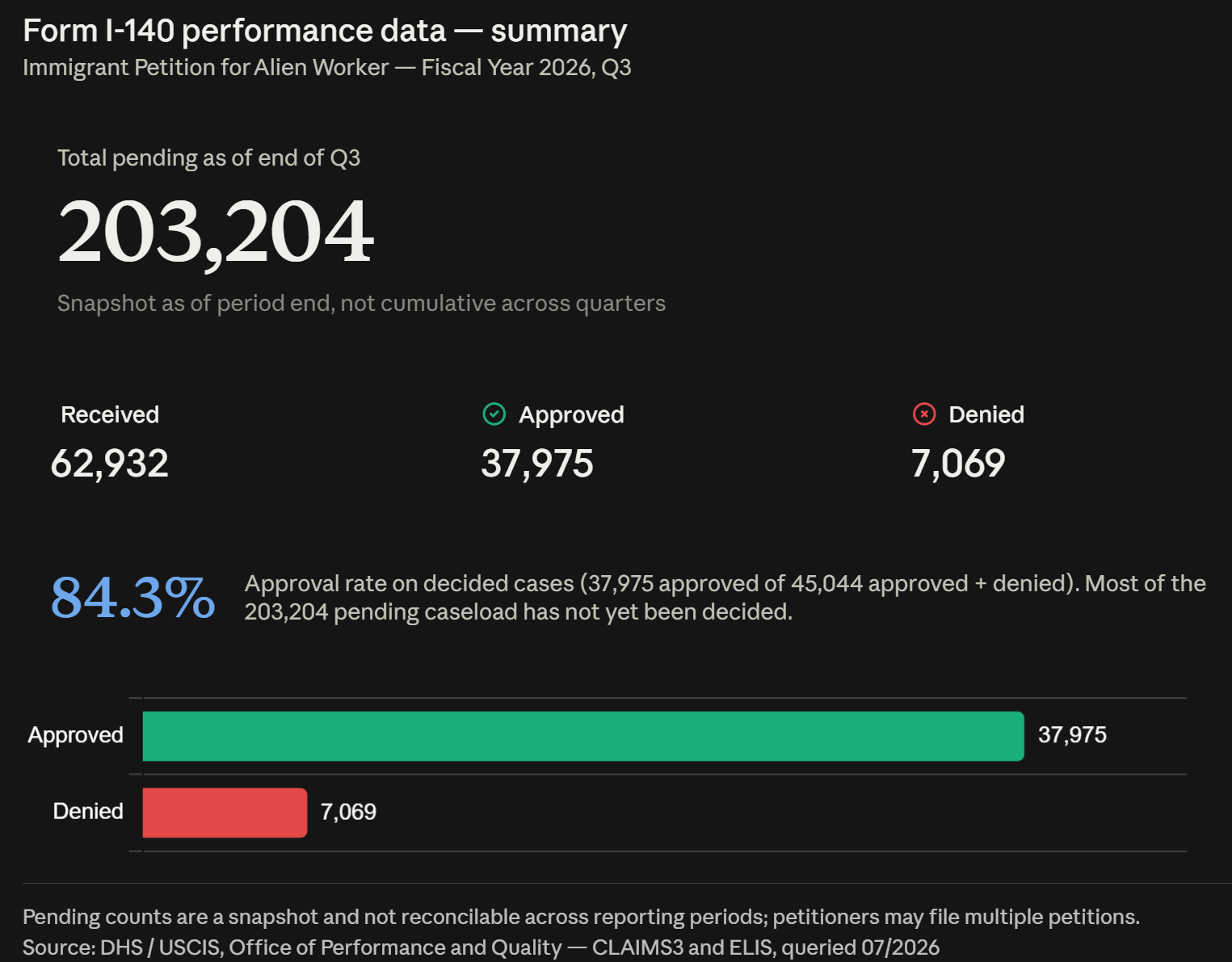
This report on I-140 approvals Q3 FY2026 tracks eight employment-based subcategories, spanning EB-1 through EB-3. USCIS approved 37,975 petitions across them during Q3 FY2026. The largest single subcategory, EB-2 for Professionals with Advanced Degrees (E21), generated 12,154 approvals globally. It accounted for the majority of India’s total.
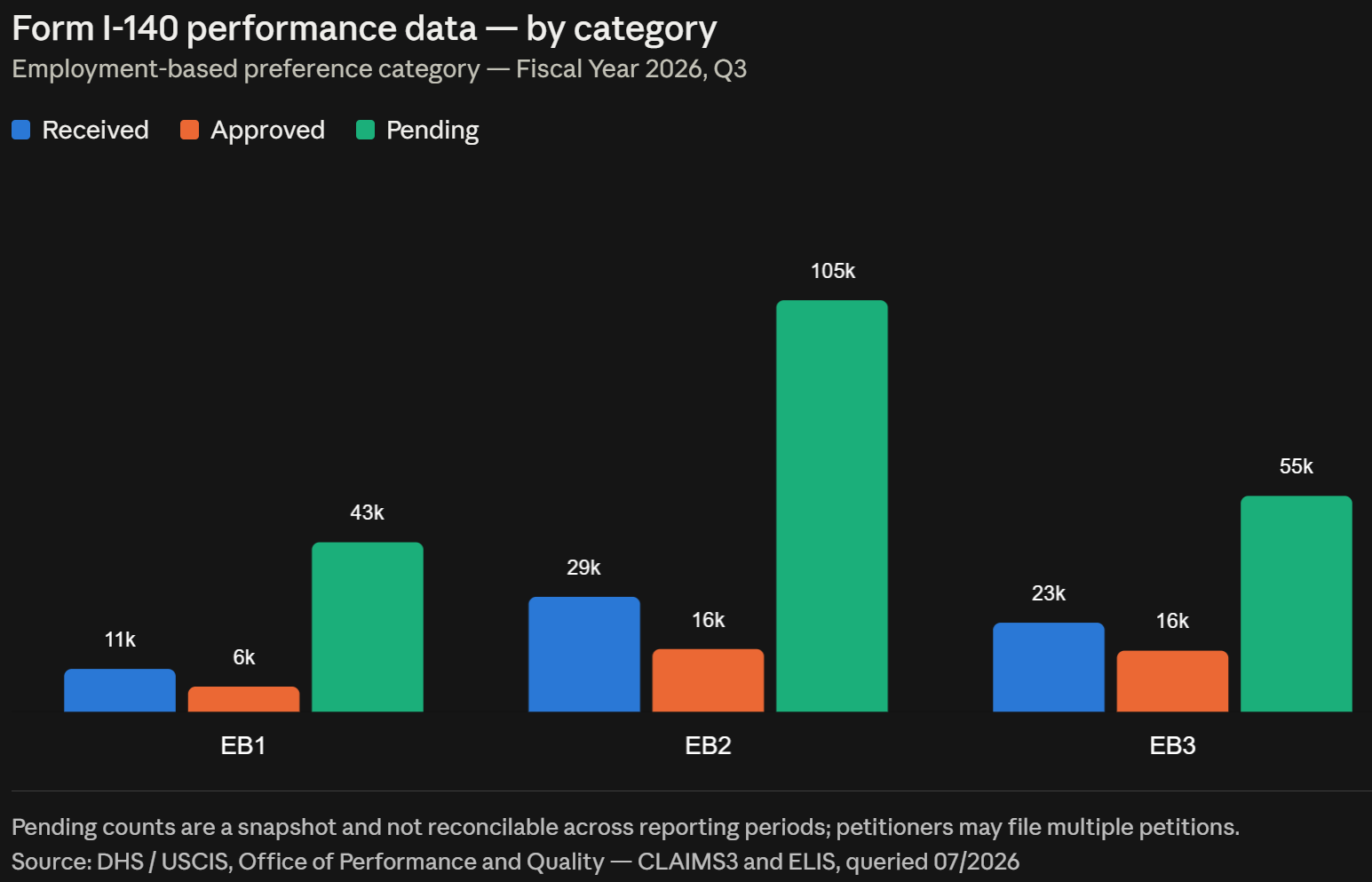
India’s 13,923 approvals broke down as follows: 8,476 in the EB-2 Advanced Degree category, 2,188 in EB-3 Professionals with Baccalaureate Degrees, and 1,506 in the EB-1 Multinational Executive or Manager category. The remainder included 463 as Outstanding Professors or Researchers, 423 through the National Interest Waiver pathway, 462 as Skilled Workers, and just five in the unskilled worker category. China followed with 4,130 approvals, led by EB-2 Advanced Degree (1,472) and National Interest Waiver (717). The Philippines earned 2,791 approvals, driven overwhelmingly by EB-3 Skilled Workers (1,900). This pattern reflects longstanding healthcare-sector sponsorship of Filipino nurses and allied health professionals. Vietnam (1,473), South Korea (1,377), and Mexico (1,286) rounded out the top six countries by total approvals.
Form I-140 Performance Data — FY2026 Q3 Infographics
The four charts below break down Form I-140 receipts and approvals for the third quarter of fiscal year 2026 by beneficiary state and by beneficiary country of birth. Swipe or scroll the charts sideways, or use the arrows and dots below to move between them. Each chart can be opened at full size in a new tab.
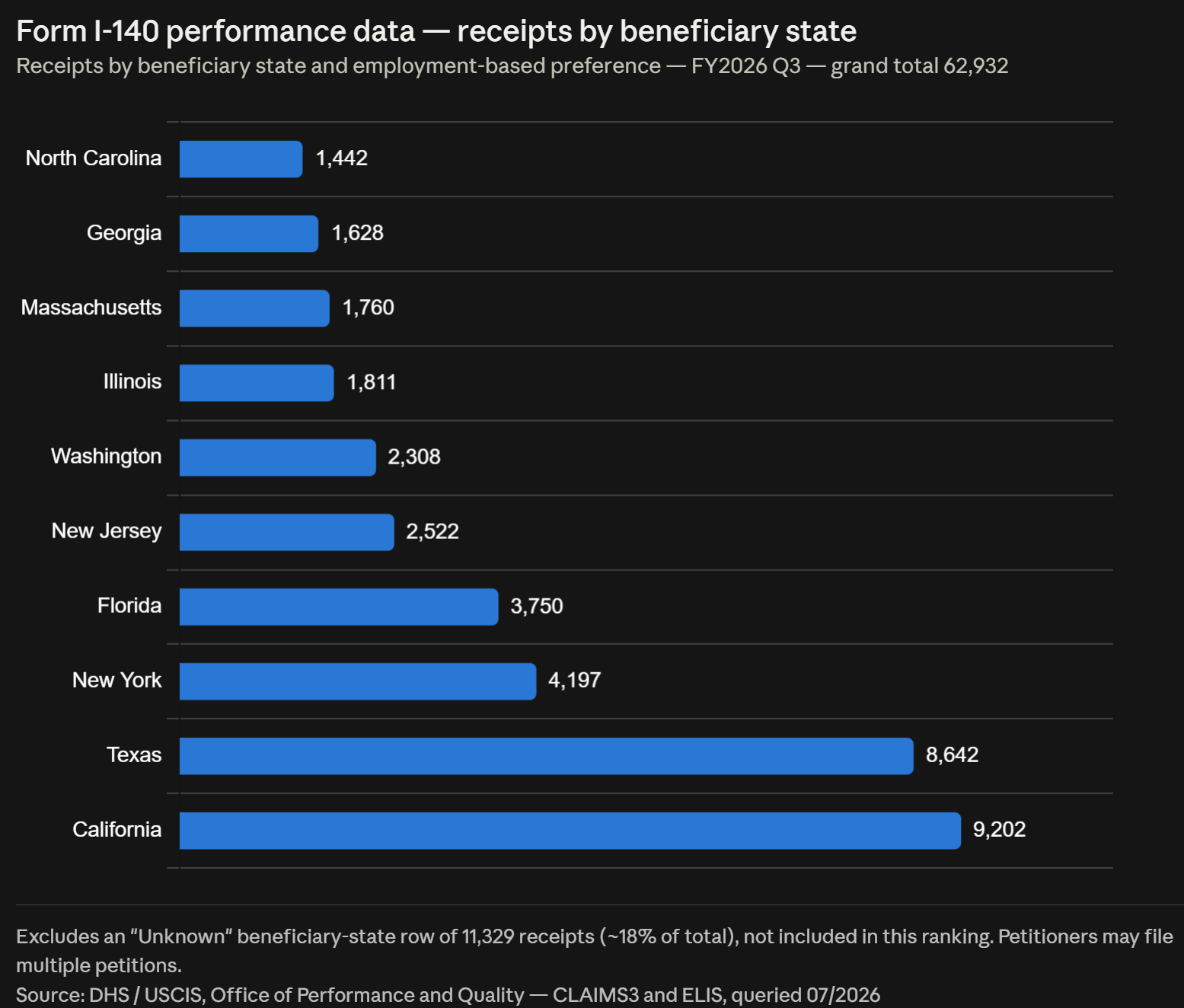
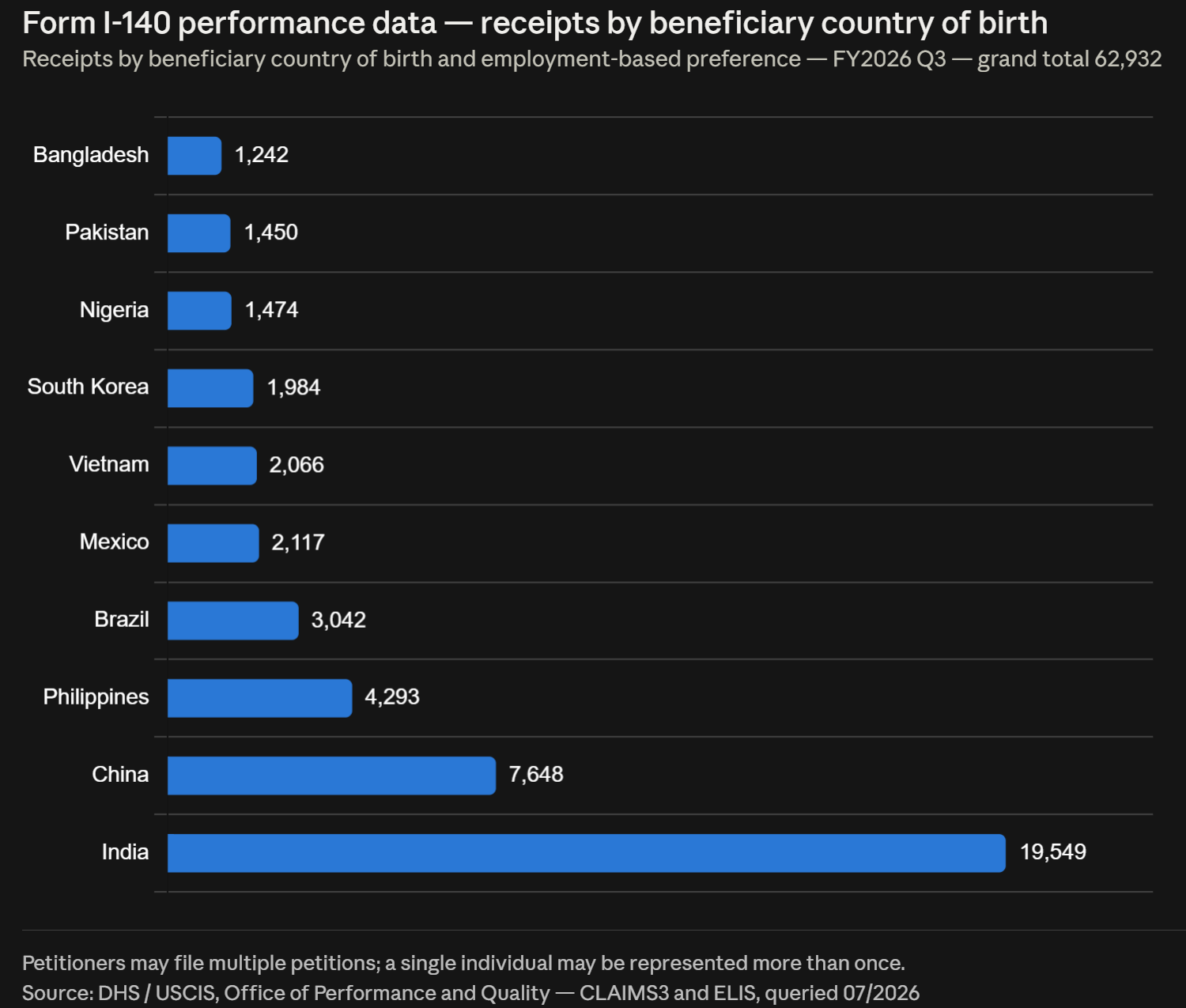
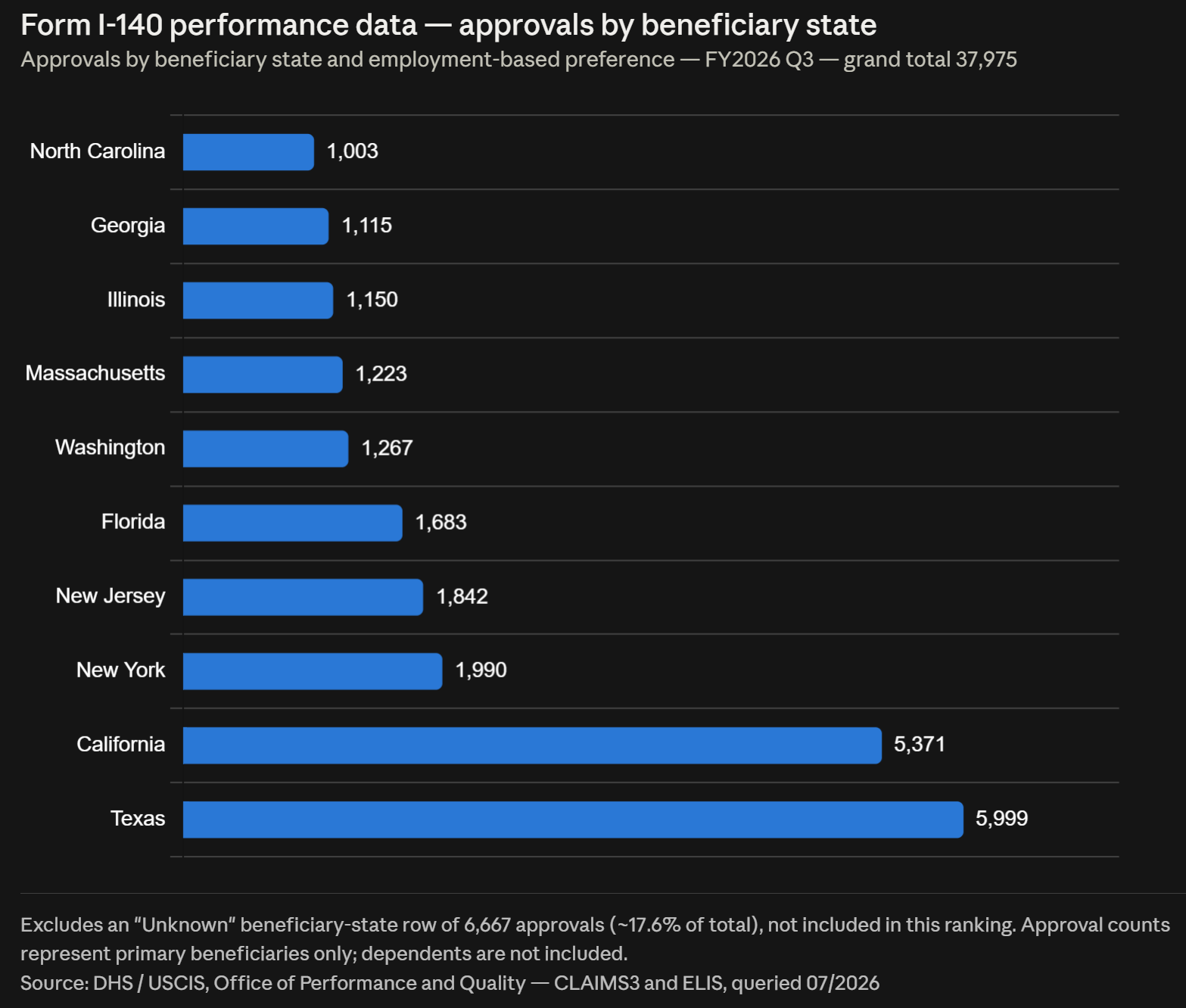
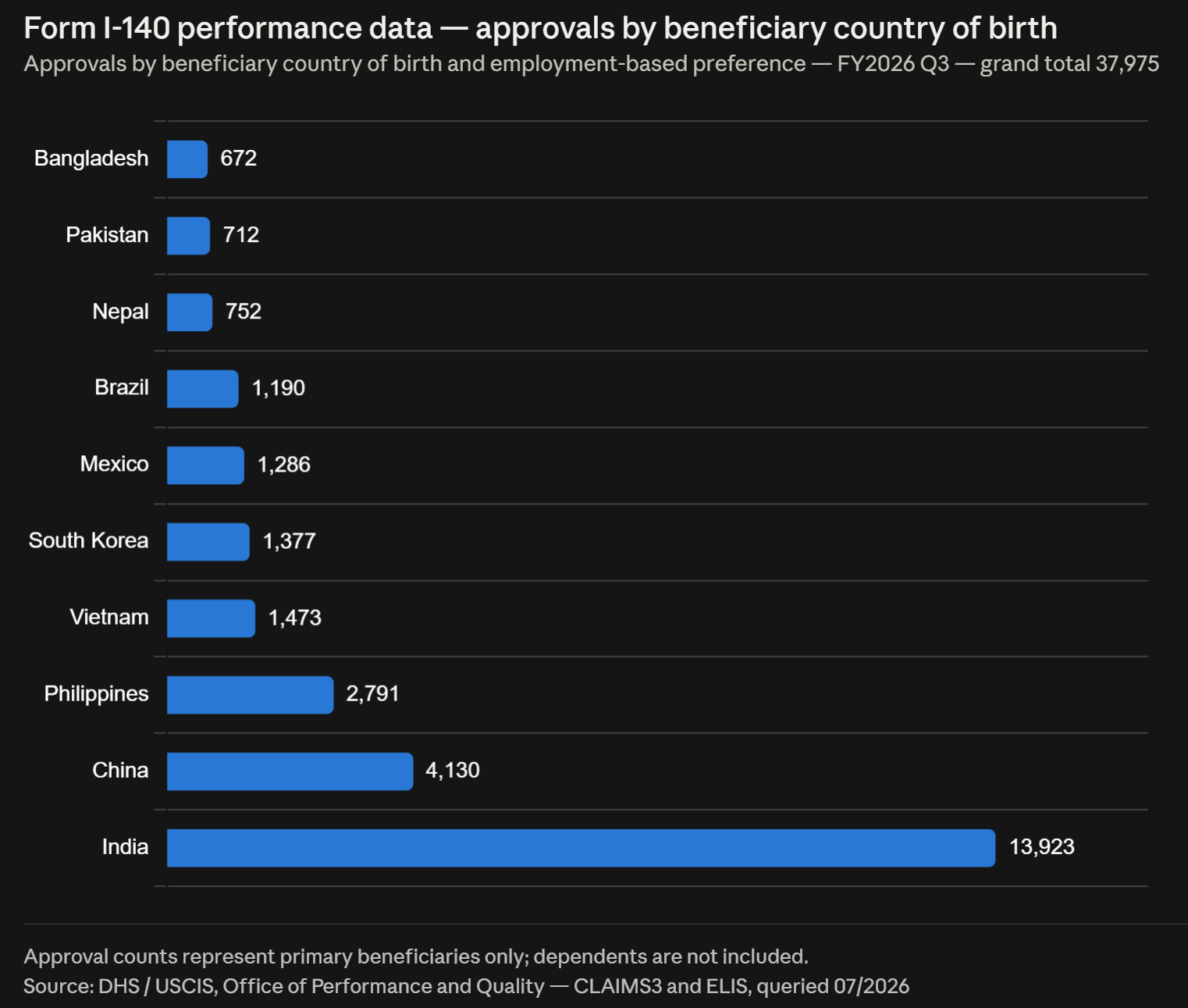
Source: DHS / USCIS, Office of Performance and Quality — CLAIMS3 and ELIS data, queried July 2026. The underlying quarterly reports are published on the USCIS Immigration and Citizenship Data page.
Other countries with notable approval counts include Brazil (1,190), Nepal (752), Pakistan (712), and Bangladesh (672). Countries such as Canada (523), Ghana (504), and Kenya (503) also reached the 500-approval threshold. Kenya and Ghana showed particular concentration in the EB-3 Skilled Worker category. Across the full dataset, beneficiaries from more than 130 countries received at least one I-140 approval during the quarter.
Who Is Affected by These Approvals
The data is most directly relevant to foreign national workers who are current beneficiaries of pending or recently approved I-140 petitions. This is particularly true for those born in India and China. The applicant's country of birth — not citizenship — determines visa number availability. As a result, nationals of oversubscribed countries face multi-year or multi-decade waits between I-140 approval and the ability to file for adjustment of status or receive an immigrant visa. An approved I-140 is a prerequisite. But the volume of India-born approvals relative to the per-country annual visa limits means that approval alone does not translate quickly into a green card for most Indian beneficiaries.
These numbers reveal pipeline demand that indirectly affects employers. This includes employers sponsoring foreign national workers in technology, engineering, healthcare, and research sectors. HR professionals and corporate immigration coordinators at companies with India-born employees in advanced degree or skilled worker categories should take note. The demand concentration continues to place pressure on an already constrained visa queue. Workers born in countries with lower approval volumes — most of Europe, Latin America, and sub-Saharan Africa — generally do not face the same backlog constraints. Their petitions, however, are subject to the same evidentiary requirements.
Practical Implications for Workers and Employers
For India-born workers, the concentration of approvals in the EB-2 Advanced Degree and EB-3 Professionals categories underscores a key strategy. Securing I-140 approval as early as possible helps lock in a priority date. Even when visa numbers remain unavailable for years, a confirmed priority date preserves the worker's place in line. Under current portability rules, it may also allow them to change employers or roles without losing that position, provided they meet certain conditions.
The National Interest Waiver (NIW) numbers are also worth noting. India generated 423 NIW approvals and China generated 717. Together, these represent more than 30 percent of the global NIW total of 3,835. The NIW pathway allows qualifying individuals to self-petition without an employer sponsor. It continues to attract significant use among researchers, scientists, and professionals who can demonstrate that their work serves U.S. national interests. Professionals may be evaluating whether to pursue employer-sponsored EB-2 or the self-petitioned NIW route. The volume of NIW approvals suggests this pathway remains viable and actively used.
The data carries an important methodological note. Because USCIS counts petitions it approved in the quarter rather than filed, one individual could theoretically appear more than once if USCIS approved multiple petitions for them. Additionally, the figures reflect only primary beneficiaries — they do not count dependent spouses and children. This means the actual number of people affected by these approvals is considerably higher than the petition totals suggest.
For employers, these figures reinforce the value of filing I-140 petitions promptly once they make a sponsorship decision. USCIS assigns priority dates based on the filing date, not the approval date. Applicants, however, must have an approved petition before they can act on priority dates. Delays in filing translate directly into longer waits for employees in backlogged categories.
What to Watch For After I-140 Approvals Q3 FY2026
USCIS typically releases quarterly I-140 data on a rolling basis. Building on this analysis of I-140 approvals Q3 FY2026, stakeholders should monitor the Q4 FY2026 release for any shifts in approval volume by category or country. Changes in adjudication policy, staffing levels, or filing volumes could affect approval patterns in subsequent quarters. This includes the outcome of the recent H-1B final rule and broader employer-sponsored petition trends. The State Department's monthly Visa Bulletin remains the key document for tracking when approved priority dates become current for India-born and China-born beneficiaries. Further guidance on portability and priority date retention is anticipated through USCIS policy channels.
How Immigration Professional Association Can Help
The I-140 approval process sits at the center of nearly every employment-based green card case. Understanding how to position a petition for approval — and how to plan around the backlog realities that these numbers reveal — requires careful, case-specific analysis. Immigration Professional Association regularly assists employers and their foreign national employees with I-140 preparation across all employment-based categories. This includes EB-1 extraordinary ability and outstanding researcher petitions, EB-2 advanced degree sponsorships, and National Interest Waiver self-petitions for researchers and professionals who may qualify to sponsor themselves.
For India-born and China-born professionals who have already received I-140 approvals, our team can help. We evaluate priority date strategies, portability options, and the timing considerations that determine when adjustment of status filings become realistic. For employers managing a workforce that includes employees in the backlog queue, we work closely with HR and legal teams. Together, we build sponsorship timelines that account for both adjudication realities and business continuity needs.
You may be an employer, HR professional, or foreign national worker with questions about what the latest USCIS I-140 approval data means for your specific situation. Immigration Professional Association welcomes the opportunity to discuss your case. Reach out to our team to schedule a consultation focused on your employment-based immigration strategy.