Introduction: The TPS Application Backlog in FY2026
USCIS data covering the first three quarters of fiscal year 2026 reveals that more than 567,000 Form I-821 applications for Temporary Protected Status remain pending review. That figure has stayed above half a million since the fiscal year began in October 2025. The TPS application backlog, tracked through June 30, 2026, reflects a system receiving new cases far more slowly than it is working through its existing queue. That raises significant concerns for hundreds of thousands of people from countries including Haiti, Ukraine, and El Salvador who depend on TPS for their legal work permit and protection from removal.
Background
Temporary Protected Status is a humanitarian status. It allows people from certain countries facing ongoing armed conflict, natural disasters, or other extreme conditions to live and work legally in the United States for defined periods. Individuals apply using Form I-821, and keeping valid TPS usually requires timely re-registration when the government extends a country’s status. USCIS reviews these applications centrally, and processing times have long stretched across multiple years. As a result, many people continue living and working under automatic extensions while their formal applications wait for a decision. The size of the current backlog reflects two things: the size of TPS-covered groups in the United States, and the review capacity USCIS has brought to this form type.
The TPS Application Backlog by the Numbers
The USCIS data release covering October 1, 2025 through June 30, 2026 shows the total pending count. It began the fiscal year at approximately 582,813 applications and fell step by step over three quarters to 567,110 by the end of Q3. During that same period, USCIS approved 25,615 applications and denied 2,582, while receiving 2,913 new applications system-wide. The math reflects a system making progress, but slowly. Approvals are ahead of new receipts, yet the backlog remains huge in total terms.
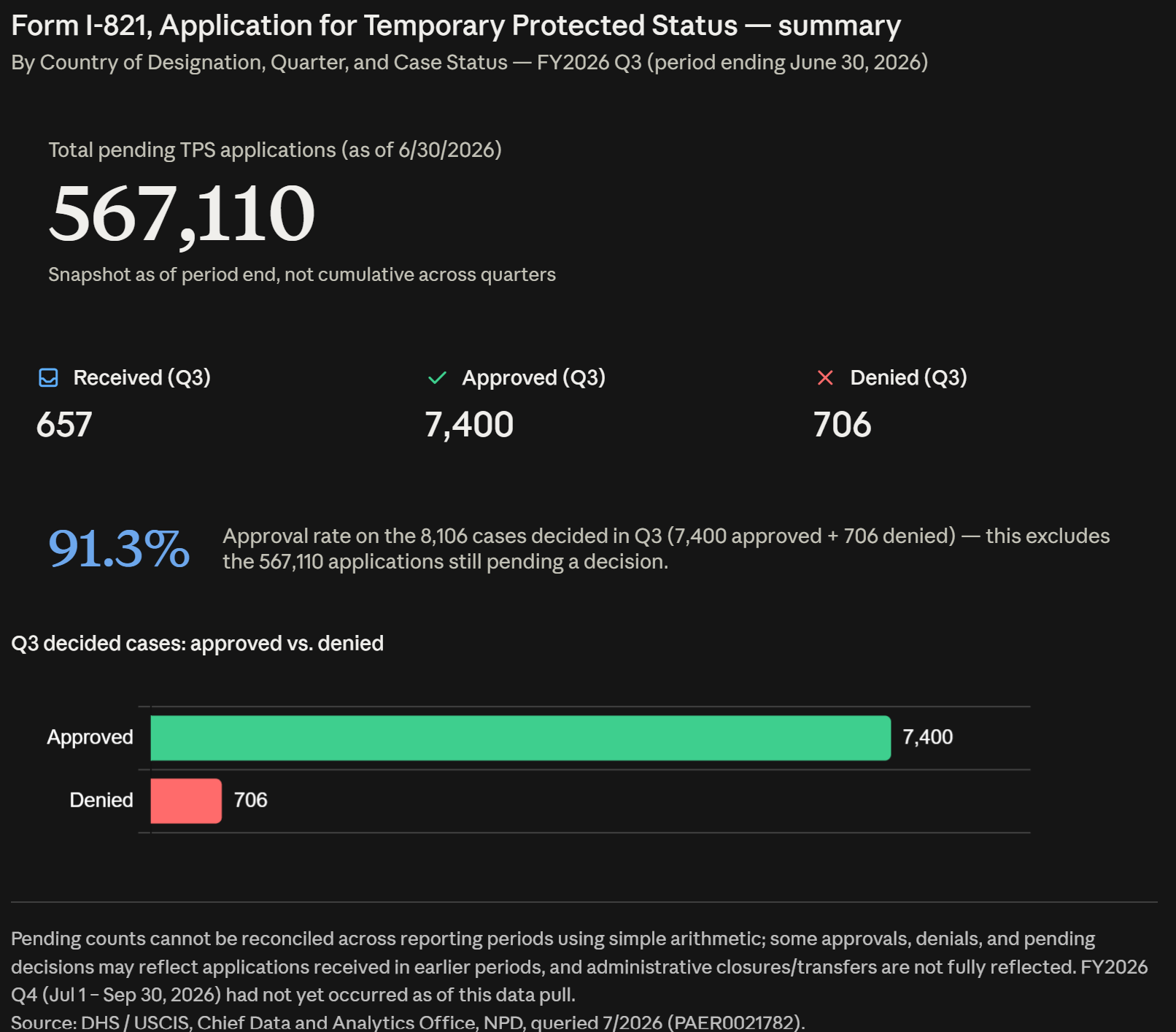
The data comes from USCIS’s Chief Data and Analytics Office. It shows the agency’s most current estimate at the time of the query in July 2026. Disclosure rules hide certain country-level figures to protect individual privacy in small groups. The data marks these with “D” or “H” labels.
Who Is Affected
The biggest clusters of pending cases fall along clear lines. People from Haiti make up by far the largest single share of the backlog. Their 332,184 applications pending as of June 30, 2026 amount to more than 58 percent of the total. People from Ukraine make up the second-largest group at 124,402 pending cases, followed by people from El Salvador at 103,875. These three groups together make up about 99 percent of the total pending cases. This makes the backlog heavily clustered rather than spread evenly across all covered countries.
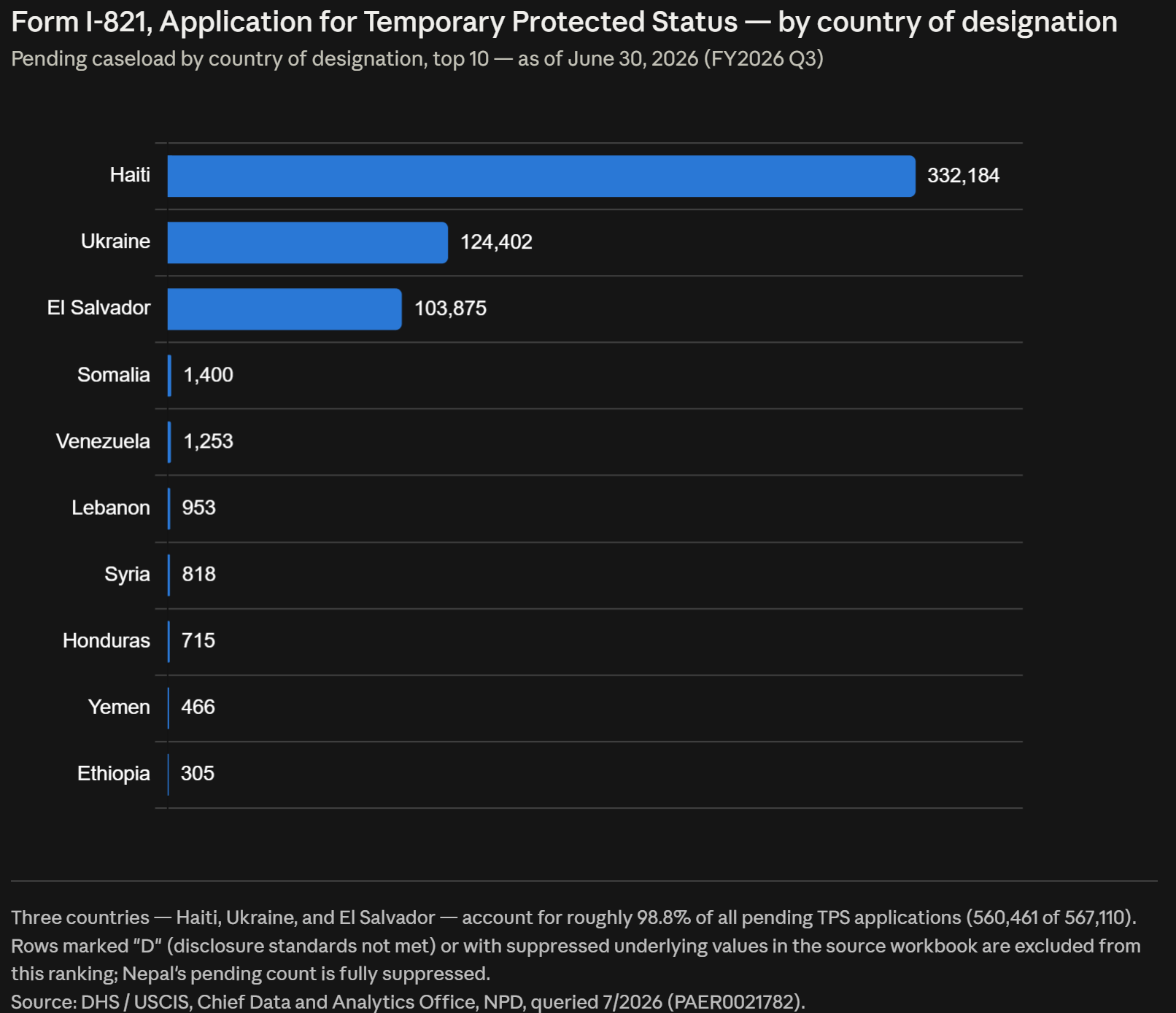
Other covered countries with pending applications include Somalia, Lebanon, Syria, Yemen, Sudan, Venezuela, Honduras, Burma, Ethiopia, South Sudan, and Nicaragua. Their individual pending counts, though, are much smaller. USCIS does not publish the pending count for nationals of Nepal, which falls below the disclosure cutoff.
The backlog affects filers directly — those waiting for initial TPS grants or re-registration decisions. It also creates knock-on effects for employers who rely on TPS holders for their staff. TPS status and the regular re-registration process together govern the work permit.
Practical Implications of the TPS Application Backlog
For TPS holders and applicants, a pending Form I-821 does not automatically mean a loss of the work permit. USCIS has historically issued automatic extensions of Employment Authorization Documents for TPS holders. This happens during pending re-registration periods and when it extends a country’s status. However, working through those automatic extensions needs careful attention to Federal Register notices for each covered country. The terms and length of automatic extensions vary by country and status period.
The pace of adjudication has been slow — approximately 8,538 approvals per month on average across Q1 through Q3 — against a pending pool of more than 567,000 cases. At current rates, clearing the backlog would take years without a real increase in review capacity or a change in policy. Applicants should not read a pending status as a bad sign about their own case. Still, they should keep complete records of their pending application and any automatic extension notices that apply to their country’s status.
For employers, the backlog underscores the importance of understanding the legal basis for TPS holders’ ongoing work authorization. It also means keeping I-9 compliance records current with the relevant Federal Register extension notices, rather than relying only on the expiration date printed on an Employment Authorization Document. Employers who fire workers based on a seemingly expired EAD without accounting for automatic extensions may face discrimination liability.
The data does not show what share of pending cases involve first-time filers versus re-registrants. Nor does it break down processing times by filing group. Those distinctions matter practically. Re-registrants who previously held TPS often have stronger records and may face different review factors than first-time filers. USCIS has not published that level of detail in this dataset.
What to Watch For Next
The Q4 data covering July through September 2026 will provide a complete fiscal year picture. It will show whether the downward trend in pending cases seen in Q1 through Q3 continued or reversed. USCIS updates its official processing time estimates separately from this statistical report. Stakeholders should watch them for country-specific Form I-821 timelines, including the TPS application backlog. Also, any changes to individual country TPS status — extensions, endings, or redesignations — will directly affect the make-up of the pending backlog and applicants’ basic eligibility. Further guidance on automatic extension terms is expected each time USCIS or the Department of Homeland Security acts on a country’s status. Affected nationals should track Federal Register publications for their country closely.
How Immigration Professional Association Can Help
At Immigration Professional Association, we work directly with TPS holders, re-registrants, and the employers who rely on them. We understand that a 567,000-case backlog is not an abstract statistic. It stands for people waiting on decisions. Those decisions affect their ability to work, their families’ stability, and their long-term planning in the United States.
Our team assists people from Haiti, Ukraine, El Salvador, and other TPS-covered countries with Form I-821 filings and re-registration submissions. We also help with the often complex task of keeping valid Employment Authorization Documents during long review periods. We also advise employers on I-9 compliance strategies specific to TPS-based work authorization. This includes how to correctly record automatic EAD extensions without exposing the company to discrimination risk.
If you or someone you employ is working through the TPS backlog — whether waiting on an initial application, managing a re-registration cycle, or trying to understand what a pending case means for work authorization right now — Immigration Professional Association is ready to help. We can help you make sense of where things stand and what steps to take next. Reach out to our team to discuss your specific TPS situation.