Introduction
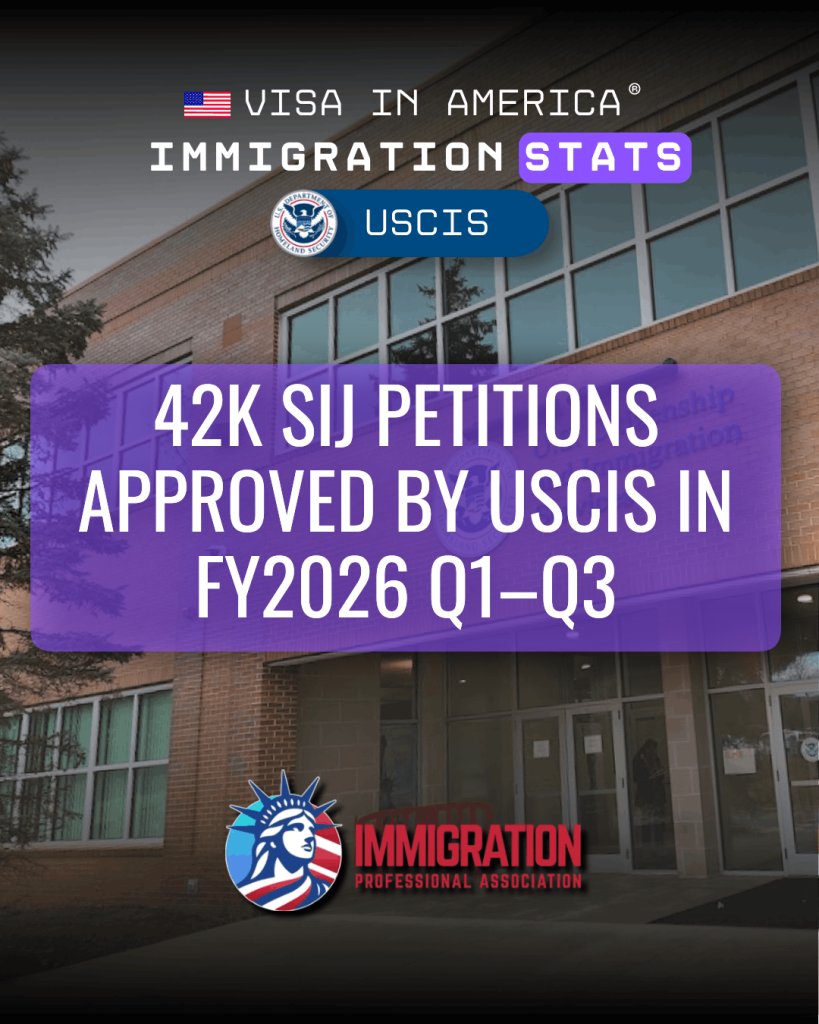
USCIS has released its congressional data report covering Special Immigrant Juvenile petition adjudications for the first three quarters of fiscal year 2026. The report spans October 1, 2025 through June 30, 2026 and is drawn from the agency’s Chief Data and Analytics Office. The data shows that USCIS approved 42,649 SIJ petitions during this nine-month period while denying 1,692. This is a meaningful indicator of both demand and processing trends for one of the immigration system’s most vulnerable populations. For families, advocates, and attorneys, this report offers the most current public picture of SIJ processing. It shows both petition processing times and approval rates.
Background
The Special Immigrant Juvenile classification provides a pathway to lawful permanent residence. It applies to foreign-born children whom someone has abused, neglected, or abandoned. A U.S. state court must have the child under its jurisdiction. The process begins in state family or juvenile court. There, a judge issues specific findings about the child’s situation and best interests. Once those findings are in place, the child — or a representative filing on their behalf — submits Form I-360 to USCIS. This establishes the SIJ classification. Approval of the I-360 is a prerequisite to applying for a green card. The timing of that next step depends on visa availability, which varies by the applicant’s country of birth.
USCIS produces quarterly SIJ adjudication data as a congressional reporting obligation. Congress established this requirement through the Consolidated Appropriations Acts of 2023 and 2024. This report covers the third quarter of FY2026, making it the most current dataset available for this petition category.
What the Data Shows
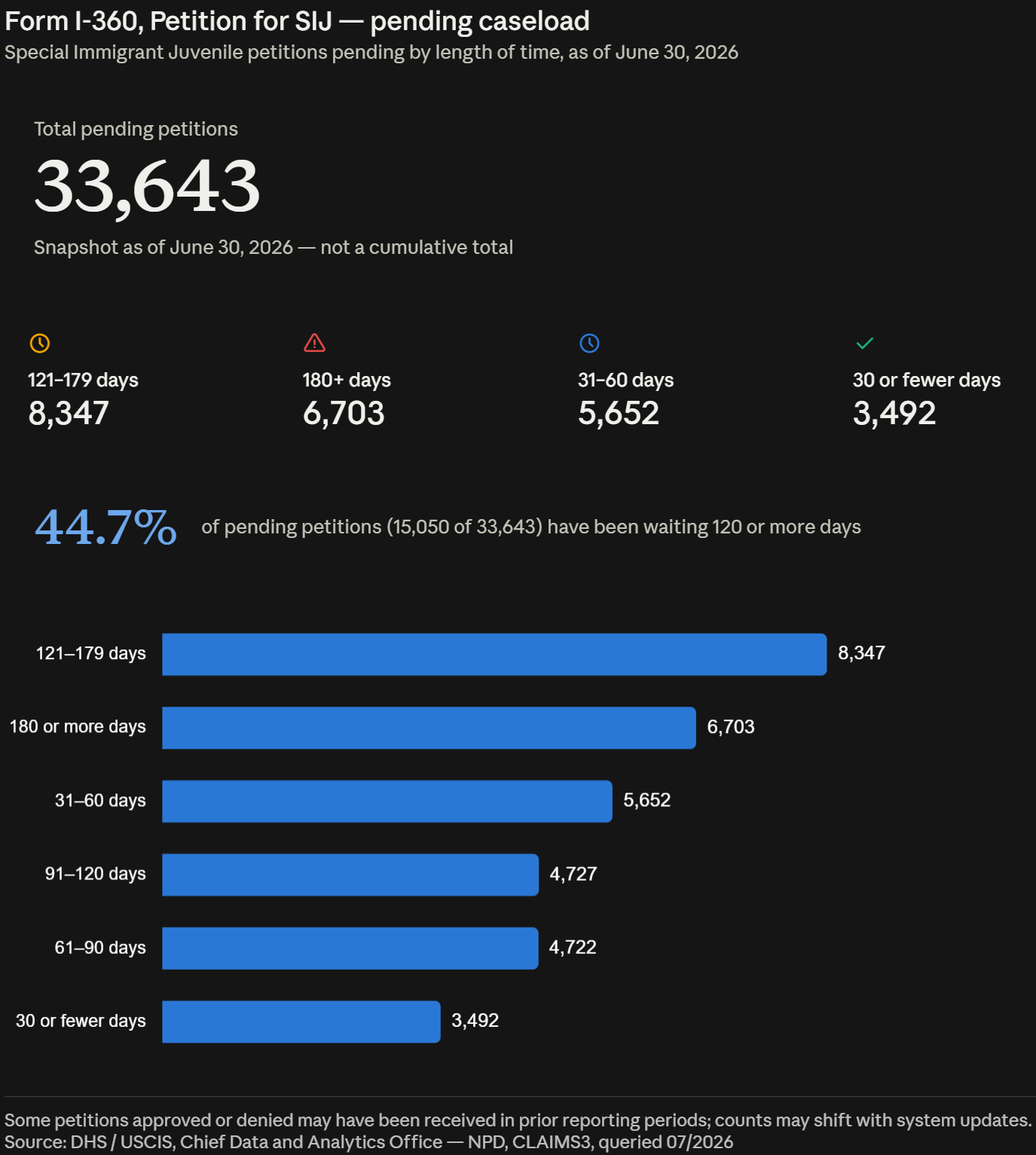
Form I-360, Petition for SIJ—pending caseload Q1-Q3 2026
Of the 33,643 pending SIJ petitions as of June 30, 2026, the largest single bucket (8,347) has been waiting 121 to 179 days, and another 6,703 have crossed 180 days. Together that’s 15,050 petitions, or 44.7%, pending four months or longer, while only about 10% have been in queue 30 days or less.
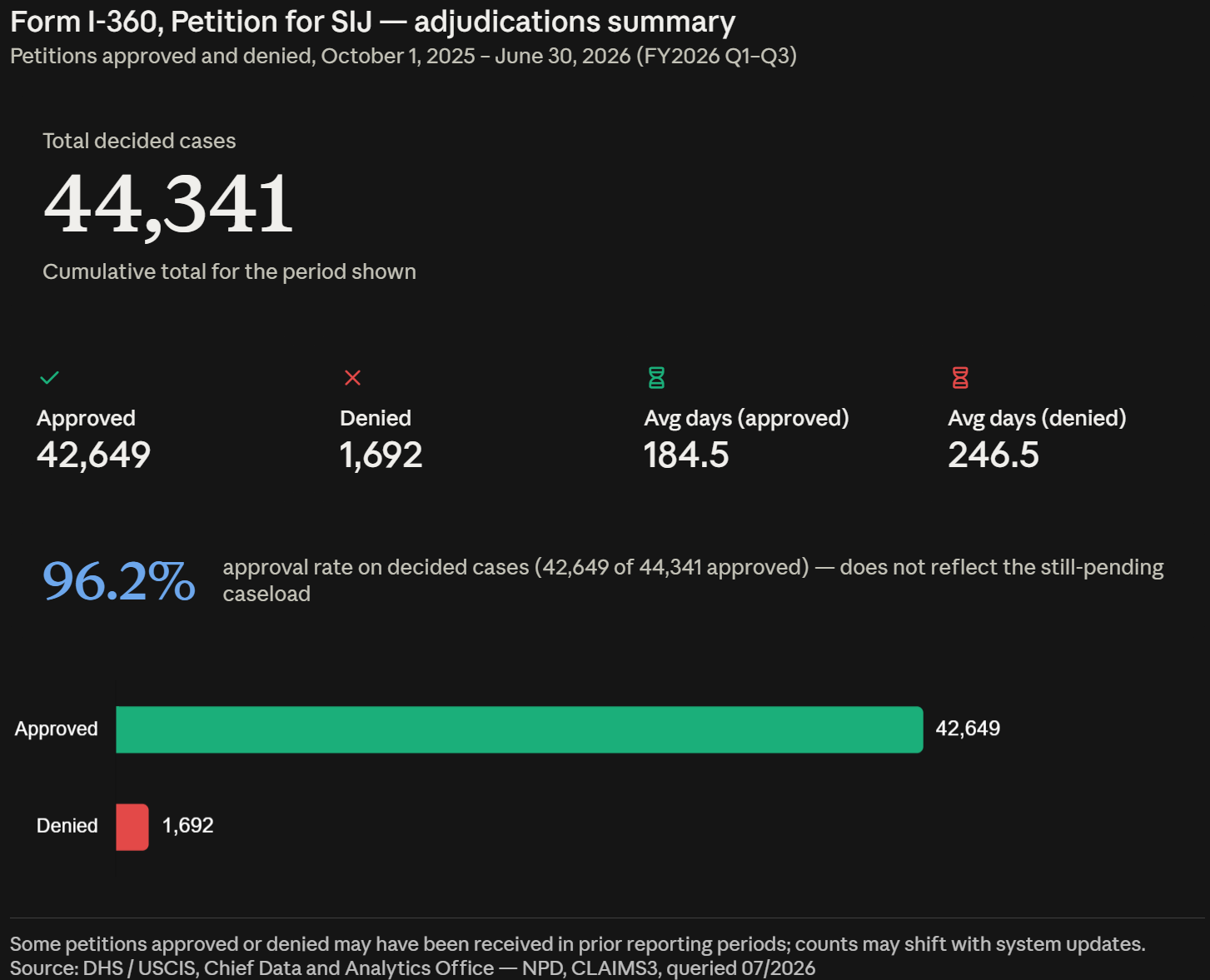
Form I-360, Petition for SIJ—Adjudications Summary Q1-Q3 2026
Across the three quarters, USCIS decided 44,341 I-360 SIJ petitions, approving 42,649 for a 96.2% approval rate. Denied cases took noticeably longer to resolve (246.5 average days versus 184.5 for approvals) consistent with the extra review that typically precedes a denial.
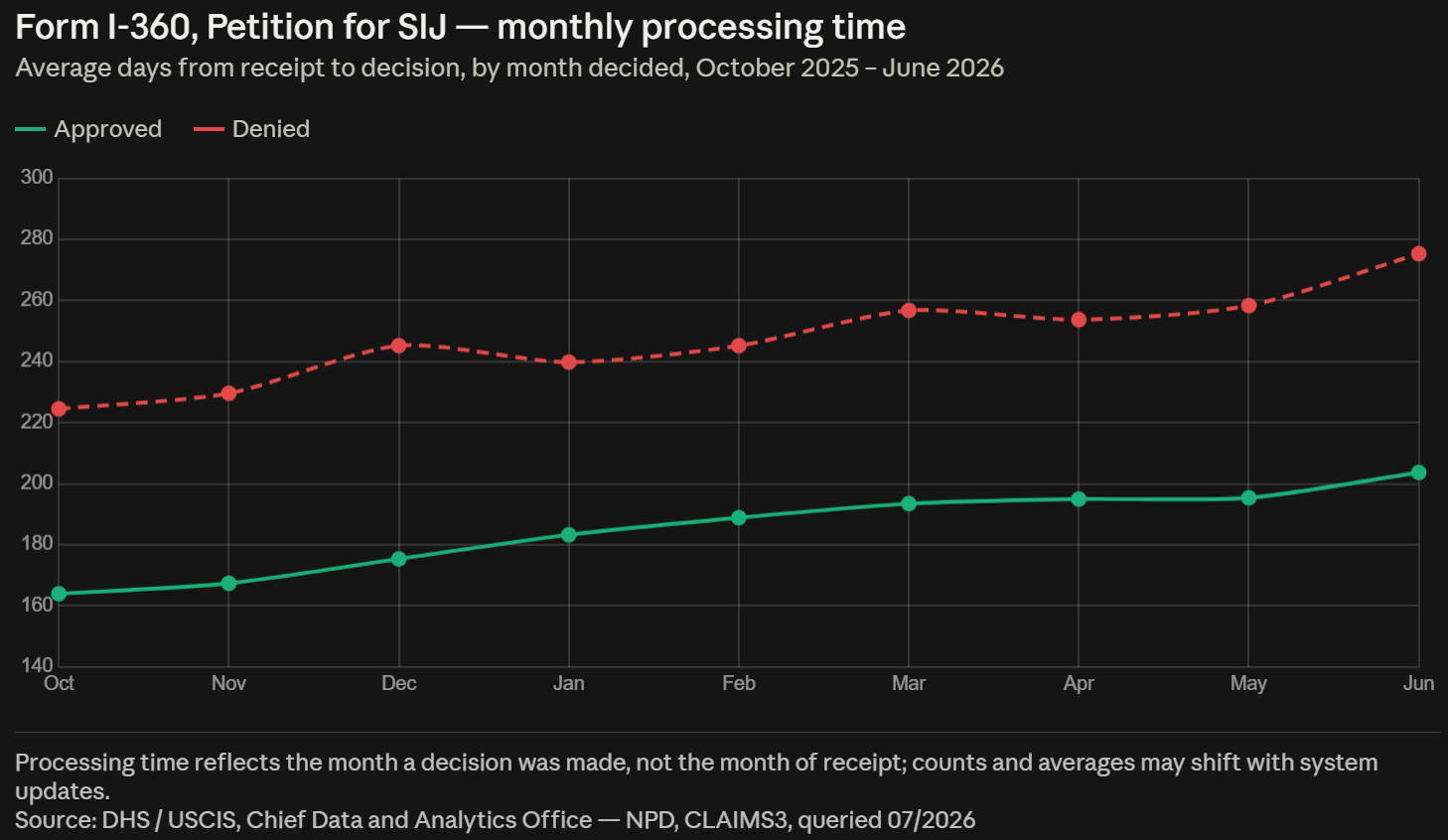
Form I-360, Petition for SIJ — monthly processing time Q1-Q3 2026
Processing time climbed steadily all three quarters rather than holding flat: approved cases went from 164.0 average days in October to 203.7 in June, and denied cases rose from 224.5 to 275.3 over the same span – a roughly 40-day increase on both tracks.
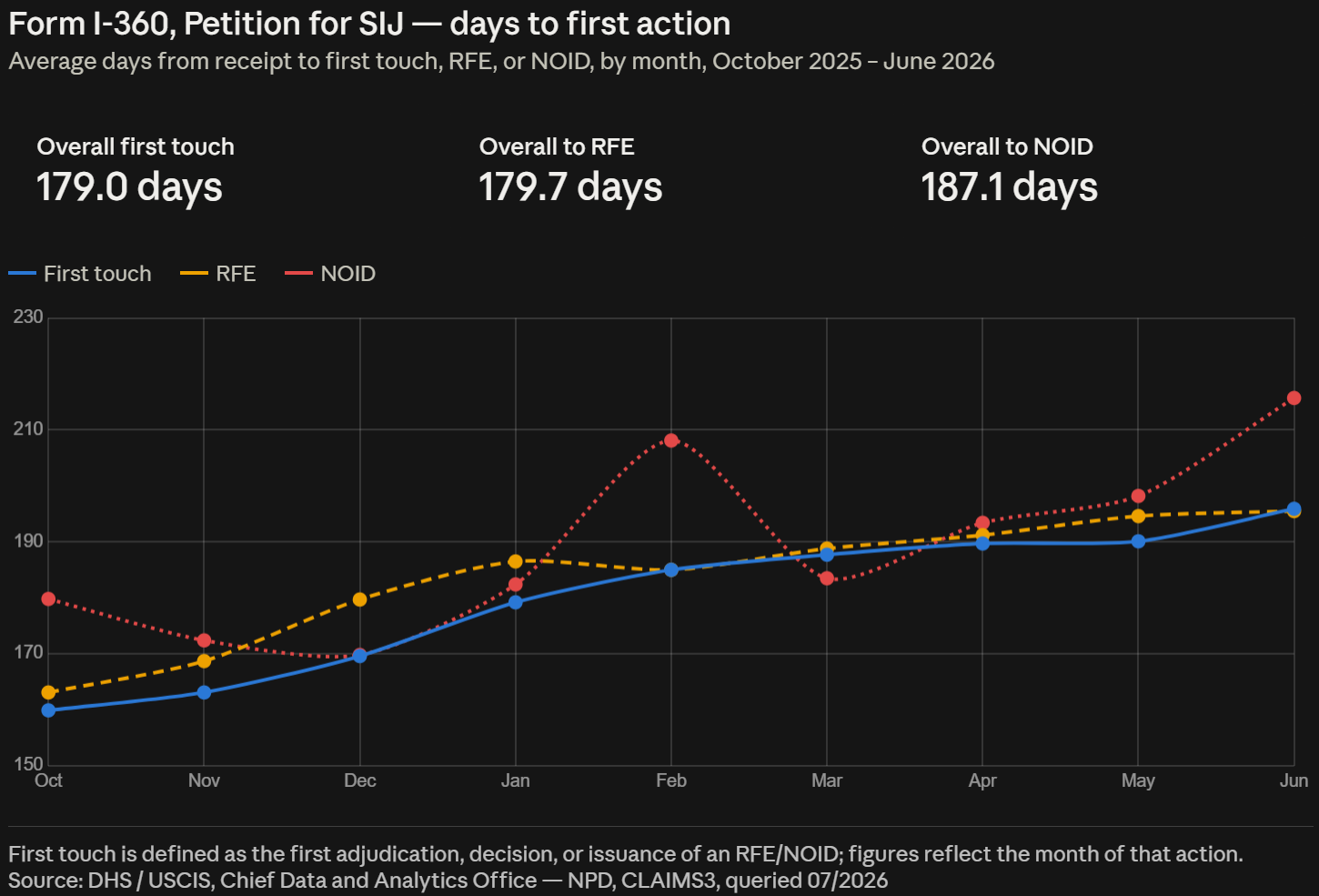
Form I-360, Petition for SIJ — days to first action Q1-Q3 2026
First touch and RFE timing track each other closely all year (179.0 and 179.7 days overall), but NOID timing is noisier and runs consistently a bit longer: 187.1 days overall, spiking to 208.1 in February and 215.7 in June, well above the other two lines those months.
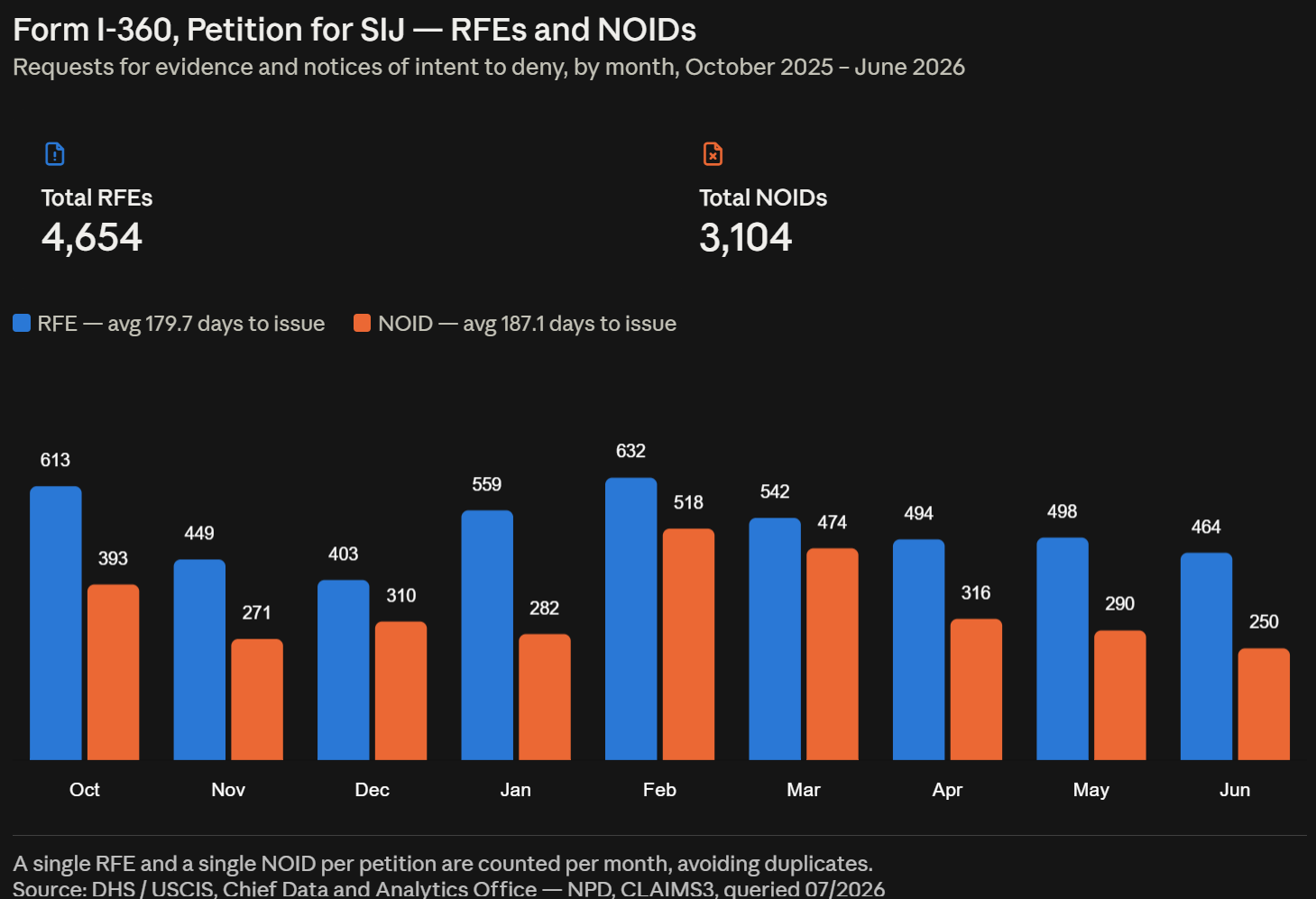
Form I-360, Petition for SIJ — RFEs and NOIDs Q1-Q3 2026
RFEs (4,654 total) outpace NOIDs (3,104 total) most months, but February stands out: both spiked together to 632 RFEs and 518 NOIDs, the highest counts of either notice type in the period – the same month the NOID-timing chart above also showed its biggest delay.
Who Is Affected
This data most directly concerns children currently under state juvenile court jurisdiction. A court must have found that they meet the predicate findings for the SIJ classification. Specifically, the court must find that reunification with one or both parents is not viable. The basis must be abuse, neglect, abandonment, or a similar reason under state law. The court must also find that returning to their country of origin would not serve the child’s best interests. In many cases, nonprofit legal organizations, court-appointed guardians, or private immigration counsel represent these children.
Attorneys and advocates tracking pending I-360 petitions will find the processing time trend directly relevant to case planning. Foster care agencies, child welfare departments, and family law practitioners who collaborate with immigration counsel on SIJ cases should also note the lengthening timelines. These timelines affect the overall sequence and timing of a child’s path to permanent residence.
Employers and HR teams generally do not form the primary audience for SIJ data. This classification centers on child welfare rather than employment-based immigration.
Practical Implications
The most operationally significant finding is the steady rise in SIJ petition processing times. This rise occurred over the nine months covered. A petition approved in October 2025 took an average of 164 days to resolve. By June 2026, the same outcome required an average of nearly 204 days. That is an increase of approximately 40 days in just nine months. This classification serves minors, many of whom are already navigating the child welfare system. The lengthening timeline has real consequences for stability, court jurisdiction, and the timing of downstream immigration steps.
Practitioners should factor the current processing baseline into case planning. It now averages over 200 days for approved cases filed in mid-2026 or later. Applicants who filed earlier in the fiscal year and whose cases are still pending may be approaching or exceeding average processing times. This can inform decisions about submitting service requests or inquiry letters to USCIS.
The denial processing time — averaging 246.5 days overall and reaching 275 days in June — also warrants attention. Adjudicators take significantly longer to adjudicate petitions that they ultimately deny than those they approve. This suggests that more complex cases, or those requiring additional evidence or requests for evidence, consume considerably more adjudicator time. Attorneys preparing I-360 petitions should make initial filings as thorough as possible. This reduces the risk of prolonged adjudication or denial.
SIJ status does not automatically confer a green card. Visa availability for this classification depends on annual numerical limits and country of chargeability. As a result, the time between I-360 approval and eligibility to file for adjustment of status can be substantial in certain cases. Tracking both the I-360 processing window and the visa bulletin simultaneously remains essential.
What to Watch For Next
USCIS plans to release fourth-quarter FY2026 SIJ adjudication data in a subsequent congressional report. This will complete the full fiscal year picture and allow for year-over-year comparisons. Stakeholders should monitor whether the upward processing time trend continues into Q4 or stabilizes. Any policy guidance affecting SIJ adjudication standards or evidentiary requirements would also directly affect outcomes. The same is true of guidance on which state court findings USCIS will accept as sufficient. This data release, however, does not indicate any such guidance changes.
How Immigration Professional Association Can Help
Immigration Professional Association has extensive experience representing children and families navigating the SIJ classification process. Our work spans coordinating with family law and juvenile court practitioners on the predicate findings. It continues through preparing and filing the I-360 petition with USCIS. We understand how the intersection of state court timelines and federal immigration processing windows affects case strategy. The current data makes clear that precise timing and thorough initial filings matter more than ever.
Your child, or a child in your care, may qualify for Special Immigrant Juvenile status. If so, Immigration Professional Association welcomes the opportunity to help. The same is true if you are an attorney or advocate. We can help you understand how the current processing environment affects a pending case. Reach out to our team for a consultation focused specifically on the SIJ process. We’ll explain what it means for your situation today.