Introduction
More than one million approved family-based immigration petitions are currently sitting in limbo — approved by USCIS but unable to move forward because a visa number is not yet available. A USCIS data release covering approved I-130 petitions awaiting visa availability, measured as of March 31, 2025, puts the total at 1,029,813 principal beneficiaries across all family preference categories. For the U.S. citizens and lawful permanent residents who filed these petitions — and the family members waiting abroad — this dataset offers a rare, concrete look at the scale of the backlog that defines the family-based immigration system today.
Background
Form I-130, the Petition for Alien Relative, is the foundational document in family-based immigration. A U.S. citizen or lawful permanent resident (LPR) files it to establish a qualifying family relationship with a foreign national they wish to sponsor for a green card. USCIS approval of an I-130 does not itself grant any immigration benefit — it establishes the existence and validity of the family relationship, nothing more. The beneficiary cannot actually apply for a green card until a visa number becomes available under their preference category and country of birth, as governed by the State Department’s monthly Visa Bulletin.
Because Congress has set annual numerical caps on family-preference visas, demand dramatically outpaces supply in many categories. The result is a queue: approved petitions wait, sometimes for years or decades, until the Visa Bulletin’s Final Action Dates advance far enough to permit the next step. The USCIS quarterly data release on pending approved I-130s is one of the clearest windows into the actual depth of that queue at any given moment.
What Is Changing
This is a data release, not a policy change. USCIS published its fiscal year 2026, second-quarter snapshot of approved I-130 petitions that remain pending due to visa unavailability, reflecting conditions as of March 31, 2025, with visa availability assessed against the March 2026 Visa Bulletin Final Action Dates chart.
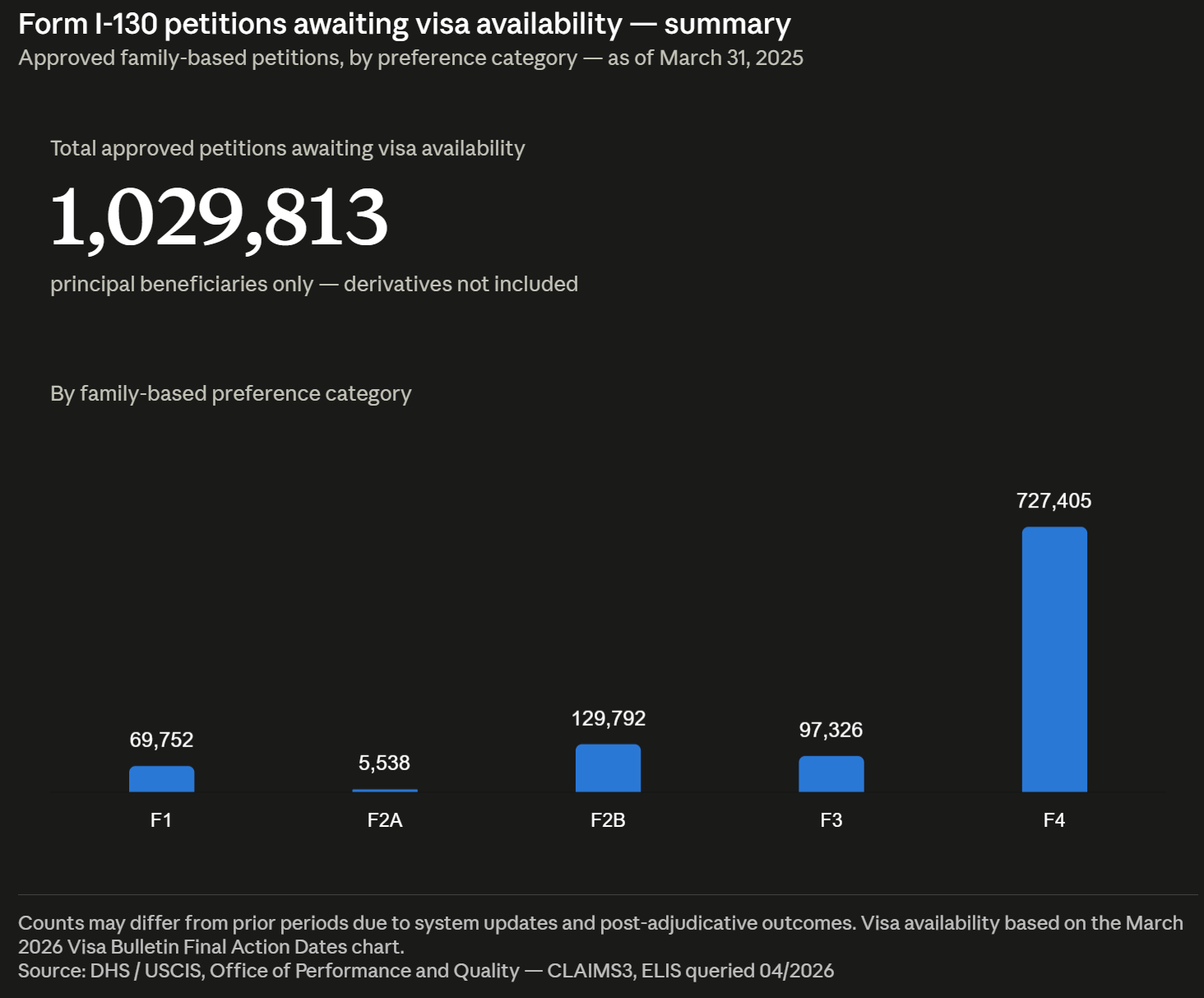
The headline figure is 1,029,813 total approved petitions awaiting a visa number. The breakdown by preference category reveals where the weight of the backlog falls. The F4 category — brothers and sisters of adult U.S. citizens — accounts for the single largest share at 727,405, representing more than 70 percent of the total backlog. F2B, covering unmarried sons and daughters over age 21 of lawful permanent residents, holds 129,792 pending petitions. F3, for married sons and daughters of U.S. citizens, accounts for 97,326. F1, covering unmarried sons and daughters of U.S. citizens, holds 69,752. F2A, the category for spouses and minor children of LPRs, has the smallest pending count at 5,538 — a reflection of the higher annual visa allocations and priority treatment that category receives under current law.
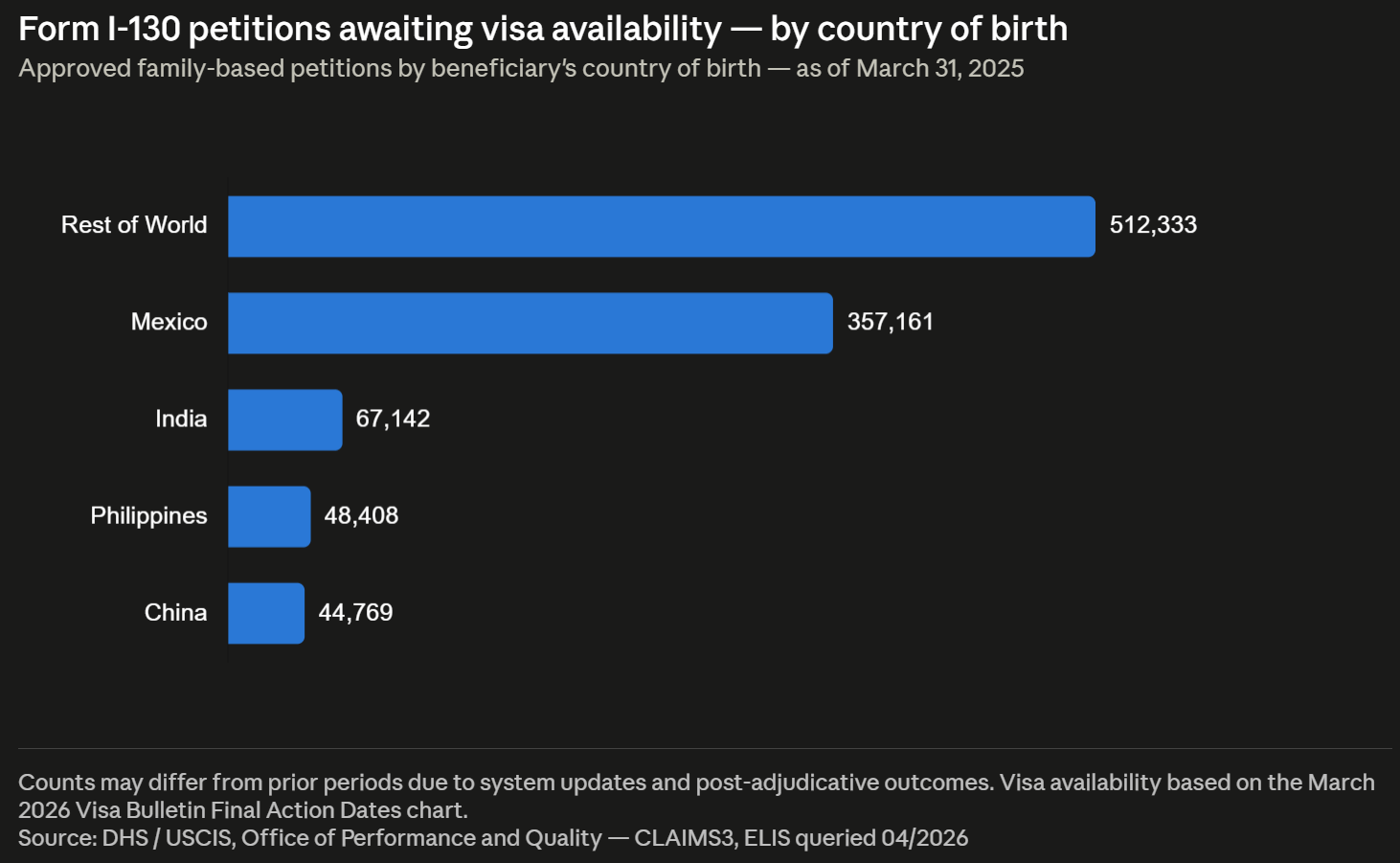
By country of birth, Mexico dominates the backlog at 357,161 total petitions, with an especially heavy concentration in F4 at 269,198. India and China each hover around 44,000 to 67,000 total pending petitions. The Philippines accounts for 48,408. All remaining countries of birth are grouped as “Rest of the World” at 512,333, meaning that the majority of petitioners waiting are not from the high-retrogression countries typically discussed in employer-based immigration contexts.
USCIS notes that counts in this report reflect only principal beneficiaries — derivative family members accompanying or following to join the principal are not included in these figures. The report also excludes petitions on behalf of individuals who have already obtained LPR or U.S. citizen status.
Who Is Affected
The people most directly affected by what this data represents are the foreign nationals named as beneficiaries on these petitions and the U.S. citizens or LPRs who petitioned for them. For beneficiaries currently outside the United States, this backlog typically means waiting abroad, often in situations of prolonged family separation, until their priority date becomes current. For beneficiaries inside the United States in a temporary status, it may mean navigating years of extensions, status changes, or other strategies to maintain lawful presence while a visa number matures.
Employers are indirectly affected when employees in temporary work-authorized status have long-pending family petitions that complicate long-term workforce planning. Immigration attorneys and HR professionals tracking employee immigration portfolios also use data like this to calibrate expectations for clients and employees whose situations involve family-based components.
Practical Implications
The sheer volume captured in this dataset — over one million approved petitions — reinforces what practitioners already know: approval of an I-130 is the beginning of a process, not its resolution. For families in the F4 category especially, current wait times in many countries stretch to decades, and this backlog figure of more than 727,000 approved F4 petitions explains why.
For petitioners who have not yet filed, this data underscores the importance of filing as early as possible. Priority dates are established at the time USCIS receives the petition, not when it is approved. Every year of delay in filing is a year added to an already long wait.
For beneficiaries who are inside the United States in a status that may expire, understanding the interplay between their visa availability timeline and their current status is critical. Options such as maintaining lawful status through employment-based pathways, student visas, or other nonimmigrant classifications while a family priority date matures deserve careful analysis — the right approach depends heavily on individual circumstances.
One important technical note from USCIS: because petitioners can file more than one petition, this report may include multiple petitions for a single individual. The raw figure of 1,029,813 should therefore be understood as a count of petitions, not necessarily a count of unique individuals.
What to Watch For Next
USCIS releases this data on a quarterly basis, so the next update will reflect conditions as of June 30, 2025, and is expected to be published in mid-2026. Stakeholders should also monitor the State Department’s monthly Visa Bulletin, which controls when beneficiaries in specific categories and countries of birth can take the next step in the green card process. Any legislative developments affecting annual visa caps or category allocations would substantially change the picture this data presents — though no such legislation has been enacted as of the time of publication.
How Immigration Professional Association Can Help
Understanding where a petition sits within the broader backlog is one part of managing a family-based immigration case — knowing what to do while waiting is the other part, and it is often the more complex question. Immigration Professional Association works with U.S. citizens, lawful permanent residents, and their family members to navigate exactly this kind of long-horizon planning: filing petitions correctly to preserve the earliest possible priority date, evaluating options for maintaining lawful status while a visa number matures, and preparing for the adjustment of status or consular processing steps once that number finally becomes available.
If you have an approved I-130 petition and you are trying to understand where you stand in the queue, what your options are in the meantime, or how to ensure you are positioned to act quickly when your priority date becomes current, Immigration Professional Association is ready to help you work through those questions. Reach out to our team to discuss your family’s specific situation.