Introduction
USCIS data released for the second quarter of fiscal year 2026 shows that blanket L petition approvals reached a 97.7 percent approval rate between October 1, 2025 and March 31, 2026. The figures come from USCIS’s quarterly nonimmigrant worker petition statistics, which track Form I-129 filings by case status and Request for Evidence (RFE) issuance. For multinational companies that rely on the blanket L program to transfer employees to the United States efficiently, this approval rate signals a favorable adjudication environment — one worth understanding in detail before your next transfer cycle.
Background
Understanding the Blanket L Program
The blanket L petition is a mechanism that allows qualifying multinational organizations to obtain advance USCIS approval covering their entire enterprise rather than filing individual petitions each time they need to transfer an intracompany transferee. Once a blanket approval is in place, the employer can send eligible employees — managers, executives, and workers with specialized knowledge — directly to a U.S. consulate to apply for their L visa without waiting for USCIS to adjudicate a separate petition for each individual.
This structure differs from the standard L-1A and L-1B individual petition process. Individual L filings require a dedicated USCIS review each time a qualifying employee is identified for transfer. The blanket route trades that per-employee review for a single organizational approval, which is then extended over time as long as the company continues to meet the qualifying criteria. The USCIS quarterly data released here covers only blanket L filings and explicitly excludes individual L-1A and L-1B petition counts from this report.
What the Data Shows
Approval Rates and Volume Across the Period
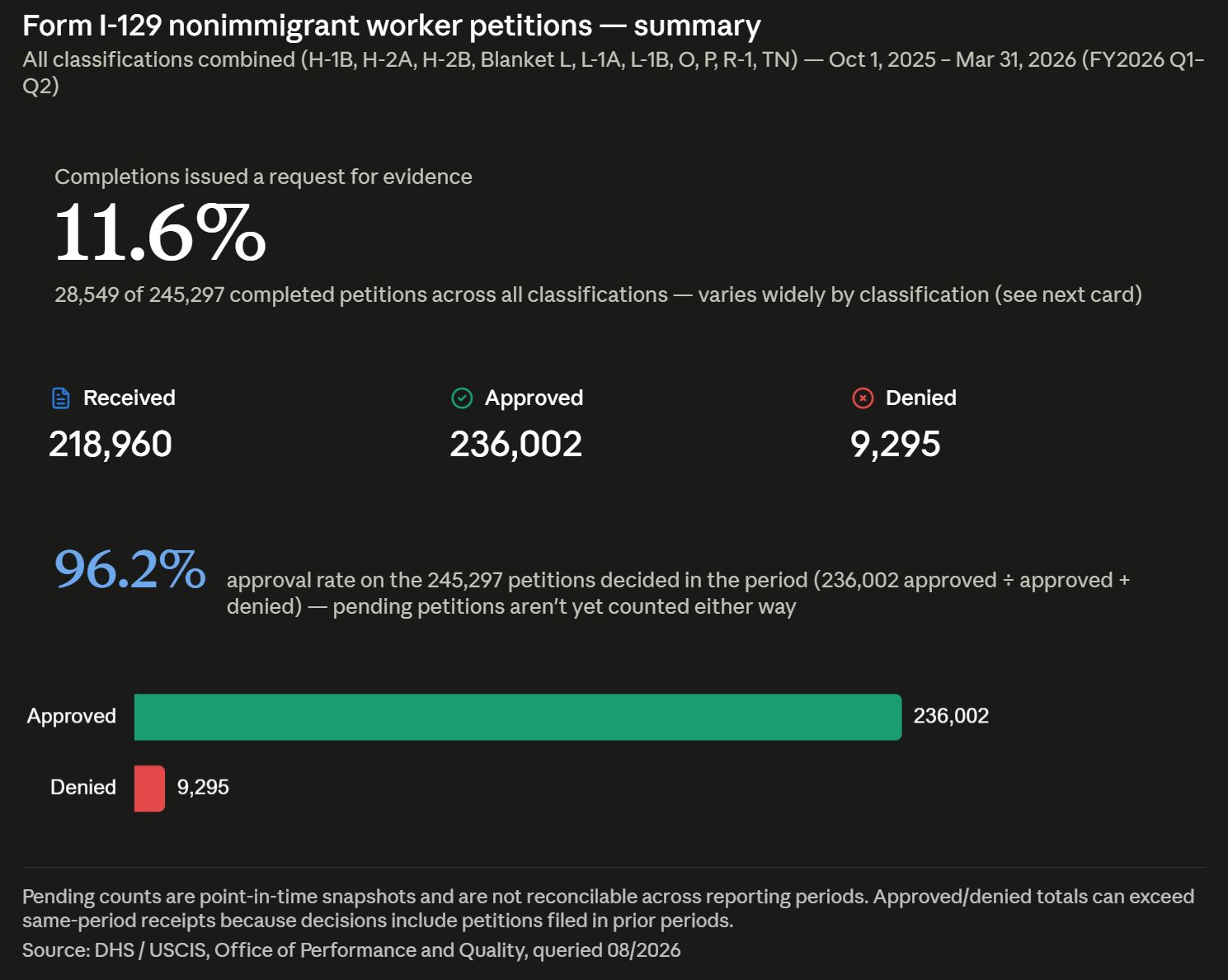
During the six months covered by this report, USCIS received 673 blanket L petitions and completed adjudication on 662 of them. Of those completed cases, 647 were approved and 15 were denied, producing the 97.7 percent overall approval rate. The pending count stood at 146 cases as of March 31, 2026, reflecting petitions that were still awaiting a decision at the end of the quarter.
Monthly figures remained consistent throughout the period, with no single month falling below 97.1 percent. October 2025 posted the highest monthly rate at 98.5 percent. February and March 2026 came in slightly lower at 97.1 and 97.2 percent respectively, though the differences are minor. The consistency across all six months suggests stable adjudication patterns rather than a single outlier month driving the overall figure.
RFE Issuance and Outcomes
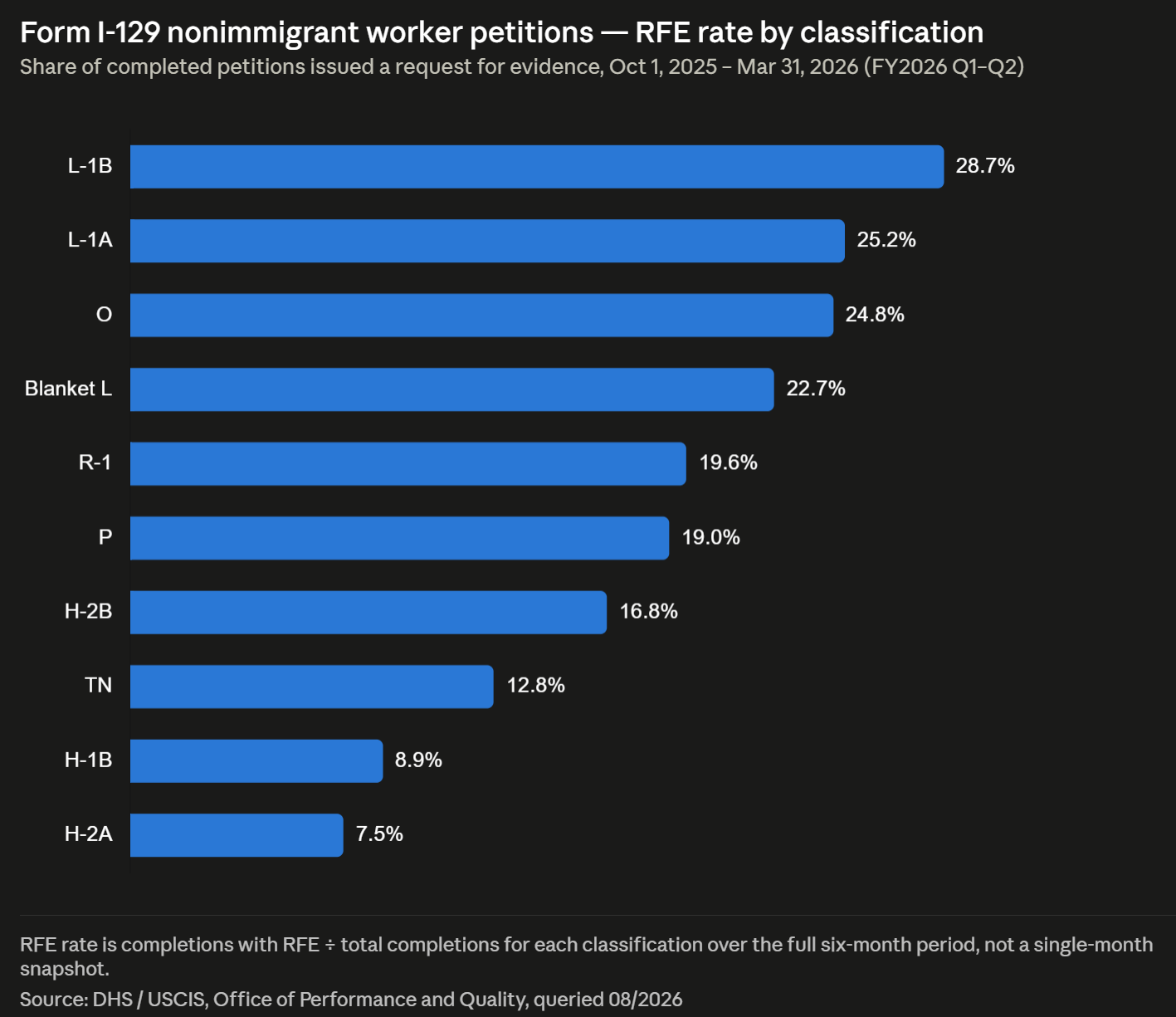
Requests for Evidence were issued in 22.7 percent of all completed cases — 150 out of 662 total completions. Of those 150 RFE completions, 138 were ultimately approved, representing 20.8 percent of all completions. This means that receiving an RFE did not typically result in denial: the vast majority of petitions that received additional evidence requests still ended in approval. USCIS notes that petitions with multiple RFEs are counted only once in this dataset, and that some petitions may have received an RFE in a different reporting period than when they were ultimately adjudicated.
Who Is Affected
The organizations most directly affected by this data are multinational companies that have an existing blanket L approval or are evaluating whether to pursue one. This includes corporations with significant U.S. operations and a regular need to relocate employees from foreign affiliate offices, subsidiaries, or parent companies. Human resources teams and global mobility professionals at these organizations use quarterly USCIS data to set expectations internally and plan transfer timelines.
Individual employees being considered for blanket L transfers are indirectly affected in the sense that overall program health influences consular processing expectations and corporate transfer timelines. However, the blanket L petition itself is the employer’s filing, not the employee’s, so individual workers do not file these petitions on their own behalf.
Employers who file individual L-1A or L-1B petitions rather than operating under a blanket approval are not covered by this dataset. USCIS publishes separate quarterly figures for individual L petitions, and this report explicitly excludes them.
Practical Implications
What a High Approval Rate Actually Means for Planning
A 97.7 percent approval rate reflects strong program performance at the organizational petition level, but it does not guarantee outcomes for any individual company’s filing. The 15 denials recorded during this period serve as a reminder that blanket L eligibility requirements — including the company’s qualifying relationship structure, the nature of the employee’s role, and the continuous compliance of the blanket approval itself — still require careful attention at every renewal and extension.
The RFE rate of 22.7 percent is a meaningful planning variable. Even in a high-approval environment, nearly one in four completed cases involved a request for additional documentation. Companies that maintain well-organized records of their corporate structure, employee qualifications, and the basis for intracompany transferee status tend to be better positioned to respond to RFEs without significant delay. Response timelines to RFEs directly affect when an employee can proceed to a consular interview, which in turn affects operational start dates.
The 146 petitions pending as of March 31, 2026 represent cases that will carry into Q3 adjudication. USCIS notes that pending counts cannot be calculated cumulatively from prior periods due to administrative closures and inter-office transfers, so this number reflects only the snapshot at the end of the quarter.
What to Watch For Next
USCIS publishes these quarterly statistics on a rolling basis, and the Q3 FY2026 report covering April through June 2026 is expected to follow later this year. Organizations managing active blanket L approvals or planning new transfers should monitor whether the RFE rate changes across quarters, as shifts there tend to be an earlier indicator of adjudication policy changes than the overall approval rate. Any broader USCIS policy developments affecting intracompany transferee definitions or blanket L qualifying criteria would also influence how to read future quarterly figures.
How Immigration Professional Association Can Help
Immigration Professional Association works directly with multinational employers to manage the full lifecycle of blanket L approvals — from the initial petition and organizational eligibility analysis through extensions, renewals, and individual employee consular preparation. The strong approval environment reflected in this Q2 data is an opportunity for companies to evaluate whether their current blanket L strategy is as efficient as it could be, or whether operational changes since their last renewal have created compliance gaps worth addressing proactively.
For companies that have not yet pursued blanket L status and are currently filing individual L-1A or L-1B petitions for each transfer, our team can assess whether your organization’s size and transfer volume make the blanket route a better long-term fit. For those already operating under a blanket approval, we assist with RFE responses, extension filings, and preparation of individual employees for their consular appointments.
If your company transfers employees to the United States and you want to understand what this quarter’s data means for your specific program, we invite you to reach out to Immigration Professional Association to speak with our team about your blanket L situation specifically.