Introduction
USCIS has released its fiscal year 2026 second-quarter data on U visa bona fide determinations, revealing that the agency granted approximately 14,115 U visa BFDs in the first half of fiscal year 2026. This U visa bona fide determination data, drawn from USCIS’s Office of Performance and Quality and covering the period from October 2025 through March 2026, provides the clearest current picture of how crime victims and their qualifying family members are progressing through the U nonimmigrant status pipeline. For the many applicants waiting years for a U visa number to become available, these determinations carry significant practical weight.
Background
The U nonimmigrant visa exists to protect victims of certain serious crimes who have suffered substantial mental or physical abuse and who cooperate with law enforcement in the investigation or prosecution of that criminal activity. Congress created the U visa program with a statutory annual cap of 10,000 visas — a limit that has consistently been exhausted every year, producing a backlog that now stretches for many years.
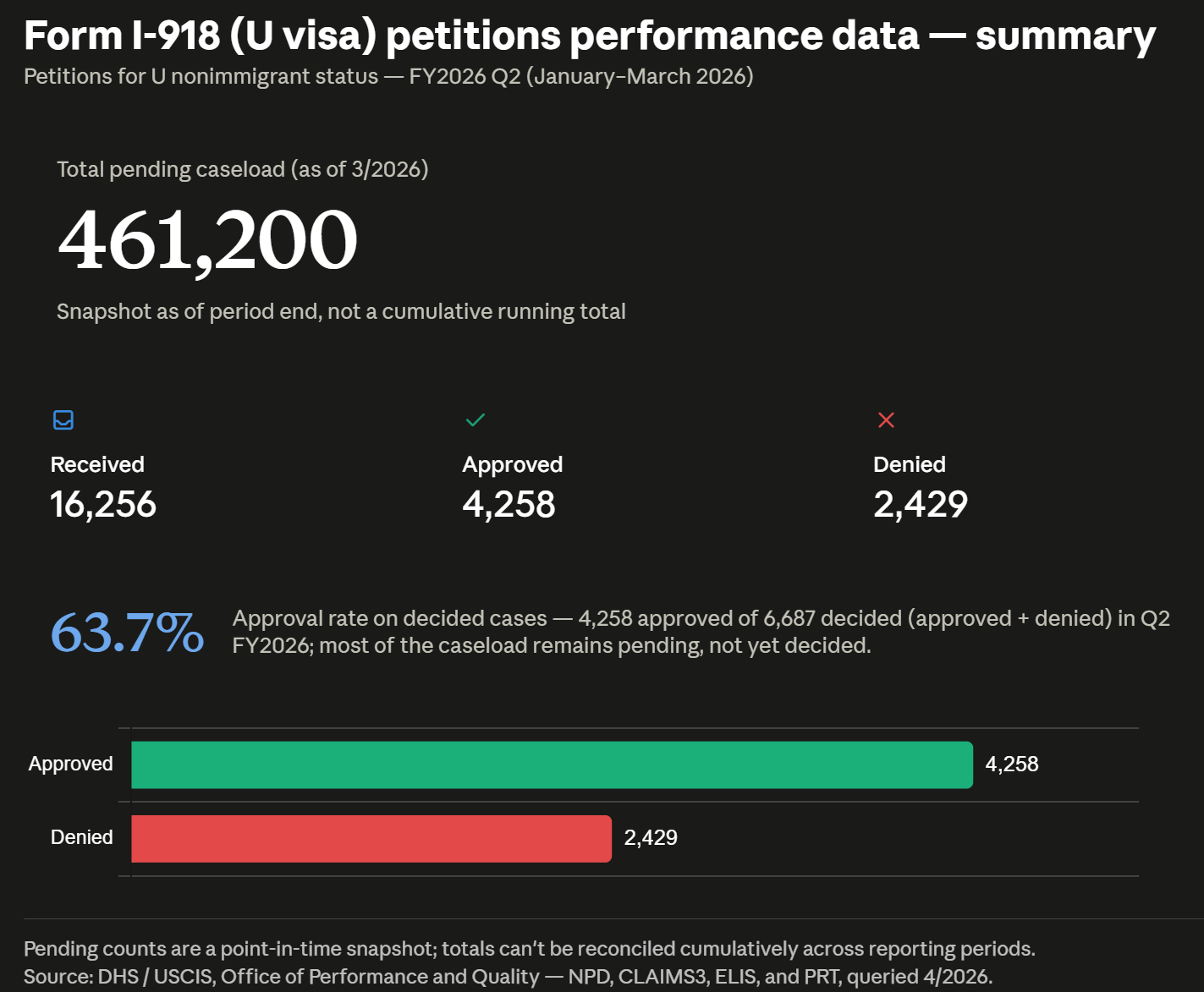
Because the cap creates such a prolonged wait, USCIS introduced the bona fide determination process in 2021 as an administrative mechanism to provide interim relief. When USCIS determines that a petition appears bona fide — meaning the filing is complete, properly signed, and accompanied by a law enforcement certification — the applicant can receive deferred action and work authorization while waiting for a visa number to become available. The BFD review does not approve the underlying petition or guarantee a U visa will ultimately be issued; it is a preliminary eligibility screen that unlocks temporary benefits during the queue.
What Is Changing
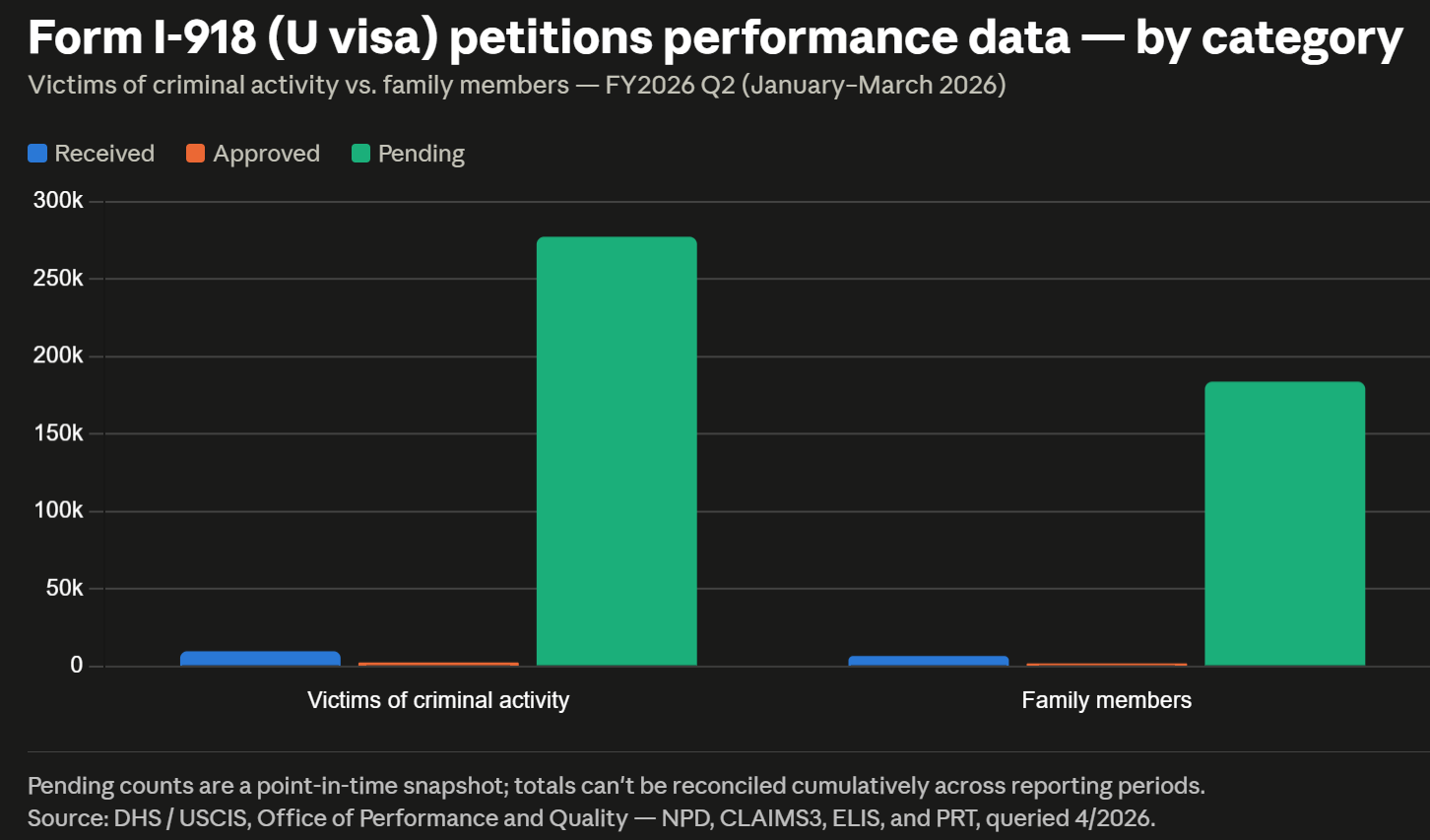
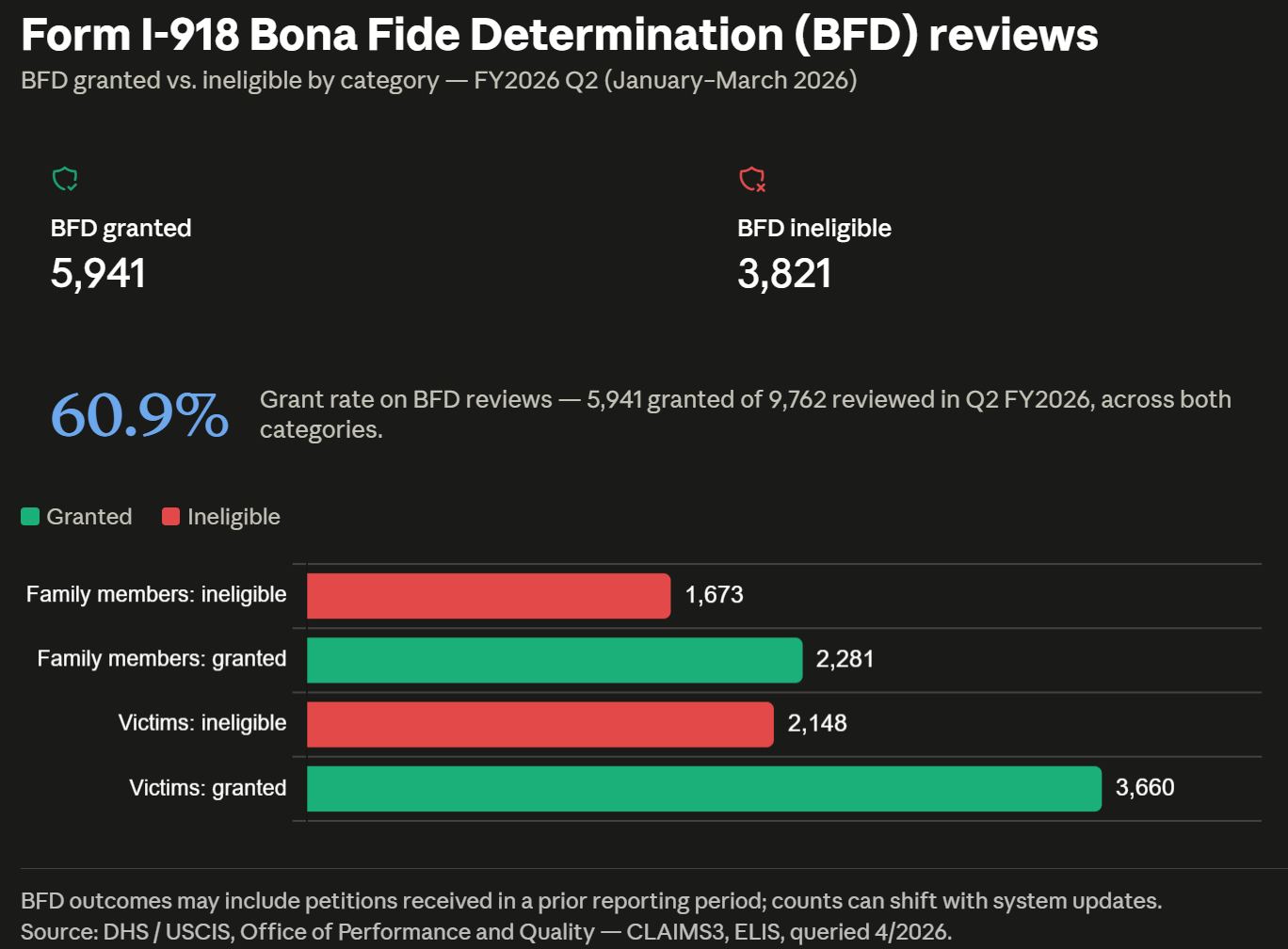
The newly released data does not announce a policy change but rather provides a statistical update on BFD processing volume through the first two quarters of fiscal year 2026. In Q1, covering October through December 2025, USCIS conducted 8,174 granted BFD decisions across both principal petitioners and family members, alongside 4,457 ineligible determinations. Q2, covering January through March 2026, saw 5,941 granted BFDs and 3,821 ineligible outcomes. The combined FY2026 total through Q2 stands at 14,115 granted and 8,278 ineligible.
The data separates outcomes between victims of certain criminal activities — the principal U-1 petitioners — and their qualifying family members, categorized as U-2 through U-5 beneficiaries. Of the 14,115 granted BFDs in FY2026 so far, 8,785 belong to principal victims and 5,330 belong to family members.
Who Is Affected
The BFD data matters most directly to individuals who have already filed Form I-918 petitions for U nonimmigrant status and are awaiting processing. These are crime victims who experienced qualifying criminal activity on U.S. soil, obtained law enforcement certification, and submitted complete petitions. Family members who filed concurrently or derivatively — spouses, children, parents of minor victims, or unmarried siblings of minor victims, depending on the petitioner’s age — are also affected as a distinct tracked category.
Employers are indirectly affected because a BFD grant triggers eligibility for employment authorization, which means a pending employee or prospective hire may become work-authorized before a visa number is ever issued. Immigration attorneys working with crime victim populations, domestic violence advocacy organizations, and nonprofit legal service providers who assist underserved communities with these filings will also draw operational insight from where processing volume is trending.
Practical Implications
The FY2026 numbers, when read against the prior fiscal year trend, reveal a notable deceleration in BFD grant volume. In FY2024, USCIS granted 102,157 BFDs for the full year. FY2025 came in at 103,196. The first half of FY2026 has produced 14,115 — a pace that, if sustained, would yield roughly 28,000 for the full fiscal year. That would represent a dramatic reduction compared to the prior two fiscal years.
Petitioners and their representatives should be cautious about reading too much into two quarters of data, because processing rates can shift significantly across quarters and USCIS itself notes that counts may differ from previous periods due to system updates and post-adjudicative outcomes. Still, applicants who filed petitions and have not yet received a BFD determination or interim work authorization should understand that wait times may be extending, not contracting.
The ineligible BFD rate is also worth monitoring. In FY2026 so far, 8,278 petitions received ineligible determinations against 14,115 granted — a ratio that reflects a meaningful portion of applications failing to clear even the bona fide threshold. This reinforces why complete, well-supported filings with proper law enforcement certifications are essential. An ineligible BFD determination delays access to deferred action and employment authorization, leaving the petitioner in a more vulnerable position during an already lengthy wait.
Applicants who received an ineligible BFD determination should work with qualified counsel to evaluate whether the deficiency is correctable and whether refiling or supplementing the record is appropriate. An ineligible BFD outcome is not the same as a denial of the underlying petition, but it forecloses interim benefits until the issue is resolved.
What to Watch For Next
USCIS will release Q3 data covering April through June 2026 in a subsequent update. Stakeholders should monitor whether the Q1-to-Q2 decline in grant volume continues into the second half of the fiscal year or reflects a temporary processing slowdown. Further guidance on BFD processing priorities or any adjustments to interim benefit policies could emerge from USCIS at any time and should be tracked through the agency’s official newsroom and policy channels. Organizations that advise crime victim populations should also watch for any agency rulemaking or guidance that affects the scope of qualifying criminal activities or the law enforcement certification requirement.
How Immigration Professional Association Can Help
Immigration Professional Association has experience guiding crime victims and their families through the U visa process from the initial filing of Form I-918 through BFD review and, ultimately, the adjudication of the underlying petition. We understand that the people pursuing U nonimmigrant status are often in vulnerable circumstances, facing long processing timelines while waiting for the protection and stability a U visa can provide. Getting the petition right from the beginning — with complete documentation, a qualifying law enforcement certification, and properly supported personal statements — is the single most important factor in reaching a granted BFD outcome and advancing in the queue.
If you or someone you know filed a U visa petition and has questions about BFD status, employment authorization eligibility, or what an ineligible determination means for next steps, we encourage you to reach out to Immigration Professional Association. Our team can review your specific filing situation and help you understand where you stand in the process and what options are available to you.