Introduction
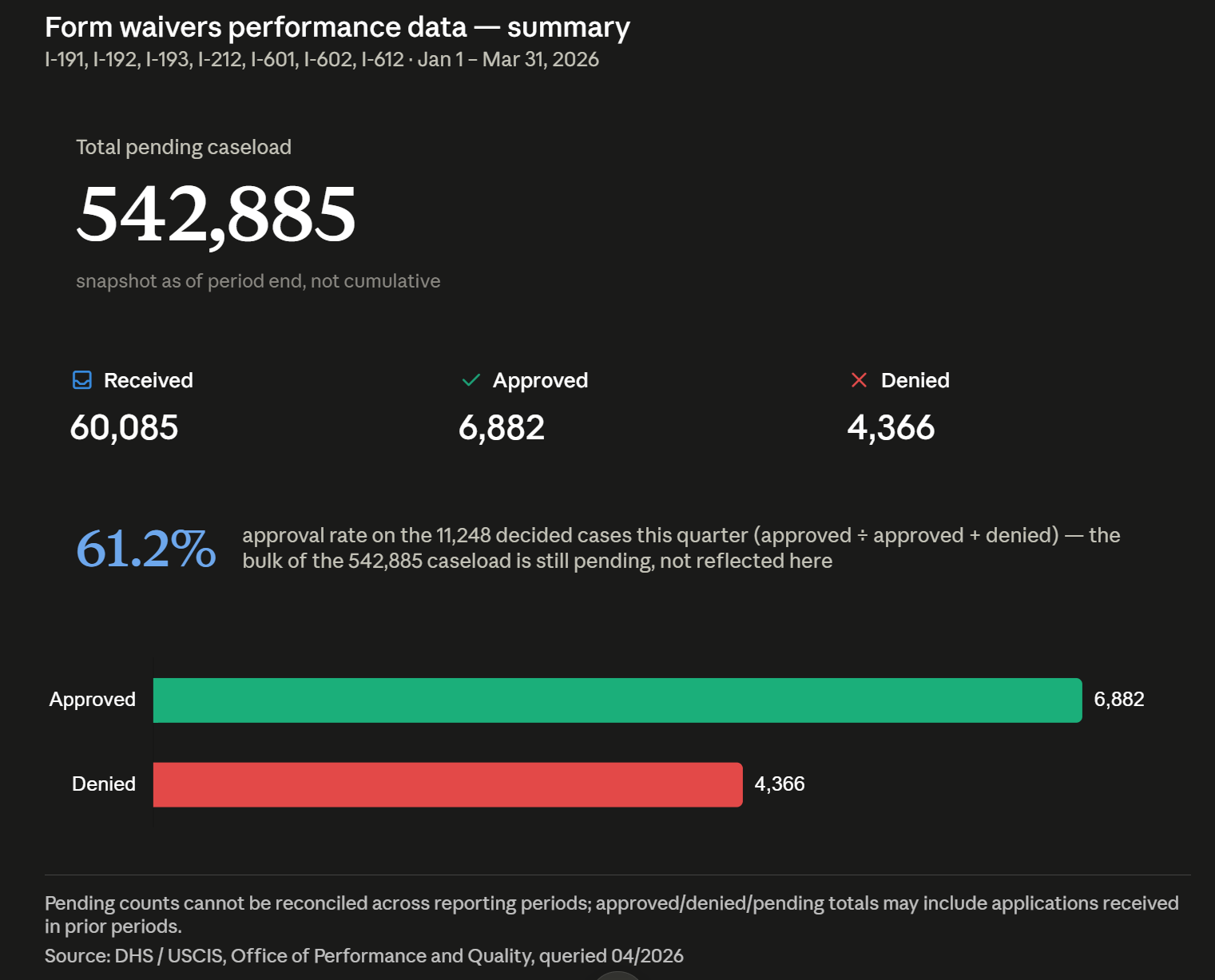
A new USCIS data release covering the second quarter of fiscal year 2026 — January through March 2026 — shows that more than 542,000 waiver cases were pending agency decision as of March 31, 2026. The figures, published by USCIS’s Office of Performance and Quality, provide a rare public window into the agency’s waiver workload across seven distinct application types. For the hundreds of thousands of applicants caught in this backlog, understanding the USCIS waiver pending cases landscape is critical to setting realistic expectations and making sound decisions about timing, travel, and status.
Background
USCIS adjudicates a range of waiver applications that allow individuals to overcome specific legal bars to admission, reentry, or status adjustment under the Immigration and Nationality Act. These waivers are not a single, uniform process — they address fundamentally different situations, from overcoming grounds of inadmissibility to seeking advance permission to enter as a nonimmigrant. Each waiver type carries its own eligibility criteria, evidentiary requirements, and adjudication track. What they share is that a pending waiver typically means an applicant cannot move forward with their immigration case, travel freely, or finalize a visa or adjustment until a decision is issued. The volume of cases in the pipeline directly affects how long that wait lasts.
What the Data Shows
During the second quarter of fiscal year 2026, USCIS received 60,085 new waiver applications across all tracked form types. Over the same three-month period, the agency approved 6,882 applications and denied 4,366 — a combined adjudication output of 11,248 decisions. Against an incoming volume of 60,085 new filings and a pending inventory of more than half a million cases, those output figures illustrate the scale of the processing challenge the agency faces.
The I-192, the Application for Advance Permission to Enter as a Nonimmigrant, dominates the data. It accounts for 45,428 of the 60,085 applications received in the quarter and holds the single largest pending inventory at 446,693 cases — more than 82 percent of the total backlog. The I-601, Application for Waiver of Grounds of Inadmissibility, carries the second-largest pending volume at 67,913 cases, with 10,252 new filings received during the period. The I-212, which allows individuals previously deported or removed to apply for permission to reapply for admission, had 2,982 new filings and 25,274 cases pending.
Smaller but meaningful inventories exist for several other waiver types. The I-612, which addresses the two-year foreign residence requirement under Section 212(e) of the INA for certain exchange visitors, had 1,035 new filings and 2,281 pending cases, with 480 approvals and 282 denials during the quarter — a relatively active adjudication rate compared to its filing volume. The I-602, filed by refugees seeking a waiver of inadmissibility grounds, showed 375 new filings, 282 approvals, and only 10 denials, with 253 pending. The I-191, addressing relief under former INA Section 212(c), and the I-193, for waiver of passport and visa requirements, each had minimal activity but maintained small pending inventories of 178 and 293 cases respectively.
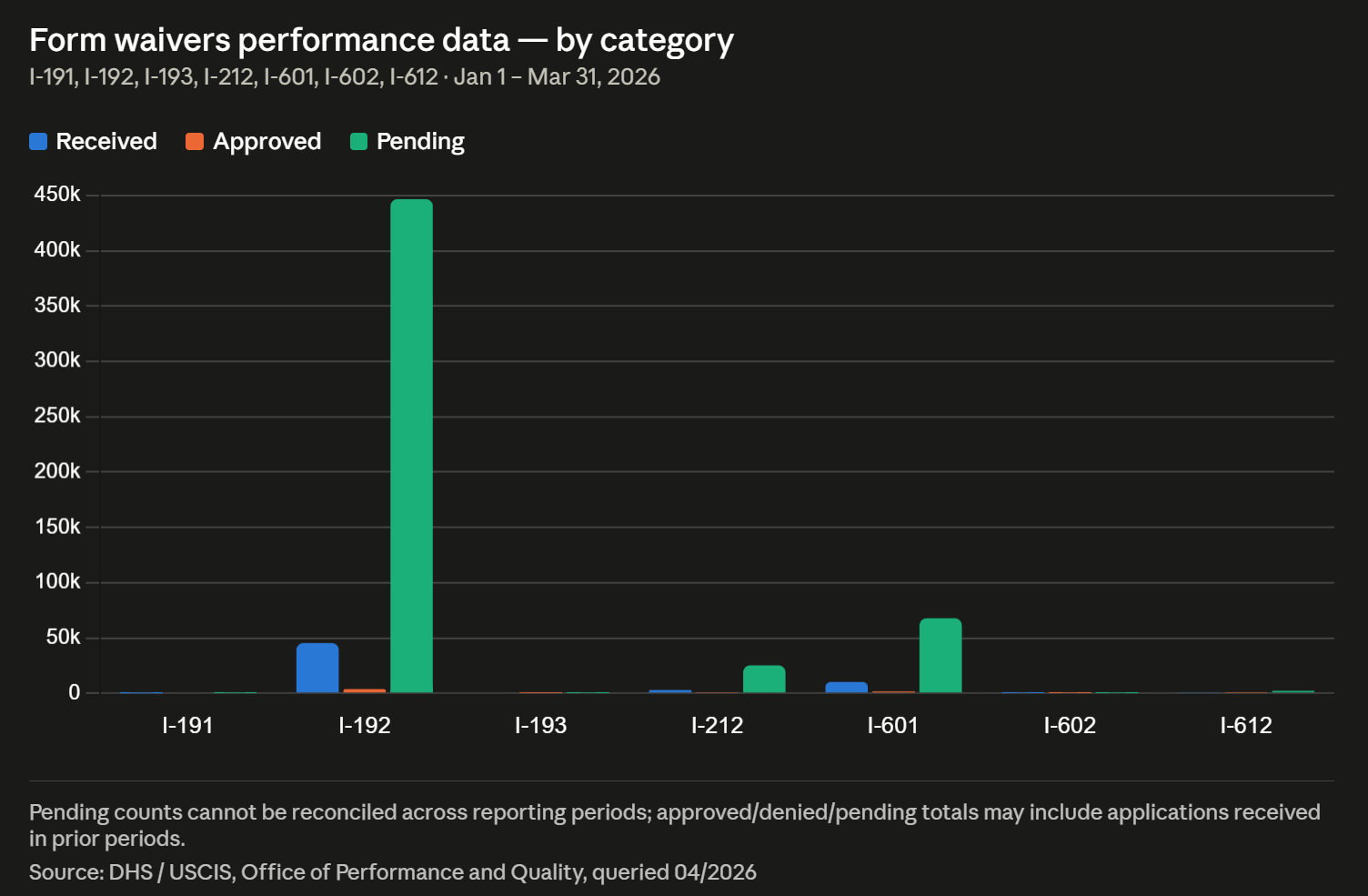
USCIS notes explicitly in the data release that pending counts cannot be reconstructed arithmetically from prior periods because some case actions — including administrative closures and inter-office transfers — are not reflected in this report.
Who Is Affected
The applicants most directly affected by these figures are the individuals whose cases make up the 542,885 pending inventory. For I-192 filers — often individuals seeking advance permission to enter the United States as nonimmigrants despite prior inadmissibility findings — the backlog of nearly 447,000 cases means that processing timelines are likely extended well beyond a single quarter. For I-601 applicants, who include family members of U.S. citizens and lawful permanent residents seeking to waive a wide range of inadmissibility grounds, the 67,913 pending cases represent real delays in family-based immigration timelines.
Employers are indirectly affected when a sponsored foreign national’s waiver remains unresolved, blocking the completion of an adjustment of status or consular processing case. U.S. citizen and LPR family members of applicants waiting on I-601 or I-212 decisions face prolonged separation from relatives. Exchange visitor alumni and their sponsoring institutions have an interest in I-612 outcomes, since the home-residence requirement can block otherwise approvable visa applications. Attorneys and accredited representatives managing waiver cases must account for the pending volumes when advising clients on realistic timelines.
Practical Implications
The approval-to-denial ratio within this quarter’s data varies significantly by form type, and that variation carries strategic weight. The I-602 shows a strikingly favorable outcome ratio — 282 approvals versus only 10 denials — though its small filing volume limits how broadly that pattern can be generalized. The I-601 shows a much tighter ratio, with 1,744 approvals and 1,675 denials in the same period, suggesting that this waiver type remains highly contested and that the strength of the underlying application matters considerably. The I-612 also reflects meaningful denial volume relative to approvals, reinforcing the need for thorough documentation in exchange visitor hardship waiver cases.
For applicants with cases already pending, the data confirms that their files sit within an enormous inventory — particularly for I-192 and I-601 petitions. Planning around a waiver approval as if it were imminent carries significant risk. Travel plans, employment start dates, and other life decisions that depend on a waiver outcome should be structured with flexibility wherever possible.
For those who have not yet filed, the pending volumes suggest that delays between filing and decision will persist through at least the near term. Filing complete, well-documented applications from the outset remains the most effective way to minimize back-and-forth and avoid requests for evidence that extend processing time further.
One area the data does not address is processing time benchmarks by office or case type — USCIS publishes those figures separately through its processing times tool. Applicants and practitioners should consult current processing time estimates in combination with this pending volume data to build realistic case timelines.
What to Watch For Next
USCIS releases quarterly waiver data on a rolling basis, and the next update covering the third quarter of fiscal year 2026 — April through June 2026 — is expected to follow the same publication schedule. Practitioners and applicants should monitor whether adjudication output increases relative to new filings, particularly for I-601 and I-192 cases where the gap between filings received and decisions issued is widest. Any policy changes affecting waiver adjudication priorities or staffing would be expected to appear in subsequent quarterly data.
How Immigration Professional Association Can Help
Navigating the waiver process — whether it involves an I-601 inadmissibility waiver, an I-212 reapplication after removal, an I-192 for advance permission to enter, or an I-612 to overcome the foreign residence requirement — demands careful preparation from the very first filing. At Immigration Professional Association, our team works regularly with individuals and families whose immigration cases involve one or more of these waiver types. We understand that a poorly prepared waiver application does not simply get denied — it costs months of additional waiting in a system already carrying more than half a million pending cases.
If you or a family member has a waiver application pending, is considering filing one, or is trying to understand how an inadmissibility issue may affect a visa application or adjustment of status case, Immigration Professional Association can provide the focused attention your situation requires. Reach out to our team to discuss your specific waiver matter and what a realistic, well-prepared filing strategy looks like for your circumstances.