Introduction
New federal data shows that more than 2.3 million I-130 petitions were pending with U.S. Citizenship and Immigration Services at the close of the second quarter of fiscal year 2026. USCIS released this figure as part of its quarterly performance data publication covering the period from January 1 through March 31, 2026. For U.S. citizens and lawful permanent residents hoping to bring family members to the United States, the I-130 petition backlog represents a concrete and consequential obstacle — one that shapes timelines, planning decisions, and legal strategy for millions of households across the country.
Background
Form I-130, the Petition for Alien Relative, is the foundational document in family-based immigration. A U.S. citizen or lawful permanent resident files it to establish the existence of a qualifying family relationship with a foreign national relative. Approval of the I-130 does not itself grant a visa or lawful status — it establishes eligibility and, for most categories, begins the wait for a visa number to become available under the annual numerical limits set by Congress.
Two broad categories govern who can be sponsored. Immediate relatives of U.S. citizens — including spouses, unmarried children under 21, and parents — are not subject to numerical caps, meaning their petitions are not placed in a preference queue. All other relatives, including adult children, married children, and siblings of citizens, as well as most relatives of lawful permanent residents, fall under the family preference system, where annual numerical limits and per-country caps create waiting periods that can stretch years or even decades.
What the Data Shows
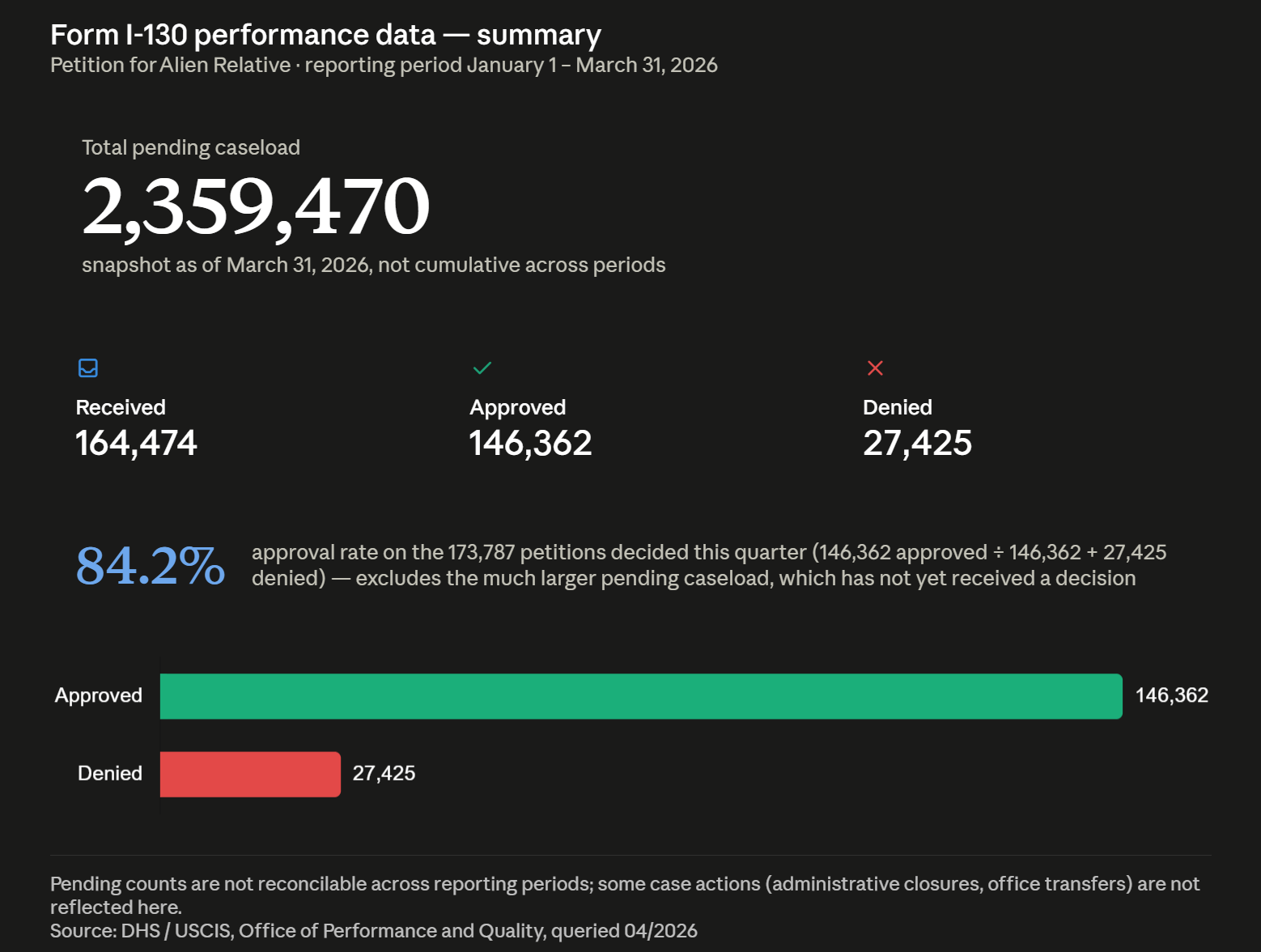
As of March 31, 2026, USCIS reported a total of 2,359,470 I-130 petitions pending across its field offices and service centers nationwide. Of that total, approximately 761,638 were pending in the immediate relative category — petitions for the spouses, minor children, and parents of U.S. citizens who are exempt from annual visa caps. The far larger share of the pending caseload, roughly 1,597,832 petitions, fell under the family preference categories, where numerical limitations make wait times substantially longer.
Petition for Alien Relative · reporting period January 1 – March 31, 2026
During the quarter itself, USCIS received 164,474 new petitions and approved 146,362 — meaning new filings continued to outpace approvals at the national level. The agency issued 27,425 denials over the same period. These figures capture only petitions entered into USCIS case-tracking systems and do not include activity at international offices.
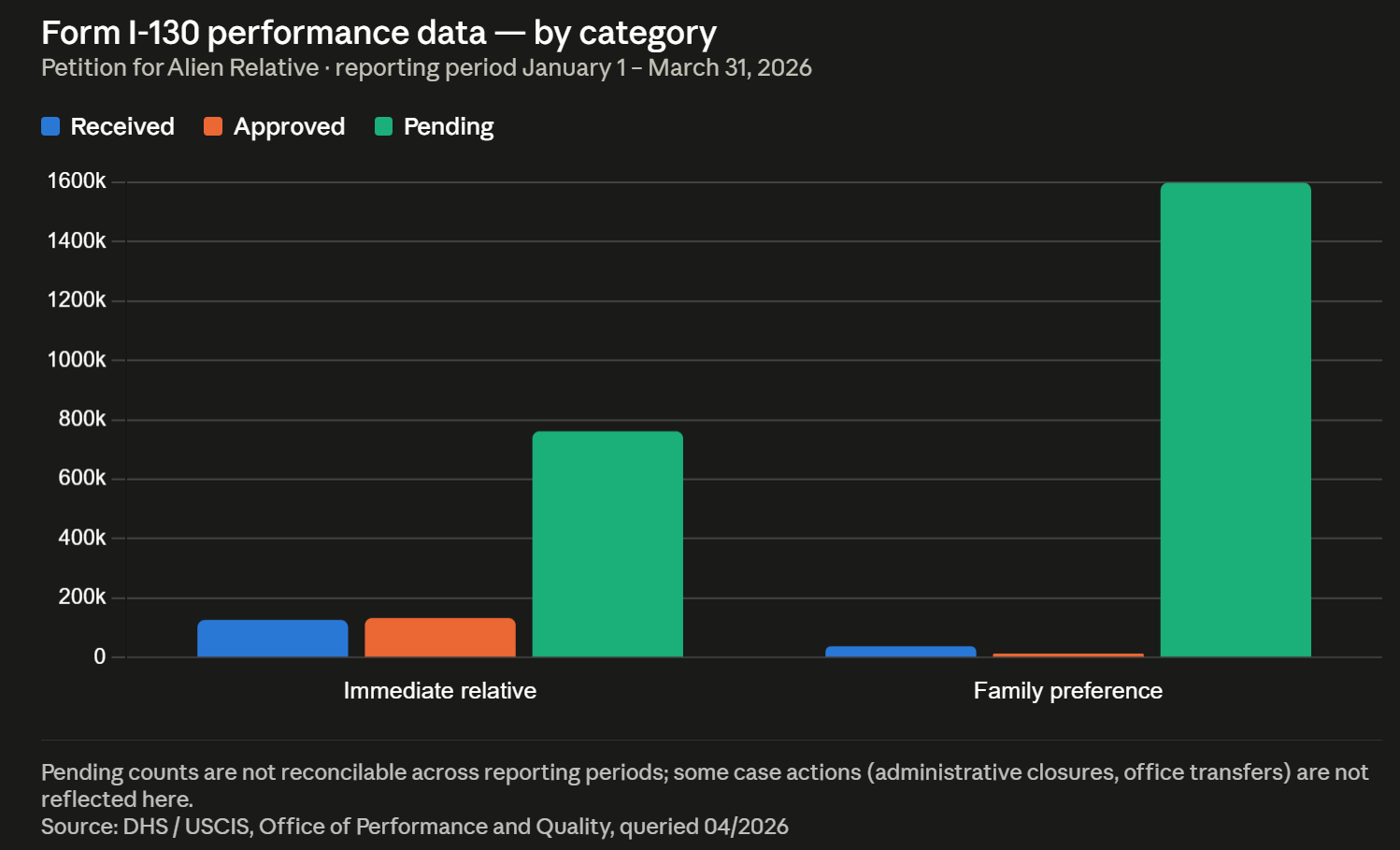
Petition for Alien Relative · reporting period January 1 – March 31, 2026
The service center caseload drives the bulk of these numbers. The four regional service centers — handling cases from California, Nebraska (the National Benefits Center and Nebraska Service Center), Texas, Vermont, and the Potomac Service Center — collectively account for the overwhelming majority of pending petitions. The California Service Center alone carried more than 449,000 pending petitions at quarter’s end, and the Vermont Service Center held more than 465,000. By comparison, individual field offices carry substantially smaller pending volumes, typically in the low thousands, though offices in major metropolitan areas like Houston (13,157 pending), Atlanta (9,567 pending), and Baltimore (10,066 pending) show considerably higher concentrations.
Who Is Affected
The most directly affected individuals are foreign national relatives waiting for a petition decision and the U.S. citizen or LPR petitioners who filed on their behalf. For immediate relatives of citizens, the pending volume means delays even for a visa category that carries no numerical cap — the bottleneck is adjudication capacity, not visa availability. For those in the family preference categories, a pending I-130 is only the first of several waiting periods; visa number availability through the State Department’s monthly Visa Bulletin introduces additional delays after petition approval.
Employers and HR professionals are generally not direct parties to I-130 proceedings, but they may have employees navigating these timelines in their personal immigration matters — particularly in industries with large immigrant workforces. Immigration attorneys and accredited representatives are indirectly affected to the extent that growing backlogs require more complex planning conversations with clients about realistic timelines and interim status options.
Notably, the data reflects only domestic USCIS offices. Petitions processed through U.S. embassies and consulates abroad are not captured in these counts.
Practical Implications
The scale of the pending caseload has several concrete implications for people currently in or entering the family-based immigration process. First, filing promptly matters. Because USCIS’s processing queues are long and the petition receipt date determines where an applicant sits in the preference category line, delays in filing translate directly into later priority dates and longer overall waits. Even in the immediate relative category — where there is no visa queue — adjudication delays mean that related steps like consular processing or adjustment of status cannot begin.
Second, the regional distribution of pending cases suggests that the office or service center handling a petition may meaningfully affect how long processing takes. Petitioners should verify current processing times on the USCIS website for their specific office and monitor for any changes. The data also shows notable variation in denial rates across offices, which underscores the importance of submitting complete and well-supported petitions from the outset.
Third, for family preference category beneficiaries, an approved I-130 does not shorten the visa queue — it simply establishes a place in line. Beneficiaries in heavily oversubscribed categories, such as siblings of U.S. citizens or adult married children, should understand that total wait times frequently extend well beyond the petition adjudication period itself. Planning for long-term status maintenance in the interim is an essential part of any family-based immigration strategy.
Finally, the high volume of pending cases means USCIS processing times remain sensitive to any operational disruptions, staffing changes, or policy shifts. A case that appears straightforward can be affected by factors outside the petitioner’s control, making ongoing monitoring and responsive document submission important.
What to Watch For Next
USCIS releases updated I-130 performance data on a quarterly basis, and the next release covering Q3 FY2026 will provide a more current view of whether pending volumes are increasing, stabilizing, or declining. Stakeholders should also monitor USCIS’s published processing time tools, which are updated separately and more frequently than the quarterly data reports. Any changes to staffing levels, adjudication priorities, or fee structures at USCIS could affect throughput and pending volumes in subsequent quarters. Further guidance from USCIS on processing initiatives or policy changes affecting family-based petitions is anticipated to emerge through agency announcements rather than this statistical report itself.
How Immigration Professional Association Can Help
Family-based immigration is among the most personal areas of immigration law — and among the most procedurally complex when backlogs are long and timelines are uncertain. At Immigration Professional Association, we work with U.S. citizens, lawful permanent residents, and their families to navigate every stage of the I-130 process, from determining the correct petition category and assembling a complete evidentiary record to managing the steps that follow approval, including consular processing and adjustment of status applications.
With more than two million petitions pending at USCIS, getting the details right from the start is more important than ever. A well-prepared petition reduces the risk of unnecessary delays caused by requests for evidence, and a clear understanding of realistic timelines helps families make informed decisions about interim status, travel, and long-term planning. If you or a family member is considering filing an I-130 — or if a petition is already pending and you have questions about what comes next — we welcome the opportunity to talk through your specific situation. Contact Immigration Professional Association today to speak with someone who can help you understand where you stand and what steps make sense for your family’s goals.