Introduction
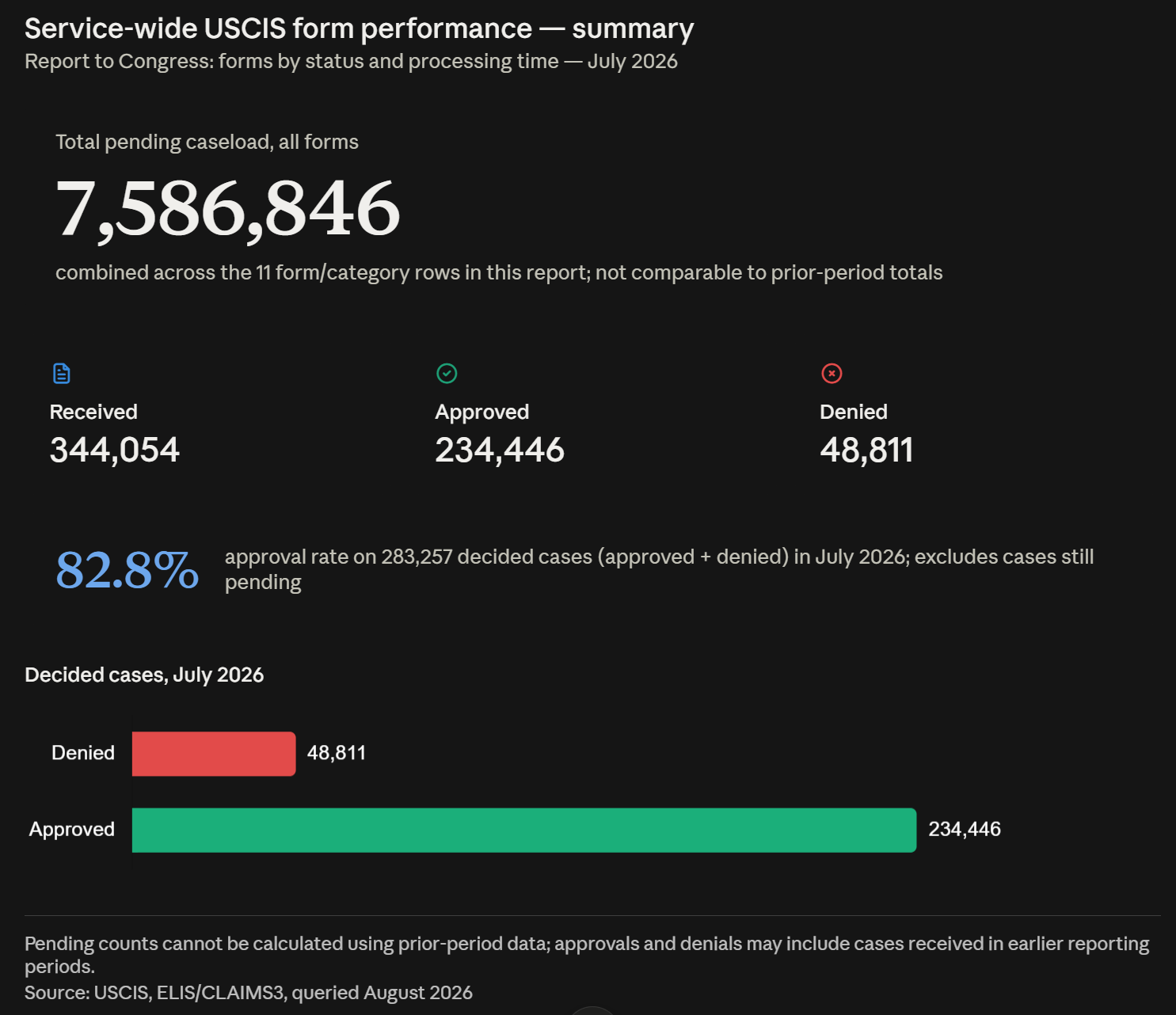
USCIS released its July 2026 congressional report on agency-wide form processing, and the numbers confirm what many applicants, employers, and immigration practitioners have been experiencing firsthand: the Employment Authorization Document backlog, formally tracked through I-765 pending cases, has reached 2.1 million cases awaiting a decision. The July 2026 USCIS processing report, mandated by the Consolidated Appropriations Act of 2022, covers receipts, approvals, denials, and pending counts across eleven major form types for the month of July 2026. Taken together, the data paint a detailed picture of where the agency stands, and where applicants are most likely to feel the strain.
Background
USCIS is required by Congress to report processing data on a monthly basis as a condition of its appropriations funding. That requirement stems from the Consolidated Appropriations Act of 2022 and the accompanying Joint Explanatory Statement, which directed the agency to produce regular, public-facing reports on form-level performance. The report covers forms received, approvals, denials, total pending cases, the subset pending over six months, and average processing times, all measured as of the end of the reporting period. The data underlying the July 2026 report were queried from USCIS case-tracking systems in August 2026.
These reports serve an important accountability function. Before Congress mandated this level of transparency, applicants and practitioners had limited visibility into system-wide backlogs. The current reporting structure allows meaningful comparisons across form types and provides a baseline for assessing whether agency output is keeping pace with incoming demand.
What the July 2026 Data Show
The I-765, Application for Employment Authorization, leads the report in total pending volume. As of July 2026, 2,100,336 I-765 applications were awaiting a decision, with 1,383,136 of those pending for more than six months. The average processing time for I-765 completions in July was 5.8 months. USCIS received 153,170 new I-765 applications during the month and approved 135,089, while issuing 30,068 denials. The gap between incoming applications and completed decisions is one contributor to the accumulating backlog.
The I-130, Petition for Alien Relative, carries the largest raw pending total among all forms tracked: 2,451,921 cases, with 2,142,026 of those pending over six months. Average processing time for I-130 completions in July stood at 17.7 months. The I-130 differs from the I-765 in a key way: I-130 approval alone doesn’t confer immigration status or work authorization; it starts a multi-stage process tied to visa availability and downstream applications.
Adjustment of status applications (I-485) appear in several subcategories. Family-based I-485 cases show 604,449 pending and an average processing time of 11.8 months. Employment-based I-485 cases total 269,963 pending, with a notably lower six-month overage proportion (136,226 out of 269,963) and a 10.5-month average. The asylum-based and refugee-based I-485 subcategories show the longest average times, 30.6 months and 21.3 months respectively, and among the highest proportions of cases pending over six months.
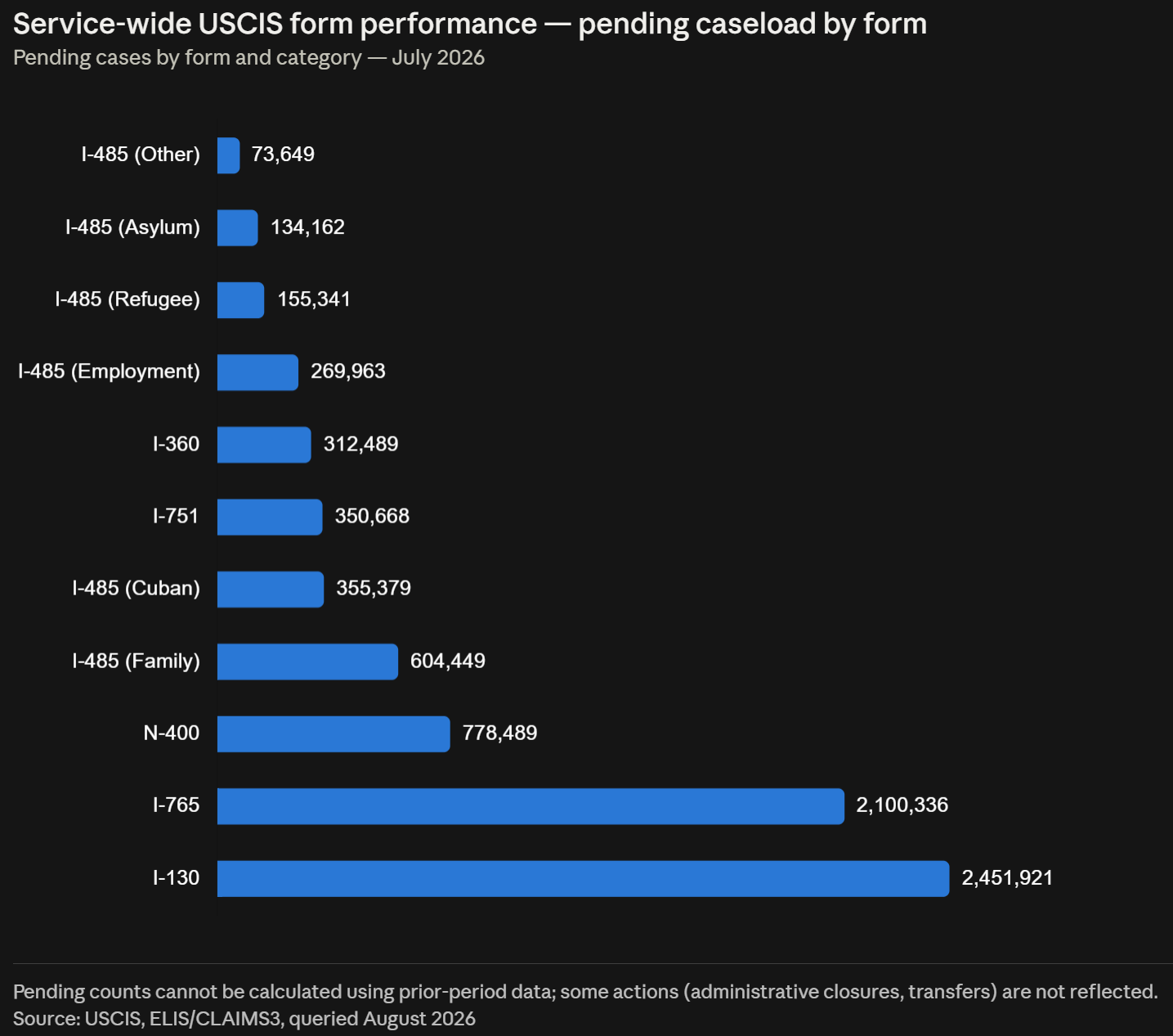
The I-751, Petition to Remove Conditions on Residence, reflects 350,668 pending cases with a 23.5-month average processing time. The N-400, Application for Naturalization, sits at 778,489 pending cases with an 11.4-month average; 485,003 of those have been pending more than six months.
Who Is Affected
The I-765 backlog most directly affects individuals who depend on Employment Authorization Documents to work lawfully. This includes applicants for adjustment of status (who file the I-765 as a derivative benefit), asylum seekers awaiting an initial EAD, DACA recipients renewing their work permits, parolees, certain nonimmigrant status holders, and a range of other categories that require work authorization independent of employer sponsorship. For all of these individuals, delays beyond six months create real disruption: gaps in employment authorization, income interruption, and cascading effects on dependents.
Employers are also directly affected, particularly those with employees whose work authorization is tied to a pending I-765. Human resources and compliance teams tracking I-9 documentation need to understand re-hire or continued employment risks when EAD renewals are delayed. Employment-based green card applicants face dual pressure: the I-485 employment-based subcategory shows meaningful volume, and many of those applicants also filed concurrent I-765 applications.
The I-130 backlog primarily affects U.S. citizens and lawful permanent residents who have filed family-based petitions, as well as the foreign national beneficiaries waiting overseas or in the United States. The I-130 itself doesn’t directly authorize any action, though; its role is to establish the petitioner-beneficiary relationship for eventual visa processing or adjustment.
Conditional permanent residents awaiting I-751 adjudication face their own category of uncertainty. A pending I-751 with an I-797 receipt notice typically extends status and work authorization, but a 23.5-month average processing time means this population may carry interim documentation for nearly two years before receiving a decision.
Practical Implications
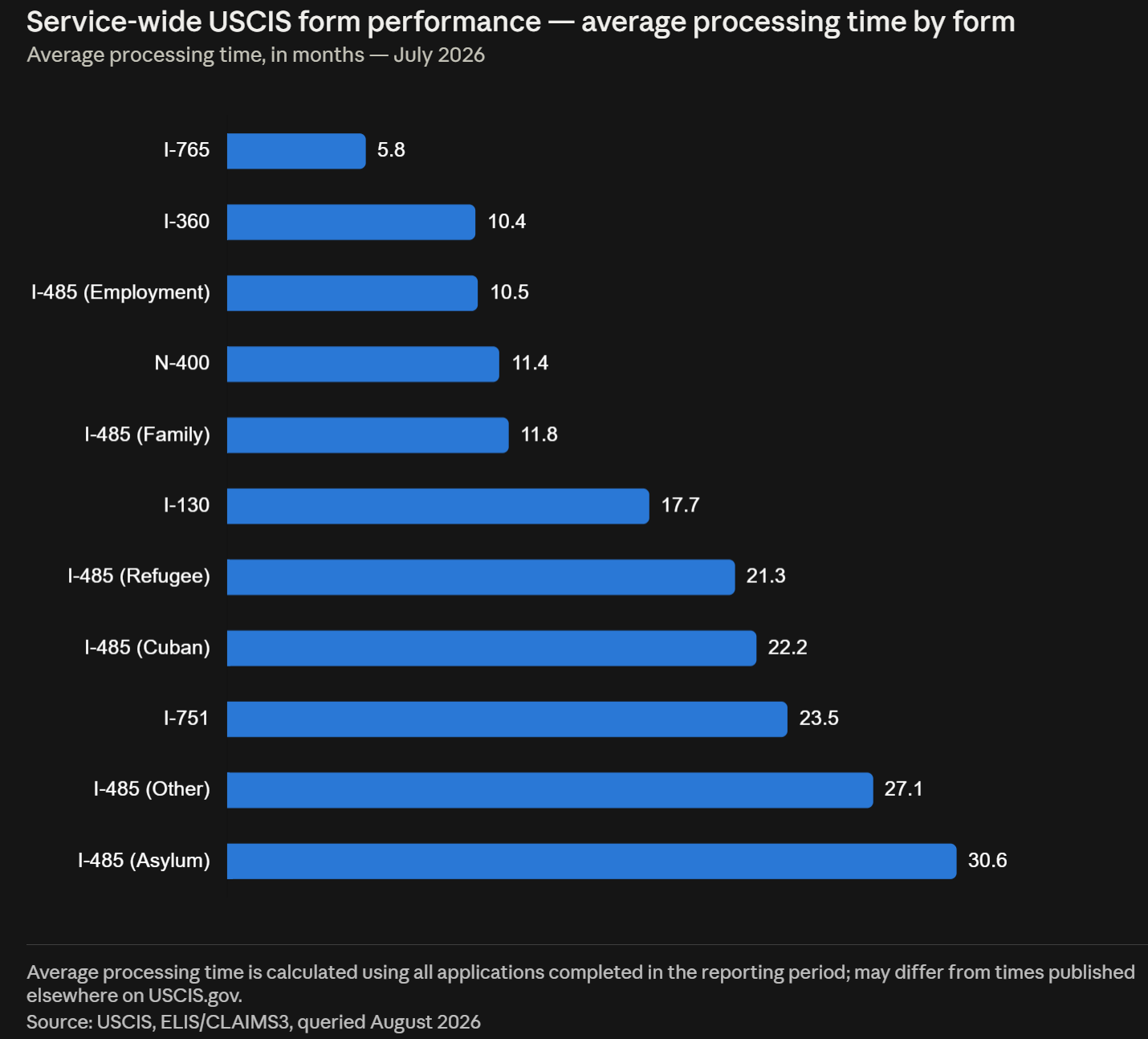
For I-765 applicants, a 5.8-month average processing time sits close to, and for a large portion of the pending population, well past, the six-month threshold. Applicants who filed EAD renewals and are approaching or have passed their current EAD expiration date should confirm whether their category qualifies for an automatic extension under USCIS rules, because not all I-765 categories are eligible. Those who are eligible for automatic extensions should make sure their employer has the correct documentation on file.
For employment-based adjustment of status applicants, the 10.5-month I-485 average is meaningfully shorter than asylum or refugee-based categories, but still represents nearly a year of pending status. Applicants in this category typically file the I-765 concurrently, meaning EAD receipt timelines and I-485 timelines interact closely. Any request for evidence or biometrics appointment delay can push both timelines back.
The I-130 data requires careful interpretation. An average of 17.7 months for completions in July doesn’t mean every I-130 case will take that long; the average reflects a range, and the type of relationship (immediate relative versus preference category) significantly affects downstream priority. Immediate relative petitions, once approved, aren’t subject to visa backlogs; preference category beneficiaries still face waits tied to the Visa Bulletin after I-130 approval.
For naturalization applicants, the N-400 data suggests that 485,003 cases have been pending more than six months. Applicants who have already had their interviews but are awaiting a decision should note that USCIS policy provides certain options when adjudication is significantly delayed post-interview, and those options may be worth exploring.
What to Watch For Next
USCIS releases this congressional report monthly, and the August 2026 report, reflecting data queried later in the year, will show whether July’s figures represent a plateau, an acceleration, or the start of a reduction. Stakeholders tracking the I-765 backlog in particular should watch for whether USCIS announces any targeted processing initiatives for employment authorization, since the agency has taken such steps in prior periods of elevated EAD demand. No specific remediation announcement was included in this report. Further guidance on processing priorities is expected from USCIS through its regular policy channels.
How Immigration Professional Association Can Help
The backlog figures in this report aren’t abstractions; they translate directly into delayed work authorization, stalled green card timelines, and uncertainty for families and employers navigating a system under real pressure. Immigration Professional Association works directly with individuals and employers across the full range of forms represented in this report: from initial I-130 family petitions to concurrent I-485 and I-765 filings, I-751 condition removals, and naturalization applications.
Our team understands how these timelines interact, particularly for employment-based applicants managing concurrent I-485 and EAD filings, or for conditional residents trying to bridge the gap during extended I-751 adjudication. When a case is pending longer than expected or a response to a request for evidence is needed, knowing the current landscape matters as much as knowing the underlying law.
If your application or your employee’s application appears in any of the form categories reflected in this report, and you have questions about where your case stands, what interim documentation options may apply, or how to respond to delays, Immigration Professional Association is ready to help you navigate what the numbers actually mean for your specific situation. Contact us to speak with our team about your pending case or upcoming filing.