Introduction
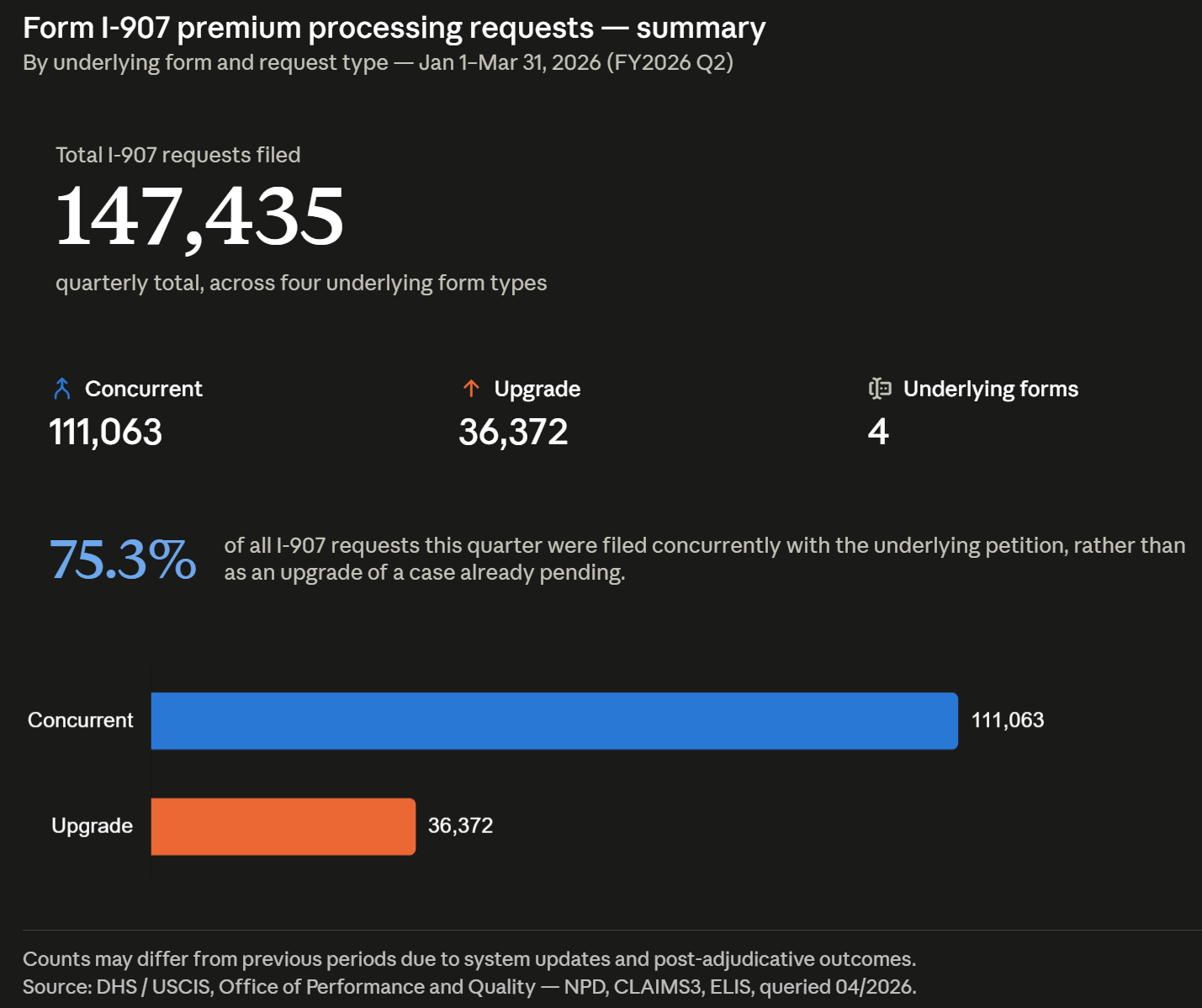
USCIS processed nearly 147,500 premium processing requests during the first quarter of fiscal year 2026, according to data released by the agency covering January 1 through March 31, 2026. The figures, drawn from Form I-907 filings and published by the USCIS Office of Performance and Quality, offer a detailed snapshot of how heavily petitioners and applicants are relying on expedited adjudication at the start of this calendar year. For employers, foreign nationals, and their representatives navigating premium processing options, this data provides useful context for understanding current demand levels and the strategic choices driving them.
Background
Premium processing is an optional service that allows petitioners and applicants to pay an additional fee in exchange for a guaranteed adjudication timeline on certain immigration benefits. USCIS processes these requests through Form I-907, which can be filed in one of two ways: concurrently with the underlying petition or application at the time of initial submission, or as an upgrade request while the underlying case is still pending. The service is available for a defined set of immigration forms, including nonimmigrant worker petitions, immigrant visa petitions for workers, certain change or extension of status applications, and employment authorization documents. Congress expanded premium processing eligibility in recent years, allowing USCIS to extend this option to categories that were previously excluded, which partly explains the broader distribution of I-907 filings now visible in quarterly reports.
What Is Changing
This particular release is a data publication rather than a policy change. USCIS’s Office of Performance and Quality issued the Q2 FY2026 premium processing report as part of the agency’s ongoing performance data transparency efforts. The report covers the period from January 1 to March 31, 2026, and reflects the most current estimates available at the time the agency queried its internal databases in April 2026. USCIS notes that counts may differ from earlier periods due to system updates and post-adjudicative adjustments, meaning the figures represent best available estimates rather than final adjudicated totals. No new policy, fee change, or eligibility modification accompanied this data release.
Who Is Affected
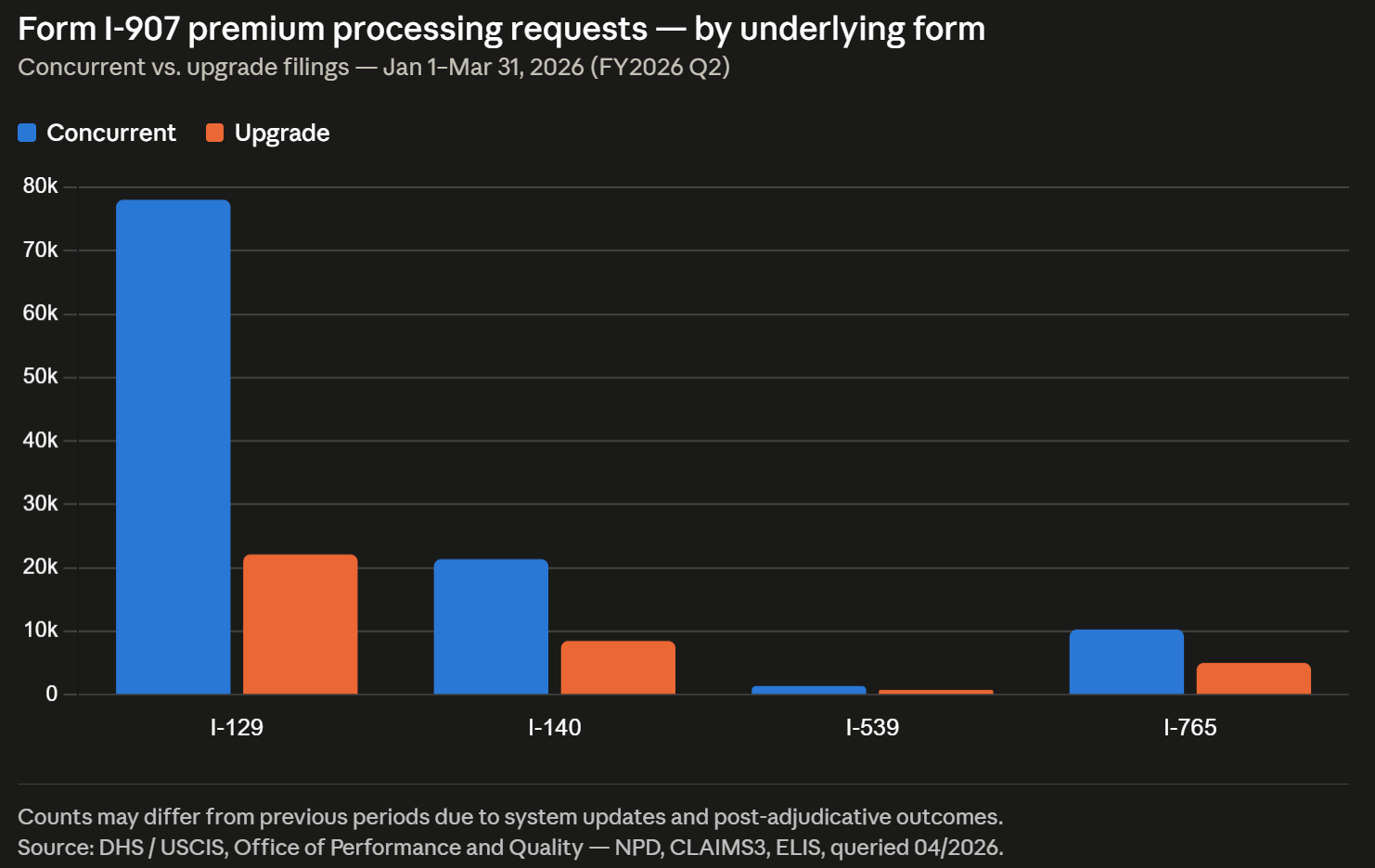
The data speaks most directly to the universe of petitioners and applicants currently using premium processing — a population that spans a wide range of immigration contexts. Employers petitioning for nonimmigrant workers under Form I-129 accounted for the largest share of total premium processing activity by a significant margin, generating 100,136 of the 147,435 total requests filed during the quarter. This category covers a broad range of nonimmigrant classifications, including H-1B, L-1, O-1, TN, and several others, making it the central driver of overall premium processing demand.
Workers seeking to change or extend nonimmigrant status through Form I-539 accounted for 2,128 requests — the smallest share among the four form types in the report, but still a notable volume given that premium processing availability for this form type is relatively recent. Employment authorization applicants filing Form I-765 generated 15,317 requests, reflecting the value that applicants place on accelerated decisions when employment eligibility hangs on a pending EAD. Immigrant petitions under Form I-140 produced 29,854 requests, underscoring ongoing employer and employee interest in expedited processing even at the permanent residence petition stage, where priority date backlogs mean an approved petition does not always translate into immediate immigration benefit.
Indirect stakeholders include HR and talent acquisition teams who track premium processing as part of workforce planning, as well as legal practitioners who advise on when the additional cost is strategically justified versus when standard processing timelines are acceptable.
Practical Implications
The sheer volume of premium processing requests filed in a single quarter — nearly 147,500 — reflects the degree to which petitioners and applicants view the standard processing timeline as an unacceptable risk for time-sensitive situations. For employers planning H-1B amendments, extensions, or new hires, the dominance of I-129 filings in this data confirms that premium processing has effectively become a standard tool rather than an exceptional one in many corporate immigration programs.
The split between concurrent filings and upgrade requests is also instructive. Of the 147,435 total requests, 111,063 were filed concurrently with the underlying petition, while 36,372 were upgrades filed after initial submission. The concurrent filing figure suggests that a substantial majority of petitioners are making the premium processing decision upfront rather than waiting to see how standard processing times develop. The upgrade volume, however, indicates that a meaningful number of petitioners initially opt for standard processing and then convert — likely when processing times extend beyond their tolerance threshold or when a specific business need arises mid-adjudication.
For I-140 petitioners, the nearly 30,000 premium processing requests warrant particular attention. An approved I-140 can preserve a priority date and serve as leverage in retaining international employees, even when an immigrant visa number is not immediately available. Employers navigating retention risk with foreign national employees should factor premium processing into their I-140 strategy accordingly, especially in visa categories with long backlogs.
Applicants filing I-765 employment authorization renewals should also note the high premium processing volume for that form. Gaps in work authorization carry serious consequences for both employees and their sponsoring employers. The 15,317 premium processing requests filed for I-765 in a single quarter signal how seriously affected parties view that risk.
What to Watch For Next
USCIS publishes premium processing data on a quarterly basis, and the Q3 FY2026 report — covering April through June 2026 — is expected to follow as agency systems are queried in subsequent months. Stakeholders monitoring premium processing fee levels should note that USCIS has the authority to adjust premium processing fees periodically under existing statutory authority, and any proposed fee schedule adjustments would be announced through the standard federal rulemaking process. Practitioners and employers should also monitor whether USCIS further expands or modifies premium processing eligibility for additional form types, as the agency has taken incremental steps in that direction in recent years.
How Immigration Professional Association Can Help
Understanding aggregate premium processing data is useful, but translating it into a sound strategy for a specific petition or application is where professional guidance makes a genuine difference. At Immigration Professional Association, we work with employers and individuals daily on exactly the kinds of decisions this data reflects — when to request premium processing upfront, when an upgrade makes sense for a pending case, and how to structure I-129, I-140, I-539, and I-765 filings to protect our clients’ timelines and employment authorization.
Whether you are an HR professional managing a corporate immigration program that spans dozens of I-129 petitions each year, an employer weighing whether to prioritize I-140 approval for key foreign national talent, or an individual applicant facing a critical employment authorization deadline, our team understands the mechanics and the stakes involved. If the Q2 FY2026 data reflects decisions you are actively navigating right now, we encourage you to reach out to Immigration Professional Association to discuss how premium processing fits into your specific filing strategy.