Introduction
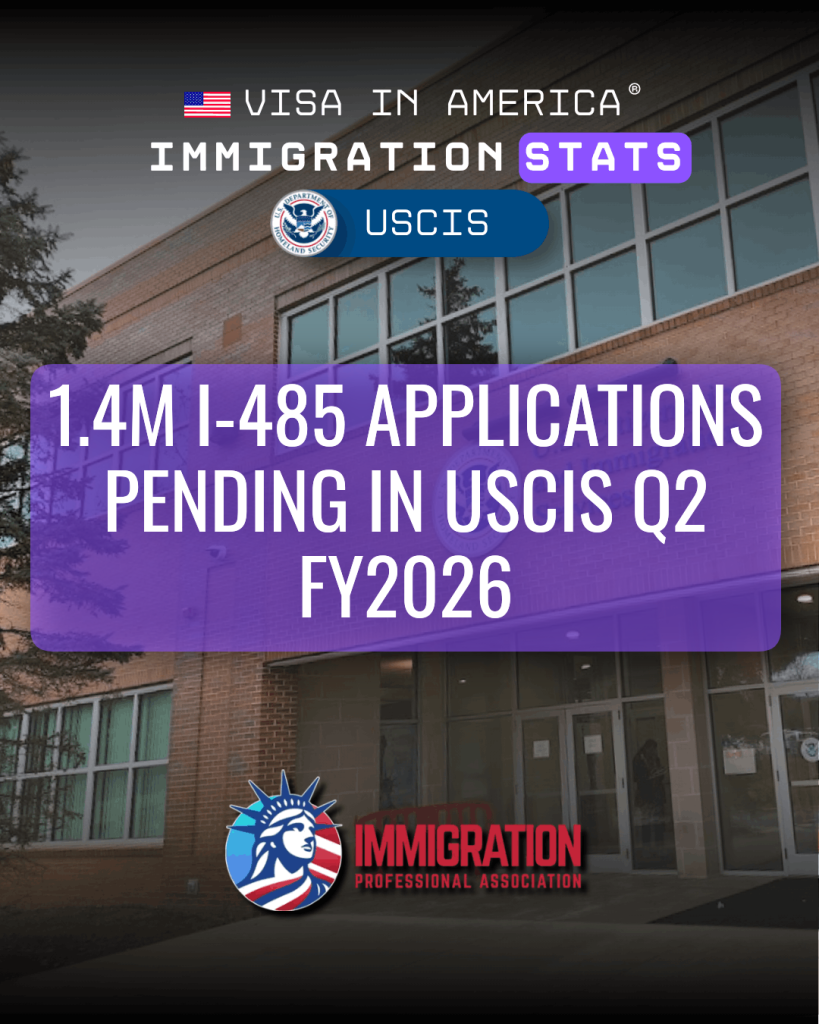
USCIS has released its Form I-485 quarterly performance data for the second quarter of Fiscal Year 2026, covering the period from January 1 through March 31, 2026. The report, published by the agency’s Office of Performance and Quality, shows that approximately 1.44 million I-485 applications for adjustment of status were pending across all USCIS field offices and service centers as of the end of that quarter. For anyone waiting to become a lawful permanent resident — or anyone filing soon — understanding the scope and distribution of this I-485 backlog is essential context for managing expectations, planning next steps, and making sound decisions about timing.
Background
Form I-485, the Application to Register Permanent Residence or Adjust Status, is the primary mechanism through which eligible individuals already present in the United States apply to become lawful permanent residents without leaving the country. Unlike consular processing, which takes place at a U.S. embassy or consulate abroad, adjustment of status allows applicants to complete the process domestically. Applications fall into four broad categories tracked in this report: family-based, employment-based, humanitarian-based (including asylees and refugees), and a residual “others” category that encompasses programs such as the Haitian Refugee Immigration Fairness Act and protections for human trafficking and crime victims.
USCIS has historically published this quarterly data to provide transparency into processing volumes and office-level workloads. The data does not capture every action taken on a file — administrative closures and transfers between offices are not reflected — so the pending totals represent a snapshot of cases awaiting final decision, not a perfect accounting of every open file.
What the Data Shows
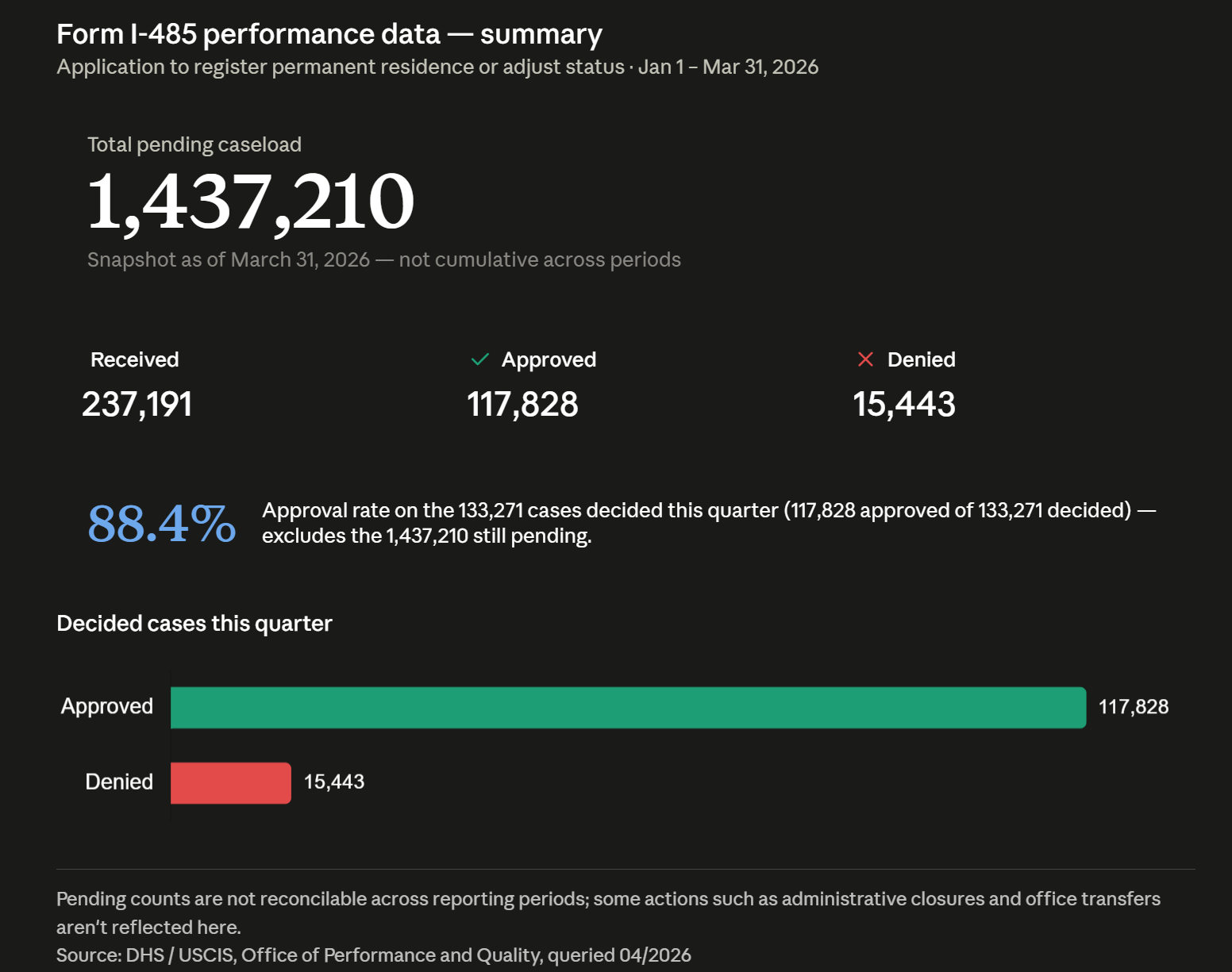
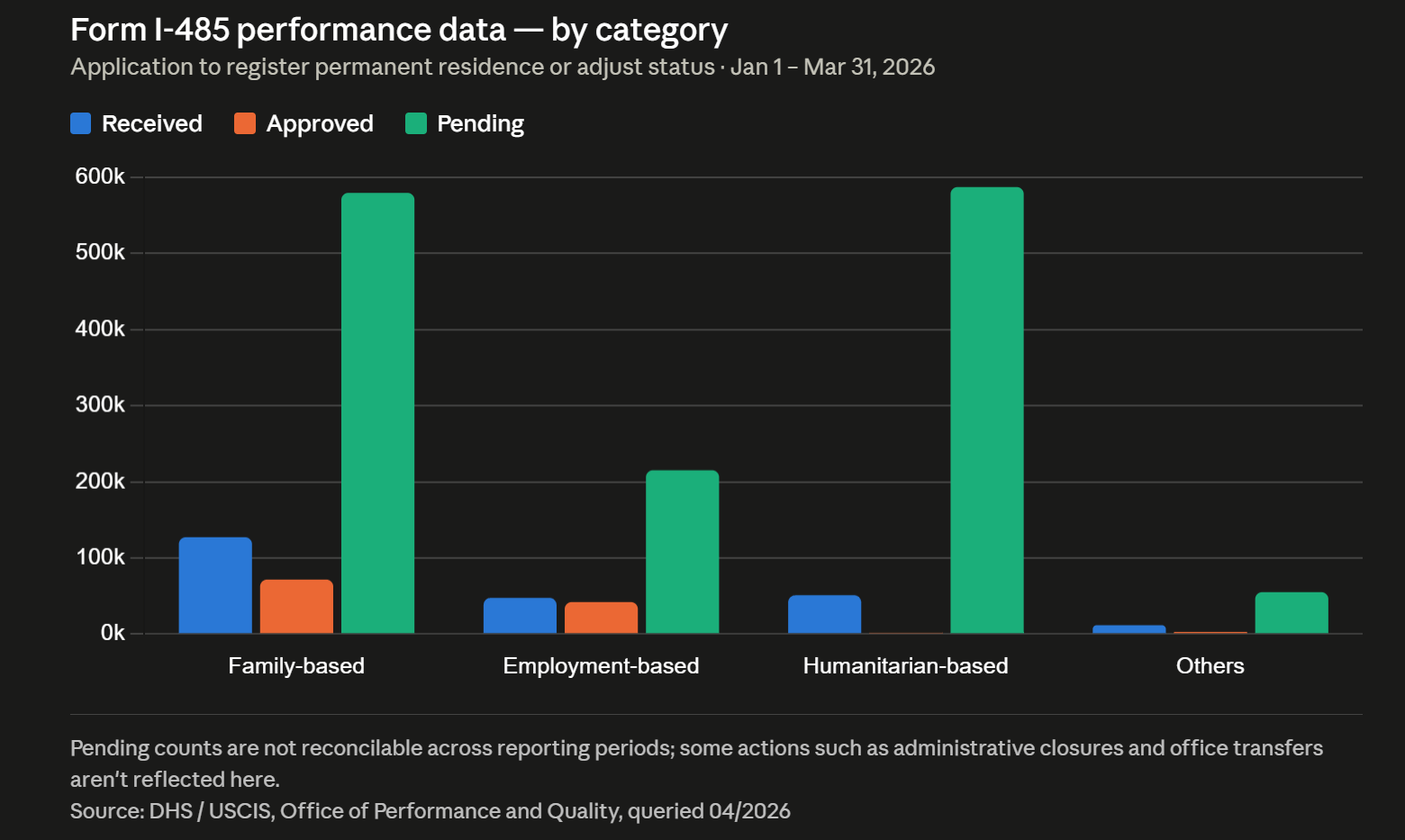
Across the entire USCIS system during Q2 FY2026, the agency received 237,191 new I-485 applications, approved 117,828, denied 15,443, and carried 1,437,210 pending applications into the next quarter. The pending caseload is distributed unevenly across the four application categories. Family-based cases account for 579,684 pending applications nationally — the single largest category. Humanitarian-based applications represent 587,337 pending cases, a figure that closely rivals the family-based total and reflects the sustained volume of asylum-related adjustment filings in recent years. Employment-based cases total 215,177 pending applications, and the “others” category accounts for 55,012.
At the field office level, several jurisdictions stand out for their pending volumes. The Houston field office carries the heaviest local burden, with 53,202 pending cases. Tampa follows with 44,554, and Kendall with 44,178. The Vermont Service Center, which handles a substantial portion of family-based filings, alone accounts for 234,265 pending applications — the largest single-location total in the report. The Nebraska Service Center carries 37,792 pending cases, and the California Service Center holds 19,999, the majority of which are employment-based.
Who Is Affected
The most directly affected individuals are those who have already filed an I-485 and are awaiting adjudication. This includes family-based applicants sponsored by U.S. citizens or lawful permanent residents, employment-based applicants whose petitions have been approved and whose priority dates are current, refugees and asylees adjusting to permanent residence, and individuals adjusting under specialized humanitarian programs.
Employers are also meaningfully affected. When an employee’s I-485 remains pending for extended periods, it creates uncertainty around work authorization continuity, travel restrictions, and long-term workforce planning. HR professionals managing foreign national employees in adjustment-of-status limbo face ongoing administrative complexity and the risk of gaps in employment authorization if I-131 advance paroles or I-765 employment authorization documents are not renewed on schedule.
Prospective applicants — those whose priority dates are approaching currency or who are considering whether to file concurrently — should understand that a national pending backlog of this size signals that adjudication timelines will vary significantly by office, category, and individual case characteristics.
Practical Implications
The scale of the pending inventory has several direct consequences for applicants and their representatives.4
Processing Times
First, processing times are not uniform. An applicant whose case is assigned to a high-volume office — Houston, Tampa, Dallas, Baltimore, or the Vermont Service Center — faces a materially different wait environment than someone whose case is pending at a smaller field office. Applicants should monitor USCIS processing time estimates for their specific office and category rather than relying on national averages.
Employment-based pending count
Second, the employment-based pending count of 215,177 does not tell the full story of employment-based delays. Many employment-based applicants are waiting not for adjudication but for a visa number to become available under the annual quota system. Once a priority date becomes current and a visa number is available, the actual adjudication queue — reflected in this data — represents the next layer of delay. Applicants in high-demand categories such as EB-2 and EB-3 from oversubscribed countries should factor both waits into their planning.
Humanitarian-based pending
Third, the humanitarian-based pending total of 587,337 reflects the continued downstream pressure from elevated asylum filing volumes in prior years. Asylee adjustment applications carry specific eligibility timelines — generally, an individual may apply one year after being granted asylum — and the volume of pending cases in this category underscores the importance of timely filing once eligibility is established, rather than waiting further.
Fourth, because administrative closures and inter-office transfers are not captured in this data, actual case status should always be confirmed through the USCIS case status portal or directly with counsel. A case that no longer appears in a pending count may have been transferred rather than adjudicated.
Finally, applicants with cases pending past the published processing time for their office retain the option of submitting a case inquiry or, in appropriate circumstances, pursuing other remedies. Understanding where your case falls within the broader queue — by office and by category — is a prerequisite to making those decisions intelligently.
What to Watch For Next
USCIS releases quarterly I-485 performance data on a rolling basis, and the Q3 FY2026 report covering April through June 2026 is expected later this year. Stakeholders should monitor whether pending volumes stabilize, increase, or decline as a function of incoming application rates relative to adjudication output. Any significant shifts in USCIS staffing, fee structures, or processing priorities — including changes arising from ongoing regulatory or policy activity — could materially alter the trajectory of the backlog. Applicants and employers with cases in high-volume offices are particularly encouraged to track office-specific processing time updates, which USCIS refreshes monthly on its website.
How Immigration Professional Association Can Help
A national pending backlog of 1.44 million I-485 cases is not an abstraction — it is the daily reality facing applicants and employers across every state and territory. At Immigration Professional Association, we work directly with individuals and companies navigating the adjustment of status process, from the initial filing strategy through the complexities that arise when cases sit pending longer than expected.
For family-based applicants, we help ensure that filings are complete, accurate, and positioned to move through adjudication as efficiently as possible. For employers managing employment-based green card pipelines, we assist with coordinating I-485 filings alongside priority date tracking, concurrent work authorization applications, and advance parole documentation — minimizing the operational disruption that a prolonged pending period can cause.
And for humanitarian-based applicants — particularly asylees approaching or past the one-year eligibility mark — we provide guidance on filing timing and documentation to avoid unnecessary further delay in an already congested queue.
If your I-485 application is currently pending, or if you are preparing to file and want to understand how the current backlog environment affects your specific situation, we invite you to reach out to Immigration Professional Association. Our team can review where your case stands, explain what the current processing landscape means for your timeline, and help you make decisions grounded in current data rather than guesswork.